- E-mailrandi.gressgard@uib.no
- Phone+47 55 58 89 98
- Visitor AddressParkveien 9Ida Bloms hus5007 Bergen
- Postal AddressPostboks 78055020 Bergen
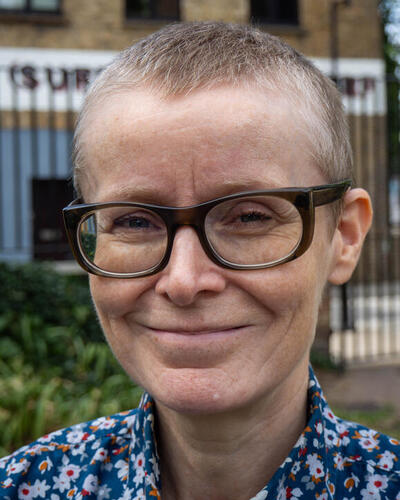
Randi Gressgård is professor at Centre for Women's and Gender Research (SKOK) and affiliated with the research unit International Migration and Ethnic Relations (IMER), University of Bergen. Her research interests span the fields of migration and minorities; gender and sexuality; and urban security and governance.
Thematically, much of the research revolves around minority issues, including multiculturalism, postcolonialism, democracy, nationalism, racism and East-West geopolitics. The publications within the field of gender and sexuality can roughly be grouped into two sub-categories: feminist theory and problems of difference; and gender and sexuality formation and politics. Within the field of urban security and governance, the most recent publications concern the turn towards resilience thinking in crime and radicalisation prevention in Sweden.
The book Multicultural Dialogue: Dilemmas, Paradoxes, Conflicts (2010/2012) was selected for debate in Dialogues in Human Geography’s book forum in 2012: https://journals.sagepub.com/toc/dhg/2/2. A decade later, it is the starting point for the essay "Dialogue in a polarized world - Is there a way out?" in the edited volume Hans-Herbert Kögler's Critical Hermeneutics (2022), with response from H-H. Kögler: https://www.bloomsbury.com/uk/hansherbert-k%C3%B6glers-critical-hermeneu...
2024
Presentation and panel discussion: Microagressions in academic institutions. Annual NORNDiP Conference 202 (NORdic Network for Diversity in Physics). 07-08.05.24
Roundtable discussion with PHD students during the PhD course Gendered Autocratization following the session "Gendered Authocratization: A Possible Research Agenda". 21.03.24
2023
Opinion piece with UiB colleagues: Skeivt kulturår 2022 - UiB ser tilbake og framover! Khrono, 19.01.23 (in Norwegian)
2022
- Panelist: Decolonization of academia: What, why, how? Organizer: SAIH Bergen, 06.10.22
- Panelist: Queer Politics & Democratic Rights in India: 1975 - Present. Organizer: SKOK, LawTransformBergen Global and GRIP, 05.10.22
- Panelist in Pedagogisk Kafé: Trenger vi egentlig menn i barnehagen? Organizer: Utdanningsforbundet i Bergen (Union of Education Norway). 28.09.22
- Panelist in Skeiv forskning i Norge - hvordan ligger vi an? during Arendalsuka 2022. 18.08.2022
- Panelist in "Rethinking the concept of 'race' in gender studies in the Nordic context" during the NORA conference 2022. Postdoctoral fellow Redi Koobak moderated the panel and PhD student Dinara Yangeldina also participated from SKOK. 22.06.2022
- Moderated the panel Hen i språket during Bergen Pride 2022. 07.06.2022
- Eksperter fra UiB: Skeivt kulturår/Pride 2022. An overview of UiB's researchers who can answer questions from the media about topics like gender, sexuality, queer love and diversity during Queer Culture Year and Pride 2022. 25.05.2022
- Panelist in the session "How to face the New Global Culture War on Gender and Sexual Identity?" during the Christie Conference 2022. 26.04.2022
- Jointly signed opinion piece: Kjønnsidentitet som kampsak. Norwegian daily Klassekampen, 31.03.2022
- Panelist - Let's talk about intimate partner violence (IPV): Lived experiences of queer women in Norway. Organized by Kvinnehelsehuset, Bergen sanitetsforening, FRI Vestland and Queer World West during Kvinnefestivalen 2022. 11.03.2022
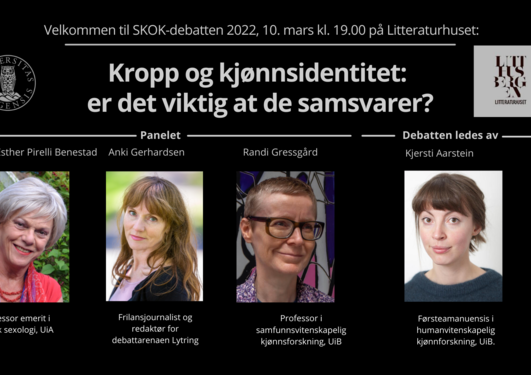
- Panelist in the SKOK debate 2022: Kropp og kjønnsidentitet: er det viktig at de samsvarer? Litteraturhuset i Bergen, 10.03.2022
- Interviewed in the news article Kan velge «hen», «de» eller «dem» på UiB: – Gjør at man føler seg mer velkommen in Norwegian daily Bergens Tidende. 02.02.2022 (in Norwegian)
- Interviewed in the news article Annonsen slo fullstendig feil for eiendomskjeden in Norwegian daily Bergensavisen. 23.01.2022 (behind paywall, in Norwegian)
2021
- Interviewed in the news article Hva vil det egentlig si å vere aseksuell? i forskning.no. 09.11.2021 (in Norwegian)
- Presentation under Transgender Awareness Week 2021 in Bergen (link to Facebook event) 14.11.2021
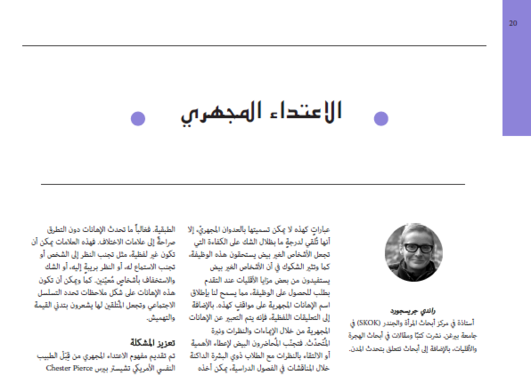
- Mikroaggression in Arabic. uib.no article about the translation to Arabic of Gressgård's article "Å stange hodet i veggen: Mikroaggresjon i akademia". 30.04.2021
- Moderated and organized the workshop "Struggles over Europe: Postcolonial East/West Dynamics of Race, Gender and Sexuality" under konferansen Troubling Gender - New Turbulences in the Politics of Gender in Europe. 08.-11.04.2022
- Interviewed in the article – Kjønn har alltid vært i bevegelse in Kilden. 16.03.2021 (in Norwegian)
- Panelist in the SKOK debate 2021: Ytringsfrihet og akademisk frihet: Debatt om rasisme og sexisme. Online. 09.03.2021
- Interviewed in the news article – Like lite som homofili kan smitte, blir barn transpersonar av å høyre om kjønnsmangfald. Norwegian news outlet NRK Møre og Romsdal, 08.03.2021 (in Norwegian)
- Væpnet til tennene med ytringsfrihet. Opinion piece with Asbjørn Grønstad about the rhetoric of free speech, Khrono, 20.01.2021 (in Norwegian)
2020
- Mener "cancel culture" i akademia er en myte. Interview about cancel culture in article in Forskerforum. 13.11.2020 (in Norwegian)
- En av verdens fremste psykologiprofessorer vitnet for feil mann. Det fikk konsekvenser. Interview about cancel culture in Forskerforum, 5.11.2020 (in Norwegian)
- Dokumentartips til BIFF. Gressgård mentioned as a member of the Gulluglen jury at Bergen International Film Festival (BIFF) 2020. UiB Aktuelt, 06.10.2020 (in Norwegian)
- Seminar at the Centre on Law & Social Transformation: Urban inequality and securitization. Participation in roundtable discussion. 17.08.2020
Monographs, edited books and special issues
"Struggles over Europe: Post-colonial East/West dynamics of race, gender and sexuality". Special issue (co-edited with Pawel Lewicki and Rafał Smoczynski) of Intersections: East European Journal of Society and Politics 6(3) 2020. https://intersections.tk.mta.hu/index.php/intersections/issue/view/24
"Planning for pluralism in Nordic cities". Special issue (co-edited with Tina G. Jensen) of Nordic Journal of Migration Research 6(1) 2016. https://journal-njmr.org/24/volume/6/issue/1/
Multicultural Dialogue: Dilemmas, Paradoxes, Conflicts. Oxford and New York: Berghahn Books, 2010 (paperback 2012) (192 pages). http://www.berghahnbooks.com/title.php?rowtag=gressgardmulticultural
Kjønnsteori (Gender Theory) (co-authored and -edited with E. Mortensen, C. Egeland, C. Holst, K. Jegerstedt, S. Rosland and K. Sampson). Oslo: Gyldendal Akademisk, 2008 (349 pages). http://www.gyldendal.no/Gyldendal-Akademisk/Humanistiske-fag/Historie/Kjoennsteori
Fra identitet til forskjell (From Identity to Difference). Oslo: Scandinavian Academic Press / Spartacus, 2005 (215 pages). http://www.spartacus.no/index.php?ID=Bok&counter=309
Dilemmaet mellom likeverdighet og særegenhet som ramme for flerkulturell dialog (The Dilemma between Equal Dignity and Distinctiveness as Constitutive Framework for Multicultural Dialogue). Doctoral dissertation in sociology, University of Bergen, 2003 (245 pages).
Fanden går i kloster. Elleve tekster om det andre (The Devil Joins the Convent: Eleven Texts on the Other) (co-editor with Siri Meyer). Oslo: Spartacus, 2002 (287 pages). http://www.spartacus.no/index.php?ID=Bok&counter=185
Det sosiale bymiljøet som visuelt felt: Et grunnlagsteoretisk fokus på forholdet mellom språk, estetikk, moral og sosiabilitet. MPhil thesis in sociology. University of Bergen, 1997 (193 pages).
Journal articles and book chapters
"Shifting notions of vulnerability and learning in Swedish prevention policy" (co-authored with Vanja Lozic). In Heath-Kelly, C. & B. Gruber (eds.): Vulnerability: Governing the Social through Security Politics. Manchester University Press, 2023: 21–40. https://manchesteruniversitypress.co.uk/9781526169372/
"Interseksjonalitet og ignoranse: Fra synliggjøring til avkolonialisering" (Intersectionality and ignorance: From visability to decolonization). In Døving, C.A. (ed.): Rasisme: Fenomenet, forskningen, erfaringene. Oslo: Universitetsforlaget, 2022: 121–138 . https://www.universitetsforlaget.no/rasisme
"Dialogue in a polarized world - Is there a way out?". In: L'ubomír, D. and C.M. Mertel (eds.): Hans-Herbert Kögler’s Critical Hermeneutics. London: Bloomsbury, 2022: 231–248. https://www.bloomsbury.com/uk/hansherbert-k%C3%B6glers-critical-hermeneutics-9781350228634/
"Nobel Polish sexuality and the corrupted European body" (co-authored with Rafał Smoczynski). Intersections: East European Journal of Society and Politics (special issue on "Struggles over Europe: Post-colonial East/West dynamics of race, gender and sexuality" co-edited by R. Gressgård, P. Lewicki & R. Smoczynski) 6(3) 2020: 13-32. https://intersections.tk.mta.hu/index.php/intersections/article/view/656
"Europeanization as civilizational transition from East to West: The diffusion of sexual modernity and racial displacement in Ukraine" (co-authored with Nadzeya Husakouskaya). Intersections: East European Journal of Society and Politics (special issue on "Struggles over Europe: Post-colonial East/West dynamics of race, gender and sexuality" co-edited by R. Gressgård, P. Lewicki & R. Smoczynski) 6(3) 2020: 74-96. https://intersections.tk.mta.hu/index.php/intersections/article/view/634
"The shifting status of failure and possibility: Resilience and the 'shift' in partnership-organized prevention in Sweden" (co-authored with Vanja Lozic). Politics 40(3) 2020: 332-347. https://doi.org/10.1177/0263395719880707
"The racialized death-politics of urban resilience governance". Social Identities (special issue on "racial urbanities", eds. Manuela Boatca, Karim Murji and Giovanni Picker) 25(1) 2019: 11–25. https://doi.org/10.1080/13504630.2017.1418605
"Welfare policing and the safety-security nexus in urban governance: The expanded cohesion agenda in Malmö". Nordic Journal of Migration Research 6(1) 2016: 9-17. https://www.degruyter.com/view/j/njmr.2016.6.issue-1/njmr-2016-0003/njmr-2016-0003.xml?format=INT Republished in Ålund, A., Schierup C-U. and Neergaard, A. (eds.): Reimagining the Nation: Essays on Twenty-First-Century Sweden. Frankfurt: Peter Lang, 2017.
"Planning for pluralism in Nordic cities: Key terms and themes" (co-authored with Tina G. Jensen). Nordic Journal of Migration Research 6(1) 2016: 1-8. https://www.degruyter.com/view/j/njmr.2016.6.issue-1/njmr-2016-0005/njmr-2016-0005.xml
"The power of (re)attachment in urban strategy: Interrogating the framing of social sustainability in Malmö". Environment and Planning A 47(1) 2015: 108-120. http://www.envplan.com/abstract.cgi?id=a130167p
"The instrumentalization of urban sexual diversity in a civilizational frame of tolerance and cosmopolitanism". In Dhawan, N., A. Engel, C. Holzhey and V. Woltersdorff (eds): Global Justice and Desire: Queering Economy. London & NY: Routledge, 2015: 99-114. https://www.routledge.com/products/9780415712255
"The whole city or the city as a whole? Questioning the conceptual assumptions of social sustainability in urban governance". In Righard, E., Salonen, T. and Johansson, M. (eds): Social Transformations of Scandinavian Cities: Nordic Perspectives on Urban Marginalization and Social Sustainability. Nordic Academic Press, 2015: 199-216. http://www.nordicacademicpress.com/bok/social-transformations-in-scandinavian-cities/
"Citoyens intolérable: tolérance, Islam et homosexualitté" (co-authored with Christine Jacobsen, trans. G. Kleppen and L-M Besançon). Nordiques No 28 2014: 41-49.
"Å stange hodet i veggen: Mikroaggresjon i akademia" (Banging your head against the wall: Microaggression in academic institutional life). Nytt Norsk Tidsskrift 31(1) 2014: 17–29. https://www.idunn.no/file/pdf/65355243/aa_stange_hodet_i_veggen_mikroaggresjoniakademia.pdf
"Spenninger i klasserommet: Mikroaggresjon som pedagogisk utfordring" (Hot moments in the classroom: Microaggression as pedagogical challenge) (co-authored with Yael Harlap). Uniped 37(3) 2014: 23-33. http://www.unipedtidsskrift.net/index.php/uniped/article/view/23779
"Asexuality: From pathology to identity and beyond". Psychology & Sexuality (special issue on asexuality) 2(2) 2013: 179–192. http://www.tandfonline.com/toc/rpse20/4/2. Republished in Carrigan, M., K. Gupta and T.G. Morrison (eds): Asexuality and Sexual Normativity: An Anthology. London: Routledge, 2014. http://www.psypress.com/books/details/9780415731324/. Republished and translated: "Assexualidade: da patalogia á identitade e além" (trans. P.V. Bezerra). In Bezerra, Paulo Victor (ed.): Assexualidade: subjetividades emergentes no século XXI. Londrina: Eduel, 2019: 77-94. https://www.eduel.com.br/?product=assexualidade-subjetividades-emergentes-no-seculo-xxi
"Aseksialitet: Central udfordring fra periferien av seksualiteten" (trans. Philip Danstrup) (Asexuality: Central challenge from the sexuality's periphery). KULTURO 20(37) 2014: 60-65. https://uib.academia.edu/RandiGressg%C3%A5rd
"Author response". In Dialogues in Human Geography (Book review forum: Multicultural Dialogue debated by Marco Antonsich, Sophie Bond, Nancy Ettlinger and Helen Wilson) 2(2) 2012: 227–231. http://dhg.sagepub.com/search/results?fulltext=Gressg%C3%A5rd&submit=yes&journal_set=spdhg&src=selected&andorexactfulltext=and&x=0&y=0
"Revisiting contingency, hegemony and universality". In Castro Varela, Maria do Mar, Nikita Dhawan og Antke Engel (eds): Hegemony and Heteronormativity: Revisiting ’the Political’ in Queer Politics. Farnham: Ashgate 2011: 25–41. https://www.routledge.com/Hegemony-and-Heteronormativity-Revisiting-The-Political-in-Queer-Politics/Varela-Dhawan/p/book/9781138270411
"When trans translates into tolerance – or was it monstrous?". Sexualities: Studies in Culture and Society 13(5) 2010: 539–561. http://sexualities.sagepub.com/content/13/5/539
"Omsorgen for 'andre': Interseksjonalitet, forskjell og ansvarlighet" (The care for 'others': Intersectionality, difference and accountability) (co-authored with Cathrine Egeland). Tidsskrift for kjønnsforskning (Journal of Gender Research) 32(4) 2008: 40-58. http://kilden.forskningsradet.no/publikasjon/vis.html?tid=57428
"Mind the gap: Intersectionality, complexity and 'the event'". Theory and Science 10(1) 2008. http://theoryandscience.icaap.org/content/vol10.1/Gressgard.html
"Krevende toleranse: Islam og homoseksualitet" (Demanding tolerance: Islam and homosexuality) (co-authored with Christine Jacobsen). Tidsskrift for kjønnsforskning (Journal of Gender Research) 32(2) 2008: 22–39. http://kilden.forskningsradet.no/c35640/artikkel/vis.html?tid=53711
"The will to empower: Managing the complexity of the Others" (co-authored with Cathrine Egeland). Nordic Journal of Women’s Studies (NORA) 15(4) 2007: 207–219. http://www.informaworld.com/smpp/19646089-3837625/content~db=all~content=a787303764. Republished and translated: "The Will to Empower: Die Komplexität der ‘Anderen’ Managen" (co-authored with Cathrine Egeland) (trans. Jana Lepczyk & Katja Scjatte), in Castro Varela, M. and N. Dhawan (eds): Soziale (Un)Gerechtigkeit: Kritische Perspektiven auf Diversity, Intersektionalität und Antidiskriminierung. Berlin: LIT, 2011: 99–117. http://www.lit-verlag.de/isbn/3-8258-1192-1
"Det beste fra to kulturer: Frihet og fellesskap" (The best of two worlds: Freedom and community). In Fuglerud, Øivind and Thomas Hylland Eriksen (eds): Grenser for kultur. Perspektiver på minoritetsforskning (Cultural limits: Perspectives on minority research). Oslo: Pax, 2007: 80–110. http://www.pax.no/index.php?ID=Bok&ID2=Vis&counter=1572
"Anerkjennelse: Hvilke forskjeller er relevante?" (Recognition: What differences matter?). Norsk tidsskrift for migrasjonsforskning (Norwegian Journal of Migration Research) 6(1) 2007: 10–26.
"The veiled Muslim, the anorexic and the transsexual: What do they have in common?". European Journal of Women’s Studies 13(4) 2006: 325–341. https://journals.sagepub.com/doi/pdf/10.1177/1350506806068651
"Beyond Man: In defence of multiple identities" (co-authored with Christine Jacobsen). In Sicakkan, Hakan and Yngve G. Lithman (eds): What Happens when Society is Diverse? Multidimentional Identities. Lewiston, Queenston and Lampeter: The Edwin Mellem Press, 2006: 53–74.
"Muslimer med slør, anorektikere og transseksuelle: Hva har de til felles?". Tidsskrift for kjønnsforskning (Journal of Gender Research) 29(1) 2005: 21–34. http://kilden.forskningsradet.no/c35640/artikkel/vis.html?tid=36649
"Opprør med stil. Forholdet mellom identitet, estetikk og subkulturell motstand" (Revolt with style. The relationship between identity, aesthetics and subcultural resistance). Norsk tidsskrift for migrasjonsforskning(Norwegian Journal of Migration Research) 4(1) 2005: 13–20.
"Hva mener regjeringen med flerkulturelt mangfold?" (What does the Government mean by multicultural diversity?). Nytt norsk tidsskrift (New Norwegian Journal) 22(1) 2005: 72–79. http://www.idunn.no/ts/nnt/2005/01/sideblikk_hva_mener_regjeringen_med_flerkulturelt_mangfold
"Den rettferdige rasismen" (The just racism). Norsk tidsskrift for migrasjonsforskning (Norwegian Journal of Migration Research) 5(2) 2004: 140–146.
"Questions of gender in a multicultural society" (co-author with Christine Jacobsen). Nordic Journal of Women’s Studies (NORA) 11(2) 2003: 69–77. http://www.informaworld.com/smpp/content~db=all~content=a713800883
"En kvinne er ikke bare en kvinne. Kjønnsproblematikk i et flerkulturelt samfunn" (A woman is not merely a woman. Questions of gender in a multicultural society) (co-authored with Christine Jacobsen). In Holst, Cathrine (ed): Kjønnsrettferdighet: Utfordringer for feministisk politikk (Gender Justice: Challenges in Feminist Politics). Oslo: Gyldendal Akademisk, 2002: 189–230. http://kjonn.maktutredningen.no/publikasjoner/326
"Lyotard og Bourdieu: Ontologisering av henholdsvis 'striden' og 'tvisten'" (Lyotard and Bourdieu: Ontologization of the 'differend' and the 'litigation' respectively). Sosiologisk tidsskrift (Journal of Sociology) 10(4) 2002: 283-307. http://www.idunn.no/ts/st/2002/04/lyotard_og_bourdieu_ontologisering_av_henholdsvis_striden_og_tvisten
"Fanden går i kloster" (The devil joins the convent) (co-authored with Siri Meyer). In Gressgård, Randi and Siri Meyer (eds.): Fanden går i kloster. Elleve tekster om det andre (The Devil Joins the Convent. Eleven Texts about the Other). Oslo: Spartacus, 2002: 7–12. http://www.spartacus.no/index.php?ID=Bok&counter=185
"Modernitetens konsekvenser". In Frode Molven (red.): Talemøte: Samtalar i norsk tid. Oslo: Det Norske Samlaget, 1998: 150–158.
"Moral og estetikk i bymiljøet – om forholdet mellom nærhet og distanse i moralsk opptreden". In Ann Nilsen (red.): Miljøsosiologi: Samfunn, miljø og natur. Oslo: Pax, 1997: 54–72.
"Den sosiale strukturen kommer til syne i språket". Sosiologisk Årbok 1(2) 1996: 153–183.
Book reviews/review essays and text book contributions
"Politisk korrekthet, identitetspolitikk og ytringsfrihet" (Political correctness, identity politics and freedom of speech). Book essay. Tidsskrift for samfunnsforskning 60(1) 2019: 91–95.https://www.idunn.no/file/pdf/67107745/politisk_korrekthet_identitetspolitikk_og_ytringsfrihet_.pdf
"Ekstrem forvandling: Fra inkludering til brutal utstøting i samfunnsliv og økonomi" (Extreme transformation: From inclusion to brutal expulsion in social and economic life). Book review of Saskia Sassen: Expulsions. Brutality and Complexity in the Global Economy. Agora: Journal for metafysisk spekulasjon 34(2–3) 2016: 236–243.
"Interseksjonalitet" (Intersectionality). Tidsskrift for kjønnsforskning (Journal of Gender Research) 37(1) 2013: 64–67 http://kilden.forskningsradet.no/c17264/artikkel/vis.html?tid=83978
"Sterk mur, svak suverenitet" (Solid wall, weak sovereignty). Book review of Wendy Brown: Walled States, Waning Sovereignty. Agora: Journal for metafysisk spekulasjon 29(2–3) 2011: 338–348. http://www.idunn.no/ts/agora/2011/02-03/sterk_mur_svak_suverenitet
"Tid for kritikk" (Time for critique). Book review of Wendy Brown: Edgework: Critical Essays on Knowledge and Politics. Kvinder, Køn & Forskning (Women, Gender & Research) 18(2) 2009: 74–75.
"Feminist Theorizes the Political: The Political Philosophy of Wendy Brown". Review essay. Nordic Journal of Feminist and Gender Research (NORA) 16(4) 2008: 257–263. http://www.informaworld.com/smpp/content~db=all~content=a906422005
"Iris Marion Young". In Mortensen et al. (eds): Kjønnsteori (Gender Theory). Oslo: Gyldendal Akademisk, 2008: 152–167. http://www.gyldendal.no/Gyldendal-Akademisk/Humanistiske-fag/Historie/Kjoennsteori
"Wendy Brown". In Mortensen et al. (eds): Kjønnsteori (Gender Theory). Oslo: Gyldendal Akademisk, 2008: 161–167. http://www.gyldendal.no/Gyldendal-Akademisk/Humanistiske-fag/Historie/Kjoennsteori
"Henrietta L. Moore". In Mortensen et al. (eds): Kjønnsteori (Gender Theory). Oslo: Gyldendal Akademisk, 2008: 224–230. http://www.gyldendal.no/Gyldendal-Akademisk/Humanistiske-fag/Historie/Kjoennsteori
"Henrietta L. Moore: Feministisk antropologi gjennom to tiår" (H. L. Mooore: Feminist anthropology over two decades). Review essay. Norsk antropologisk tidsskrift (Norwegian Journal of Anthropology) 18(2) 2007: 162–171. http://www.idunn.no/ts/nat/2007/02/henrietta_l_moore_feministisk_antropologi_gjennom_to_tiar
"Etnisk mangfold i skolen" (Ethnic diversity in school) (co-author with Sissel Lilletvedt). Book review of Joron Pihl: Etnisk mangfold i skolen: Det sakkyndige blikket. Norsk tidsskrift for migrasjonsforskning (Norwegian Journal of Migration Research) 6(2) 2005: 71–75.
"Sammensatt (om) identitet" (Complex identity). Book review of Thomas Hylland Eriksen: Røtter og føtter: Identitet i en omskiftelig tid. Norsk tidsskrift for migrasjonsforskning (Norwegian Journal of Migration Resarch) 5(2) 2004: 147–150.
Securing the future: Resilient cities in the context of migration
The project is in collaboration with Anders Rubing, Centre for Women's and Gender Research, and Bjørn Enge Bertelsen, Department of Social Anthropology, UiB. It is funded by University of Bergen’s strategic initiative on global challenges: https://www.uib.no/en/globalchallenges
In what is declared an increasingly complex and insecure world, there is a growing demand for resilience strategies in various fields. For instance, the UN Secretary-General’s High-Level Panel of Global Sustainability’s 2012 report, Resilient People, Resilient Planet, describes resilience as a governance response to complex problems in a complex world, based on the assumption that the future is truly uncertain and unpredictable.
To arrive at a more specific understanding of how resilience-informed security assemblages shape global challenges, the project sets out to examine the production of urban security problematics in the context of migration. Empirically, it focuses on transnational networks where security challenges are shaped and circulated. The project is particularly concerned with reconfigurations of gendered and racialized challenges, as well as new forms of ignorance.
Egalitarian Futures Research Group (FUTURES)
Our point of departure is the idea that the future - the orientation towards a time yet to come - is fundamental for understanding contemporary global society. The group of researchers empirically map and investigate various groups of people who are particularly and intensively preoccupied with futures.
Read more about FUTURES here: https://www.uib.no/en/egalitarianism