Software and model analysis
SOPS is probably the most user friendly software for optimization in dynamic models with uncertainty. Still, it tackles more complex problems than standard stochastic dynamic programming.
Main content
SOPS - the software
SOPS is as an add-on to Powersim Studio. Make use of Studio’s facilities when developing and testing a model and preparing the model for policy analysis. One more click with the mouse, and you are transferred to the SOPS environment. There you set parameters for accuracy and uncertainty before you hit the Optimize button. It may take only a couple of minutes from the model is finished in Studio until you see the optimal policy in SOPS! Watch three videos on: Introduction, Engineering, and Uncertainty.
What is required from you is to develop an intuitive understanding of why stochastic optimization can help you find more profitable and robust policies than deterministic methods. Most technicalities of optimization are taken care of by the SOPS program itself.
The underlying method is Stochastic Optimisation in Policy Space. As such it represents an alternative to stochastic dynamic programming. Rather than simplifying the model structure in order to find solutions, the program allows for complex models and if necessary, simplified policies. The program is particularly useful for infinite horizon problems like investment problems, inventory management, renewable resource management etc. SOPS may also be used to address complex problems involving measurement error and model uncertainty. Furthermore, SOPS can be used to find optimal controls for complex nonlinear engineering problems where alternative methods from control theory typically relies on linearization.
To download the Users' Manual and necessary software, goto Powersim Software. The User's manual gives an introduction to SOPS, guidelines on how to install and use SOPS, and it contains example models. Here you can download the example models from the Users' Manual. Note, the software only runs under Windows.
Successful use of SOPS
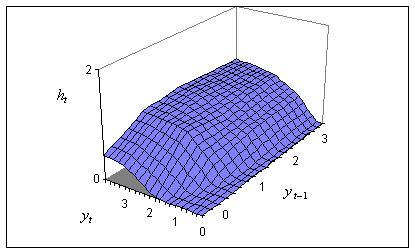
Using SOPS, the problem of measurement error in fisheries has been tackled more properly than ever before. It turns out that measurement error can be very important for quota setting and profitability in major fisheries, see the figure on this page for an example. In fact, measurement error seems to be more imporant for quota policies than the environmental variation that has been studied before.
See: Moxnes, E. (2003). "Uncertain measurements of renewable resources: Approximations, harvest policies, and value of accuracy." Journal of Environmental Economics and Management 45(1): 85-108.
Using SOPS, it has been possible to test the sensitivity of quota and capacity policies to model formulations. It turns out that policies may be less sensitive to choice of biological models than to the choice of economic model. The results clearly favour an interdisciplinary approach.
See: Moxnes, E. (2005). "Policy Sensitivity Analysis: simple versus complex fishery models." System Dynamics Review 21 (2) 123-145.
Using SOPS, one can easily find fishery quota policies for models with uncertainty in model parameters. Interestingly, model error typically implies smoother and thus simpler policies.
See: Moxnes, E. (2010). “Complexities in fisheries management: misperceptions and communication.” in Handbook of Marine Fisheries Conservation and Management, edited by Hilborn, R., Squires, D., Williams, M., Tait, M., and Grafton, Q.: Oxford University Press.
SOPS is currently being used for a variety of problems ranging from engineering problems to price forecasting, and it has been used to find benchmark policies for laboratory experiments.