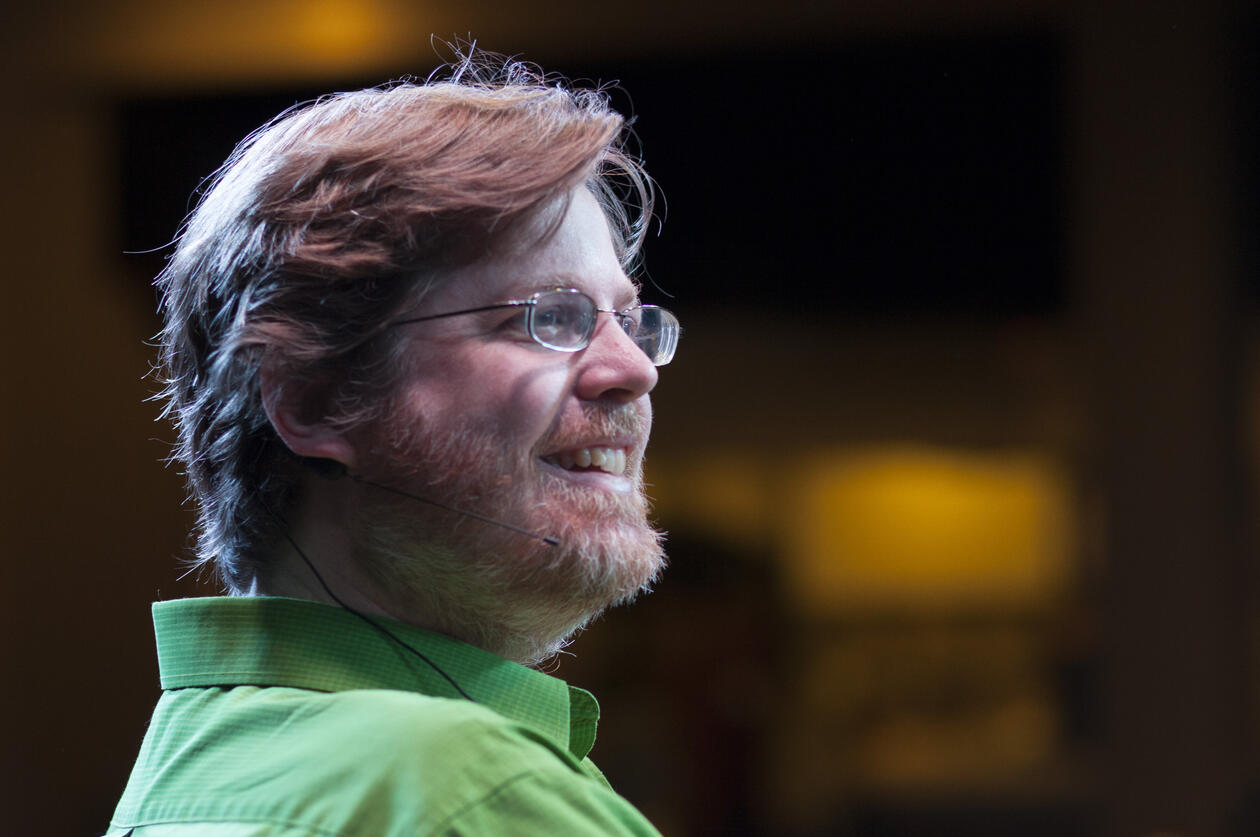
How Pac-Man Eats: Guest lecture by Noah Wardrip-Fruin
In How Pac-Man Eats, Noah Wardrip-Fruin considers two questions: What are the fundamental ways that games work? And how can games be about something? Wardrip-Fruin argues that the two issues are related. Bridging formalist and culturally engaged approaches, he shows how the tools and concepts for making games are connected to what games can and do mean.

Hovedinnhold
The Digital Narrative Network at UiB welcomes you to join us for a presentation and discussion of the new book How Pac-Man Eats.
Wardrip-Fruin proposes that games work at a fundamental level on which their mechanics depend: operational logics. Games are about things because they use play to address topics; they do this through playable models (of which operational logics are the primary building blocks): larger structures used to represent what happens in a game world that relate meaningfully to a theme. Game creators can expand the expressiveness of games, Wardrip-Fruin explains, by expanding an operational logic. Pac-Man can eat, for example, because a game designer expanded the meaning of collision from hitting things to consuming them. Wardrip-Fruin describes strategies game creators use to expand what can be said through games, with examples drawn from indie games, art games, and research games that address themes ranging from border policy to gender transition. These include Papers, Please, which illustrates expansive uses of pattern matching; Prom Week, for which the game's developers created a model of social volition to enable richer relationships between characters; and Dys4ia, which demonstrates a design approach that supports game metaphors of high complexity.
Noah Wardrip-Fruin is professor of computational media at the University of California, Santa Cruz, where he co-directs the Expressive Intelligence Studio, a technical and cultural research group. He is the author of Expressive Processing: Digital Fictions, Computer Games, and Software Studies (2009) and How Pac-Man Eats (2020). His collaborative media projects have appeared in venues such as the Whitney Museum of American Art and the IndieCade festival.