CLUSTER
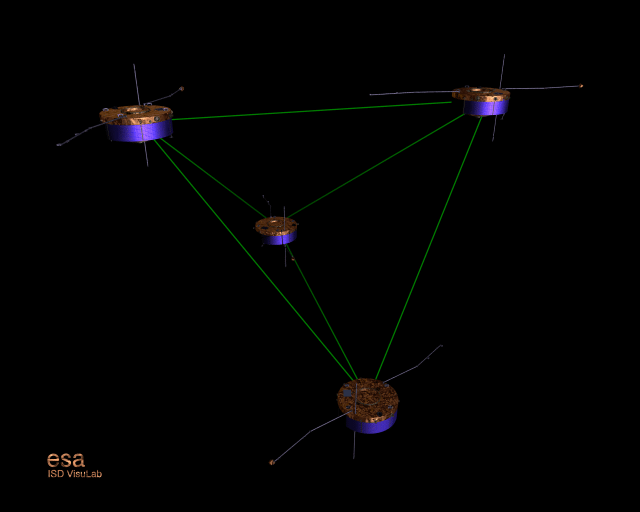
The Cluster II mission is an in-situ investigation of the Earth's magnetosphere. The scientific objectives include to study three dimensional plasma structures in the magnetopause, the polar cusps, the magnetotail and the auroral zones. Because the mission consists of four identical spacecraft, it is possible to distinguish between spatial and temporal variations in the space plasma.
Hovedinnhold
The satellites were launched in July and August 2000. They orbit the Earth in an elliptical polar orbit. Their distance from the Earth vary between 19 000 km (perigee) and 119 000 km (apogee) during their 57 hour orbit period. During one year the location of apogee varies between being at the dayside, the dawnside, the nightside and the duskside.
ESA (European Space Agency) decided to start the Cluster project in 1985. 18 different countries are contributing with instruments onboard. Norway is one of the four largest contributors. The Norwegian institutions that is involved in the Cluster II project is The Norwegian Defence Research Establishment (FFI), University of Bergen (UiB) and University of Oslo (UiO). The Norwegian Research Council (NFR) gives the economic support to the Norwegian part of the Cluster II project.