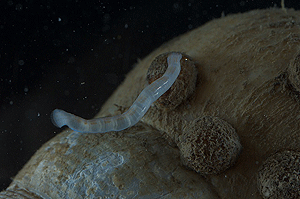
A lot of beatiful things to see on 700 meters depth.
05.08.2008 There have been a lot of exciting ROV-dives today; identification of a new type of leech (we think) and how the microbiologists received some help from a teacher. There have been a lot of sampling the last days, and for the microbiologists, there has been a rough drive for registering and preparation of the samples taken up from the seafloor.

Hovedinnhold
When they found the position for the first ROV- dive, it almost went all wrong. A seismic boat had set course right up against us, and it seemed for a while that we had to move. For Haflidi, the leader of the cruise, this was a bit dramatic; he wouldn't use unnecessary time to move when we finally found the right position and had the weather on our side. But, the seismic boat turned away, and the ROV was finally ready to dive.
The first ROV-dive struck the best, absolutely incredible to hit the right spot on over 700 meters deep. Here, they found a lot of living organisms and a seafloor with multicolor sediments. There were taken several pushcores(40x8 cm tall pipes) from the sediments. The geologists want to find answers on how the different types of pockmarks are formed, and why they exist so concentrated on Nyegga-area. It turns out to be a lot of methane gas in association with pockmarks and establishment of a certain biologic activity, in the case of bacteria and plant- and animal species.
With great precision, the ROV-pilots Frank an Svein Egil made several ROV-dives and pushcores. It was also taken up large carbonates where they found a bustling life; it was sucked up with a kind of vacuum cleaner mounted on the ROV. The macrobiologists Christiane and Daria, discovered what they believe is a new class of leech, which is not registered. This is a bloodsucking parasite that has attached their eggs at a cochlea, and finds sustenance by sucking blood from the snail. Even though it's not a "great" discovery, according to Christiane, there were big smiles and the excitement was at a high level.
David Shale is a freelance nature photographer from Southampton in England. He is hired to document the cruise through pictures and movies of the discoveries made onboard. This picture of the leech Daria and Christiane discovered is taken by David.
GS08-155-30 ROV PC is the code of one of the pushcores taken by the ROV. (GS stands for G.O. Sars, 08 is number of year, 155 is the cruise code, 30 ROV is ROV-dive with pushcore number 30). This code is also logged by the geologists and like that, they know exactly position and date/time for this sample. This profile of the sediments the pushcore took up was about 15 centimeters high with a water column on top. Both the microbiologists and the geochemistry took samples of the water to be used later in analyses. William got an ingenious idea on how to move the plastic cylinder down, at the same time as the sediments was standing still. In any case, with help from Anne Grethe and a pipe tong the job was done without spills or mayor disasters. And since Anne Grethe still was there, he also got help with different types of samples of the 15 cm layers of the sediments. After each cutting of the sediments, the equipment must be washed and sterilized with ethanol. There must also be taken samples to the DAPI and other stuff. This took a little over two hours and was the last thing William did this day, before he headed for the bed.