Appendicularian Facility

Hovedinnhold
The Oikopleura dioica culture facility at the Michael Sars Centre has 8 individually temperature-controlled aquariums with 8 experimental units in each aquarium. Our main culture of O. dioica produces approximately 2500 spawning animals weekly. The culture is kept at a temperature of 12 ± 0.5°C, to maintain a 7-day lifecycle. There are in addition 48 tanks available for experimental use. The facility supplies mature males, females, embryos and juveniles at various developmental stages for research purposes.
The model organism
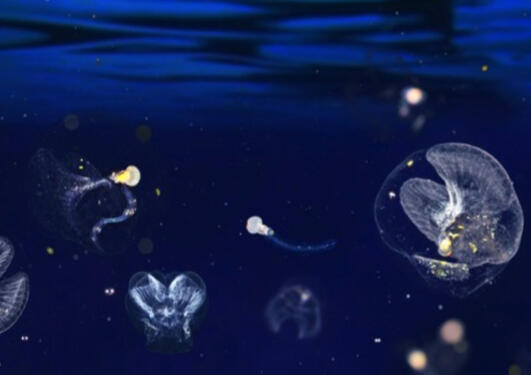
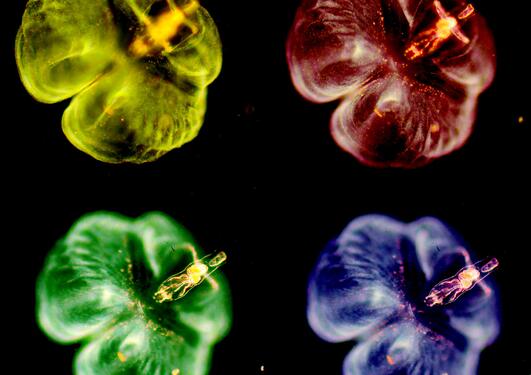
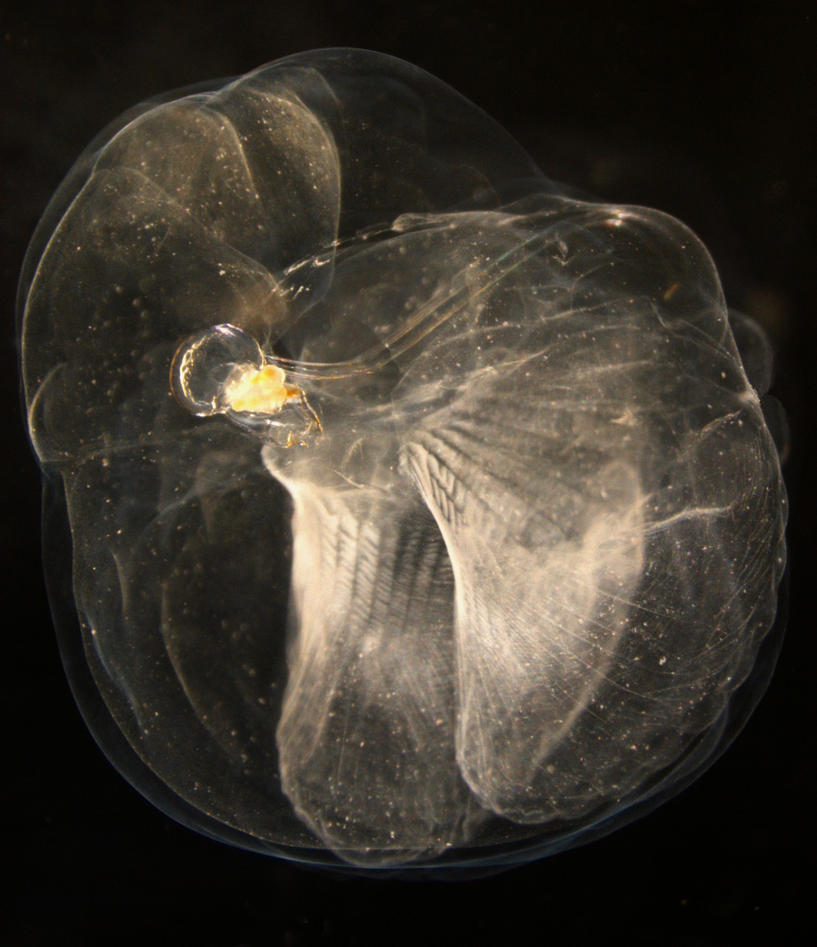
The larvacean, also known as appendicularian (Oikopleura dioica, Fol 1872), is a planktonic chordate with a persistent tadpole-like morphology throughout its lifespan. Together with ascidians and thaliaceans, larvaceans belong to the tunicates, the closest living relatives to vertebrates. The following characteristics make O. dioica a powerful system for studying developmental biology, genetics, and evolution.
As a model organism, O. dioica possesses several unique features that make it ideal for experimental research:
- Short life cycle: It completes its lifecycle in only 5 days at 20°C. Kept at 13°C lifespan is 7 days.
- Established laboratory cultures: Stable inland and laboratory cultures have been successfully maintained over multiple generations .
- Rapid development: O. dioica undergoes complete morphogenesis within 10 hours post-fertilization, resulting in a fully functional juvenile, except for the reproductive system (gonad).
- Invariant embryonic cell lineages: The cell lineages and fate map during embryonic development are highly consistent across individuals and are well-documented.
- Small cell number: A functional juvenile consists of only about 4000 cells.
- Optical transparency: O. dioica remains optically clear throughout its entire life, which facilitates live imaging and developmental studies.
- Compact genome: The genome, approximately 56 Mb in size, contains around 18,000 coding genes, and extensive genomic resources are available for research.
This information and more is available in Thompson et al., 2009 and in Nishida & Onuma, 2021.
The culture
Tank Parameters and Environmental Control
Tank Distribution:
- 64 individual experimental tanks across 8 temperature-controlled aquariums.
- 48 tanks across 6 individually temperature-controlled units available for experiments.
- 48 places for experiment tanks in room temperature.
- 8 100 L units suited for larger quantities of animals with running Hib (local) sea water available.

Temperature manipulation:
- Heaters/coolers ensure a stable environment to control the timing of growth and reproduction.
- 12 ± 0.5°C for a 7-day life cycle.
- Life cycle manipulation is possible (20± 0.5°C for 4-day life cycle).
Sea water and seawater treatment:
- Animals are cultivated in natural sea water collected from 10 meters depth at Espegrend Marine Station (BIO).
- Salinity range 28-32 ppt (seasonal).
- Filtered 20, 10 and 1 micron.
- UV-treated.
- Available running sea water (HiB (local) sea water) temperature range 10-20°C and mixing of these. Salinity 34 ppt. 20-micron filter and irradiated with 2 powerful UVs.
Automations:
- 24 tanks can simultaneously have sea water replacement by automation.
- Automated feed supply system.
Production Capacity
Adult Production: 2500 mature adults weekly, divided between 2 different life stages/populations.
Juvenile Production: Ongoing provision of juveniles at various stages. Weekly output of juveniles on average: 300 000.
Culture Maintenance
Rearing and keeping Oikopleura dioica
- Appendicularians are filter feeders with house renewal every 3 - 5 hours. They discard fecal pellets every 4 - 5 minutes. They have separate sexes and average number of eggs per female is 200-300. Feeds on phytoplankton; nano and picoplankton algae, virus, bacteria DOM in the ocean. Life cycle is mainly temperature dependent, but density and food availability affect developmental time.
- A daily sea water replacement is therefore required, either by refilling, automated or manual transfer of animals to keep the life cycle, quality- and number of eggs and sperm optimal.
- Animals must be suspended in water constantly (15 rpm motor and rotating paddle).
- Sensitive to metals such as aluminum and copper.
- All tanks, pipes and tubes need regular cleaning and scrubbing.
Algal Feeding
Routinely, a mixture of algae is used to feed Oikopleura dioica at various developmental stages. The algal mixture comprises four different species, each selected based on their size and nutritional profile to match the developmental needs of the organisms. The facility cultures its own food supply. Main supplier of starting cultures: Culture Collection of Algae and Protozoa (CCAP)
- Chaetoceros calcitrans fo pumilus
Taxonomy: Bacillariophyte (diatom)
Culture Strain: CCAP* 1010/11
Size: 4 µm (length) x 3 µm (width) - Isochrysis sp.
Taxonomy: Haptophyte (spherical flagellate)
Culture Strain: CCAP 927/14
Size: 6 µm (diameter) - Rhinomonas reticulata var. reticulata
Taxonomy: Flagellate
Culture Strain: CCAP 995/2
Size: 17 µm (diameter) - Synechococcus sp.
Taxonomy: Cyanobacteria
Culture Strain: K0408**
Size: 1 µm (diameter)
Animal and Gamete manipulations
- In vitro fertilization.
- Injection of eggs and gonads.
- Sperm cryopreservation.
- Sending/shipping animals is possible.
- CrisprCas-9.
- Sibling crosses.
Field collections
- 8-15 collections per year, with “Hans Brattstrøm”, mainly in Rosslandspollen and Korsfjorden.
- Pier collections in addition, mainly Turøyvågen and other locations.
- The purpose is to enrich the existing gene pool of cultured Oikopleura dioica.
- Collection and attempts of culture of other Appendicularians (i.e. Oikopleura Labradoriensis and Fritillaria haplostoma).
- Fritillaria borealis: seasonal sampling and culturing.
Microscopy and Imaging
- Nikon dark field microscope (magnification 10X, 20x, 40x) with Canon EOS mark II.
- 3 stereo microscopes (magnification 10 - 40x).
- Access to a common microscope room.
Key facts
- Listed in the EMBRC-Norway catalog
- GMO certified (Bio safety level 1).
- Drains and sinks lead to a water disinfection and purification system, the “pyramid”
- Major renovation in 2018.
Research
Appendicularia Facility