Ascidian Facility

Hovedinnhold
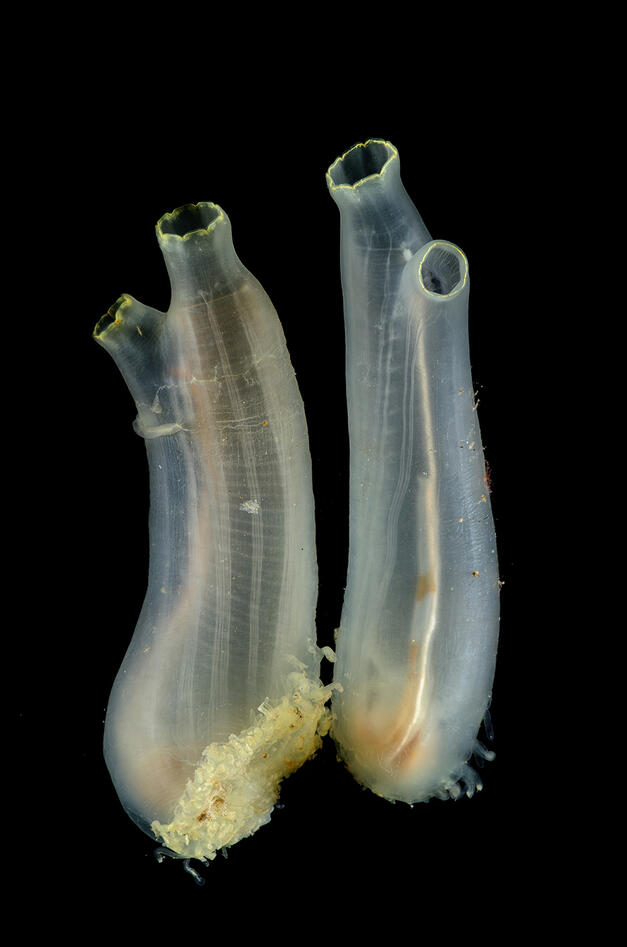
The ascidian culture facility at the Sars Center consists of 31 tanks to culture up to 10,000 adult Ciona intestinalis. The culture system is supplied with continuously running filtered sea water with its temperature and flow rate computer-regulated throughout the year. The ascidian culture is supplemented with live algae produced daily within the facility.
The model organism
Ciona intestinalis, commonly known as the sea squirt, is a marine chordate that has become a prominent model organism in developmental biology, genetics, and evolutionary studies. As a member of the tunicates, C. intestinalis is closely related to vertebrates, making it an invaluable system for studying fundamental biological processes and evolutionary relationships.
Key features of Ciona intestinalis as a model organism:
- Short Life Cycle: C. intestinalis has a relatively short life cycle, reaching sexual maturity in about 2-3 months under optimal conditions.
- Established Laboratory Cultures: stable laboratory cultures of C. intestinalis have been maintained successfully, allowing for continuous and controlled experimental studies.
- Rapid Development: the embryonic development of C. intestinalis is rapid, with the entire process from fertilization to a swimming tadpole larva taking only about 18 hours.
- Invariant Embryonic Cell Lineages: the cell lineages during embryonic development are highly invariant and well-documented, providing a reliable framework for developmental studies.
- Small Cell Number: the simplicity of its body plan, with a relatively small number of cells, makes it an excellent subject for cellular and developmental research.
- Optical Transparency: the embryos and larvae of C. intestinalis are optically transparent, facilitating live imaging and in vivo studies of developmental processes.
- Compact Genome: C. intestinalis has a compact genome of approximately 160 Mb, with around 16,000 coding genes. Extensive genomic resources, including a fully sequenced genome, are available to support genetic and genomic research.
The group's primary research focus is developmental biology/neurogenesis, and the ecological impact of noise pollution in the ocean (DeuteroNoise Project).
The culture
Overview
The C. intestinalis facility at the Michael Sars Center is comprised of 6 main tanks (System A) used for housing adult C. intestinalis that are collected from the ocean in the Bergen area. In addition to System A, we have System B comprised of 2 levels of 8 smaller tanks (16 total) ideal for housing juvenile C. intestinalis. This system (B) also uses seawater, which is then filtered through 50 and 10 µm filters and is UV-treated. Only the bottom rack is currently in use.
The temperature can be adjusted to some degree. There are two inlets with 8-10ºC and 20ºC water. Flow rate is kept constant but can be adjusted.

Tank parameters and environmental control
Tank distribution:
- 31 individual tanks present in the facility (15 large, 16 small)
- 6 large tanks currently used to house adult C. intestinalis
Temperature Manipulation:
- Inflow of seawater from 100 m depth at 8-10 ºC and 20 ºC
- Temperature modulation is dependent on season and natural temperature of water
Seawater and Seawater Treatment:
- Adult animals are housed in HIB seawater (not filtered)
- Salinity: approximately 32 ppt
- Juvenile animals are housed in HIB seawater that is filtered with 50 and 10 µm filters and then UV-treated
Automations:
- Seawater is constantly flowing and replaced in tanks
- Automated drip-feeding can be utilized
Production capacity
Lifecycle:
The complete lifecycle of C. intestinalis has not been replicated in the facility. Although possible, collecting animals every month and producing larvae when needed is more well-suited for the lab’s needs.
Adults:
- Adults are collected bi-weekly to monthly, depending on season
- Survives in facility for 1-3 months (season dependent)
Larvae:
- Larvae hatch from chorion 36 h.p.f (at 14 ºC)
- Tail regression (metamorphosis) occurs approximately 16 h post hatching
C. intestinalis husbandry
Animal Collection:
- Adult animals are collected to replenish our facility’s population
- They are collected from jetties and piers in the Bergen area (including Sotra and Askøy)
Housing and Feeding:
- Animals are kept for 1-3 months, depending on usage/season
- Animals are kept under constant lighting to avoid spawning
- Animals are fed daily or every other day, depending on season
- Filter feeders, food is poured into tanks by eye measurement
- The animals are fed with the following algal concoction:
- 1 part Chaetoceros calcitrans fo pumilus (CC) (4x3 µm LxW)
- 1 part Isochrysis sp. (Iso) (6 µm Ø)
- 1 part Rhinomonas reticulata (Rhino) (14x7 µm LxW)
- ½ part Synechococcus (bacteria) (SYN) (1 µm Ø)
- Dead/dying animals are removed at least once-a-day
Fertilization and Reproduction:
- In vitro fertilization
- Sperm and eggs collected from several animals to avoid self-fertilization
- Fertilization with and without chorion
- Transient gene expression via plasmid electroporation
Gamete and Embryo Manipulation:
Protocols for fertilization can be made available upon request.
Key facts
- GMO certified (Biosafety Level (BSL) 1)
- Faucets and drains lead to “Pyramid” (chlorinates and irradiates waste)
- Originally set up ca. 2010, tanks were replaced in 2015. System B was built in 2017, but remained unused until late 2024.
Research