Cnidarian Facility

Hovedinnhold
The Cnidaria Facility is a semi-automated culture system which allows for genetic approaches. A shelf system gives room for over 400 boxes for the different lines. Nematostella vectensis anemones are kept in boxes with 1 L brackish water (1/3 sea water), which is replaced automatically once a day. The animals are fed daily with freshly hatched Artemia brine shrimps. The brackish water is produced automatically in tanks of 1000 L by diluting filtered sea water with reverse osmosis water. The sea water is pumped from 200 m depth out of the fjord of Bergen, in a distance of a few kilometers from the shore. Temperature, salinity and pH are constantly controlled in the tanks. This set up reduces the daily hands-on time of cleaning to a minimum.
The model organism
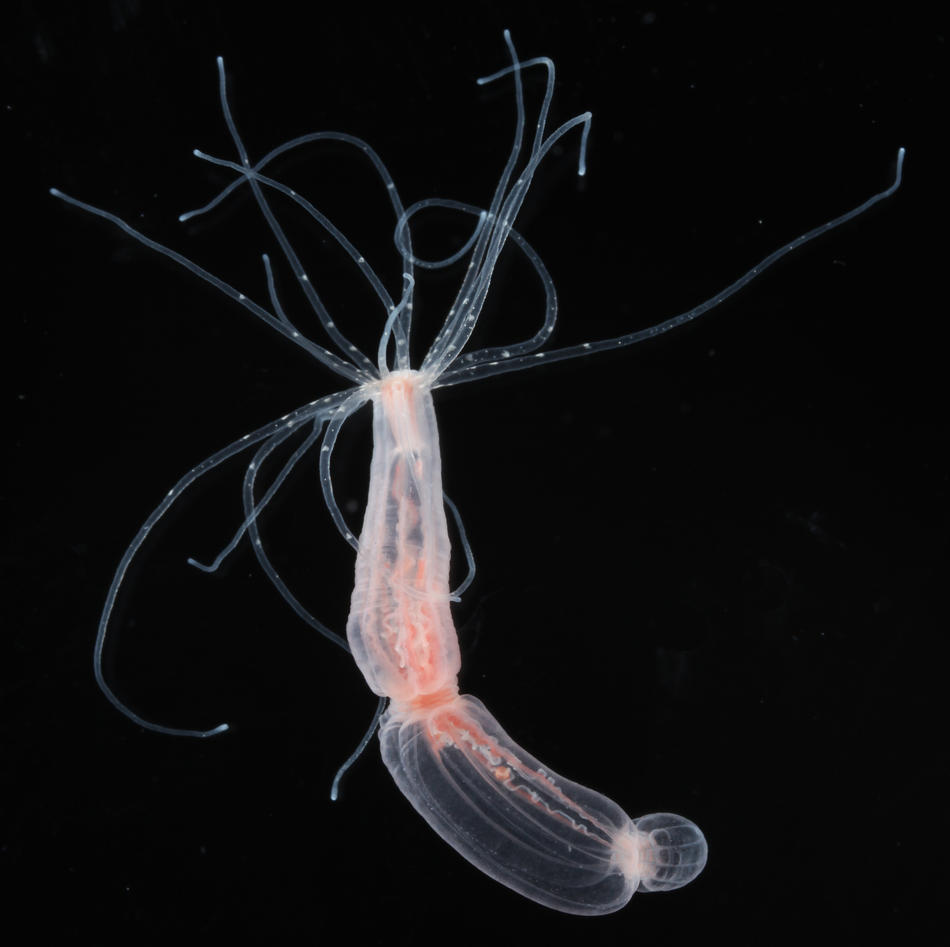
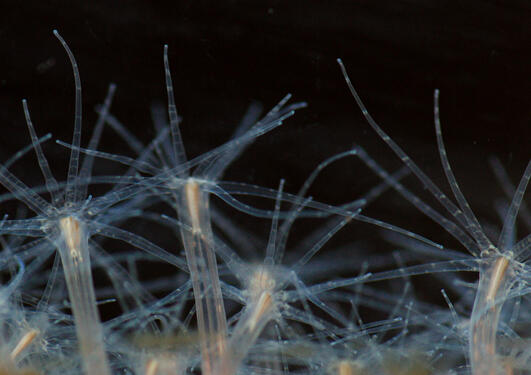
Nematostella vectensis, commonly known as the starlet sea anemone, is a species of marine invertebrate in the phylum Cnidaria, class Anthozoa. It has become a widely studied model organism in evolutionary developmental & cell biology, genomics, and evolutionary ecology due to its relatively simple body plan, transparent body, and ease of cultivation in laboratory settings.
Morphology
Nematostella vectensis has tubular body plan with a simple structure consisting of a mouth, oral disc, tentacles, and a foot for attachment to the substrate.
It has a cylindrical body with an oral (upper) and aboral (lower) end. The body is covered with a soft epidermis and contains cnidocytes (cells capable of stinging) that help in defense and prey capture.
Habitat
This species is found along estuarine environments, including mudflats, tidal pools, and mangrove swamps, where it can tolerate a wide range of salinities and temperatures, making it resilient in varying aquatic conditions.
As a research organism
Nematostella vectensis is used in research due to its ability to reproduce sexually and asexually (via budding). It has a simple life cycle with an invaginating gastrula, a planula stage and a primary polyp that grows into a juvenile and adult upon feeding.
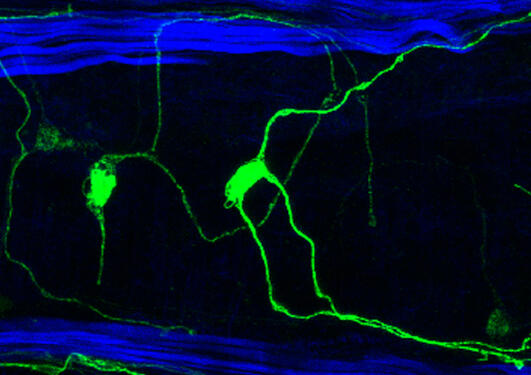
As a model organism, it is particularly useful for studying embryonic development, formation of the body plan, cellular differentiation, juvenile growth and gametogenesis. At the Michael Sars Centre, the main research interest is the environmental control of growth, and a group at BIO/UiB focuses on neurogenesis.
Genomic and transgenesis ressources
The genome of Nematostella vectensis was the first genome of any cnidarian published. In addition, ChiP-Seq, ATAC-Seq and single-cell RNA sequencing have been established. Transgenesis using I-Sce I meganuclease is routinely done in Nematostella. In addition, CRISPR/Cas9-mediated knock-out and knock-in methods have been established.
Ecological Role
In its natural environment, Nematostella plays a role as a benthic predator, feeding on small planktonic organisms and detritus. Its ecological interactions and adaptations to fluctuating environmental conditions, like salinity and oxygen levels, make it an important species for understanding marine ecosystems and the impacts of environmental stressors and the microbiome.
Nematostella vectensis is a valuable model organism in marine biology, genomics, cell & developmental biology and ecology, offering insights into evolutionary processes and the development of key biological features. It’s simple yet informative biological traits make it an excellent subject for research in these fields.
The culture
Tank Distribution:
- ~1000 individual boxes with daily, automated water exchange. Boxes are kept at room temperature (18 degrees)
- Animals are in addition kept in beakers and petri dishes
Temperature manipulation:
- Growing animals are kept at 25°C incubators
- To induce spawning, animals are kept in light at a 25 °C incubator for 12 hours
Sea water and seawater treatment:
- Animals are cultivated in brackish water a mix of reverse osmosis water and natural seawater from the house system
- Conductivity 22-24 (corresponds to ~16o/oo)
- pH ~ 8
- UV-treated
- Available in-house sea water is non-sterile, has a temperature of 9°C and a salinity of 34o/oo
- Reverse osmosis water production in the facility
Automation/sea water exchange
- ~1000 tanks with automated water exchange for 1 minute on 5 days/week (Mon-Fri).
- RO-water production automatically starts when tanks are empty.
Production capacity
Lifecycle: 3 months.
Adult production: Whenever needed.
Juvenile production: As many as the lab needs. Usually around 1000 wildtype animals per week. Transgenic lines whenever needed. 120 females are induced every day. Normal egg production per day: 60 000.

Culture maintenance
- Animals are kept in brackish water
- Life cycle is controlled by temperature, density and food availability
- 30 adults are kept in each box to optimize egg and sperm production
- Feeds on live Artemia on 5 days/week (Mon-Fri)
- Every box is manually cleaned every 3 weeks
- Automated water exchanges on 5 days/week (Mon-Fri)
- Average number of eggs per female: 400-800
- In vitro fertilizations possible
- Microinjection setups are available for injection fertilized or unfertilized eggs
- Sending/shipping animals is possible
- Scientific expertise in injecting morpholino-RNA, mRNA, tracers and Cas9/gRNA for generating knock-out and knock-in lines
Artemia production
The facility produces 2 L of freshly hatched artemia per day. The density depends on the success of the hatch.
Field collection
Nematostella vectensis is native to North America and the UK. Therefore, it is not possible for this facility to collect wild organisms. We maintain a population of wild type (WT) male and female organisms within the facility.
Key facts
- Listed in the EMBRC-Norway catalog
- GMO certified
- Drains and sinks lead to a water disinfection and purification system, the “pyramid”
- Renovation finished in 2018
Research
Rentzsch Group (BIO)