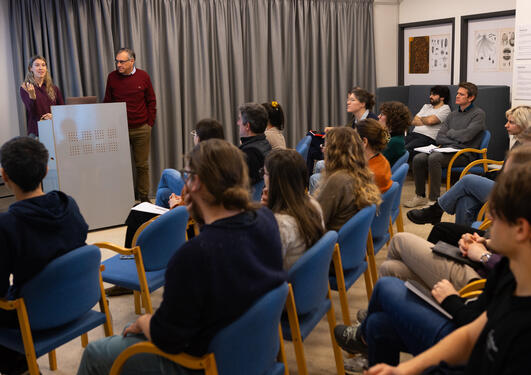
Prof. Lise Øvreås, Department of Biological Sciences, UiB
Lise Øvreås, Professor of geomicrobiology at the Department of Biological Sciences, UiB, will present: "Hot topics from cold environments"
Hovedinnhold
Svalbard is often called a “climate thermometer,” and for good reason: few places on Earth are warming faster. While the Arctic as a whole is heating up about four times faster than the global average, Svalbard is warming at an even more dramatic pace—up to seven times the global rate since the 1990s. After more than 25 years of fieldwork in Svalbard, I have seen these changes firsthand: glaciers retreating, permafrost thawing, and ecosystems shifting in ways that were once unimaginable.
My research focuses on the invisible majority of life in these environments—microbes. Using omics technologies, I study the vast communities of microorganisms that live in soils, sediments, ice, and the ocean. These microbes are essential to ecosystem function, and they often react quickly to environmental change.
Today, one of my key research areas is understanding how climate change reshapes microbial life in the Arctic. As permafrost thaws and ancient ice formations melt, entire microbial ecosystems are released and transformed. This has consequences not only for biodiversity, but also for carbon cycling and greenhouse‑gas emissions. I am also fascinated by extremophiles—the hardy, ancient forms of life that thrive in some of the coldest and harshest places on the planet. By studying these organisms, we gain insight into the origins of life and the limits of biology.
In this seminar, I will explore how rapid warming, sea‑ice loss, and more extreme weather events are altering Arctic ecosystems—and what these changes mean for the future. I will also discuss the remarkable resilience of microbes that live at the edge of what life can tolerate, and how increasing human activity in polar regions is making these systems more vulnerable, but also more accessible for scientific discovery.
The seminar will be presented together with a talk by Prof. Lars Smedsrud.