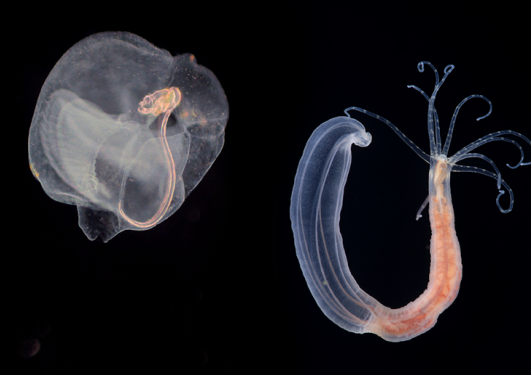
Research Groups
Researchers at the Michael Sars Centre work in 6 independent research groups. Learn more about their current projects.

Hovedinnhold
Christiaen Group
The group uses the tunicate Ciona intestinalis to connect gene regulation with the cell biology underlying embryonic development, with a focus on cardiopharyngeal lineages, which produce both cardiomyocytes of the second heart field and head muscles from Mesp1+ anterior mesoderm progenitors. The group employs a variety of experimental and computational approaches including:
- Field collection and animal culture
- Experimental embryology and transient transgenesis by microinjection and electroporation
- Genome engineering and genetic perturbations using RNAi, CRISPR/Cas9, and derivatives (e.g. CRISPR/Cas13, dCas9 variants, ….)
- A variety of histochemical techniques including fluorescent in situ hybridization, and immunohistochemistry.
- Fluorescent microscopy methods, including confocal microscopy using the Leica Stellaris 8 Falcon.
- Various cell sorting methods, including microfluidics-based multicolor sorting with the WOLFcell sorter
- Single-cell genomics methods, including scRNA-seq, scATAC-seq, and multimodal assays available on the 10X Genomics Chromium X platform.
Visit the Christiaen Group webpage.
Steinmetz Group
The Steinmetz group studies how food supply regulates growth in the sea anemone Nematostella vectensis on the organismal, cellular and molecular levels. They apply genetic, developmental and cell biology techniques to analyze gene function (e.g., by genome editing), image cell epithelial remodeling and characterize specific populations of stem or progenitor cells. Their aim is to get a comprehensive, multi-scale understanding of the processes underlying nutritionally controlled body plasticity by investigating cellular, metabolic and genetic responses to feeding or starvation.
Visit the Steinmetz Group webpage.
Chourrout Group
Our main interest is the evolution of tunicates within the phylum of chordates, to which human and all vertebrates belong. This is investigated by examining changes from chordate ancestors in the tunicate genomes and in their development mechanisms.
Our favorite model system is Oikopleura dioica, which offers multiple assets over most chordates, including a very short generation time (one week at 13°C) allowing genetic analysis, a very compact genome allowing routine re-sequencing, an optimized culture protocol validated over numerous life cycles, a presence in all oceans with a crucial role in the food chain. The lab has established most techniques for identifying and studying genetic players in Oikopleura dioica, and in the related species Fritillaria borealis.
Our lab routinely performs:
- Field collection and culture of Oikopleura dioica and Fritillaria borealis
- Manipulation of Oikopleura dioica gene function with RNAi and CRISPR/Cas9
- Gene expression profiling with RNA in situ hybridization, immunohistochemistry and single-cell RNA sequencing
- Genome and transcriptome analysis based on short- and long-reads sequencing techniques
- Study of gene function with heterologous systems (mammalian and bacterial expression)
Visit the Chourrout Group webpage.
Chatzigeorgiou Group
Understanding the mechanisms by which nervous systems develop and operate in order to collect information from the external world and generate a coordinated behavioral output is one of the most exciting problems in biological research. Our lab works at the interface between neurobiology and evo/devo using as our model organism the simple chordate Ciona intestinalis.
We are interested in how Ciona's nervous system is built and how it functions. Examples of projects taking place our lab include but are not limited to: 1. studying the molecular and cellular basis of how Ciona larvae sense chemical and mechanical cues in their environment 2. understanding the composition and organization of the larval behavioral repertoire and 3. elucidating how miniaturized nervous systems can integrate and process multimodal sensory information. To achieve our research aims the group uses a range of experimental and computational methods some of which are listed here:
- Ciona intestinalis adult collection.
- Embryological manipulations including transient transgenesis by electroporation.
- Genome editing using CRISPR/Cas9.
- Histochemical techniques such as whole-mount in situ hybridization and immunohistochemistry.
- Volumetric calcium imaging using GECIs in combination with an OLYMPUS SpinSR spinning disk confocal, FRET-based imaging using point scanning (FV3000), or spinning disk confocal microscopy.
- Quantitative behavioral analysis using 3D printed trackers and machine vision (Tierpsy) or deep learning-based tracking (DLC) software.
Visit the Chatzigeorgiou webpage.
Lynagh Group
The Lynagh group studies ligand-gated ion channels, the membrane proteins that mediate fast chemo-electric signals between neurons. We combine phylogenetic and gene expression analyses with electrophysiological experiments and genetic code expansion. With this approach, we draw on evolution to uncover biophysical mechanisms in ion channels, and we utilize biophysical experiments to understand the evolution of these crucial nervous system proteins. Regular bioinformatics and molecular biology are employed, and electrophysiological experiments utilize two electrode voltage clamp and patch clamp rigs in the laboratory. We also perform non-canonical amino acid incorporation via the non-sense suppression method.
- Genetic code expansion (non-canonical amino acid incorporation via chemical aminoacylation and nonsense suppression)
- Heterologous expression of proteins in mammalian cell lines and Xenopus laevis oocytes
- Electrophysiology
Visit the Lynagh Group webpage.
Burkhardt Group
The goal of our laboratory is to reconstruct the origin and evolution of synapses and neurons. We use a comparative approach and work with two different model organisms: a) choanoflagellates, the closest living relatives of animals, which possess a surprisingly high number of synaptic protein homologs and b) ctenophores, early branching animals with synapses and neurons, which may have developed their nervous system convergently. We aim to understand when the proteins required for synaptic activity first evolved, how they functioned at a molecular level and which combinations of synaptic proteins resulted in the origin(s) of first synapses. We use a variety of different techniques including:
- Field collection and culture of choanoflagellates and ctenophores
- Comparative genomics
- Functional biochemistry (protein-protein interactions, immunoprecipitations)
- Histochemical techniques including fluorescent in situ hybridization, and immunohistochemistry.
- Electron microscopy and 3D visualizations of cells and organisms
- Genetic perturbations using CRISPR/Cas9 in choanoflagellates
Visit the Burkhardt Group webpage.