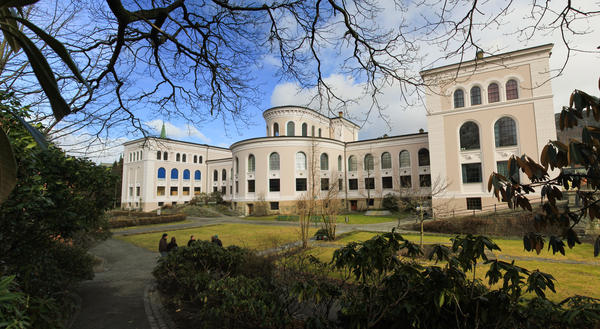
Why is the Museum being listed as a protected building?
... And ten other questions for Hanna Geiran of the Norwegian Directorate for Cultural Heritage.
Why should the Natural History Collections be listed as a protected building?
"The Natural History Collections is a wonderful building. As soon as you walk through the door, you enter a different era and a very special ambiance. The building is unique in Norway and a real national treasure. The Natural History Collections at Bergen Museum is an important, interesting and unusual building in Norwegian cultural and architectural history, as well as an important artefact in the history of museums. This type of museum is "endangered" because of the great pressure to modernise museums and make them "contemporary", usually with a focus on hi-tech exhibition solutions. Many people want to change the cabinet concept – i.e. to do away with exhibited items in cabinets. In this context, it has been suggested that the entire Muséplass 3 be listed as a grade 1 protected monument, in the Ministry of Education and Research's National Protection Plan."
Tell us about the National Protection Plan.
"A major project is under way to assess all government properties in terms of whether they merit protection. Each ministry is assessing all its buildings and then choosing the most important buildings with regard to the history of the sector and architectural and cultural value. Some of these buildings will then be "listed", i.e. protected. The purpose of this project is for the government to secure significant buildings in its portfolio for posterity."
"Protection" at this stage is thus only a recommendation – is there any reason to doubt that will happen?
"No, there is not. The work on the National Protection Plan will continue throughout the rest of the year, and until further notice both the building and the garden should therefore be treated as if the protection order is already in place."
You say that the building has "national value". Can you explain this in more detail?
"It is an important building in terms of regional and national history. Museums like the Natural History Collections in Bergen are part of Norway's nation-building history. Norway was a very poor country when Bergen Museum and the National Gallery in Oslo were built, and yet the nation still chose to invest large amounts of money in establishing these museums. It is important for the Directorate for Cultural Heritage that the Museum can be used for the purpose for which it was intended, and we are thrilled that buildings are being restored so that they can be used."
What does it mean that the museum is going to be "protected"?
It means that the heritage and architecture-historical values it represents will be preserved for future generations. Inside, the Museum will be divided into zones. The original museum, i.e. the central part, was designed by Johan Henrik Nebelong, a prominent architect in the mid-1800s who also designed Oscarshall Castle in Oslo. This part of the building is being given special priority as a "museum within the museum". Both the collection it houses and its function as a record of a past era are interesting and important. This applies both to the current appearance of the museum with its grand halls and old cabinets, and the items on exhibit. The Whale Hall is unique in Europe and has a very special ambiance. This part of the Museum is a national treasure that is to be restored and preserved as it is today or returned to its former state, according to the plans so far."
What exactly is being "protected"?
"The entire building will be protected, but not in the sense that it will be locked away behind glass. Our goal is that changes are made with a focus on preserving the cultural-historical elements, and that they are undertaken in such a way that important assets are not lost. On the basis of thorough analyses using recognised methods, we have been able to pinpoint a number of areas that will be treated differently. The cabinets in the middle section will be preserved and protected, as they are valuable objects in their own right. They were built for the Museum, and some of them are originals of exceptionally high quality. We are committed to preserving the exhibition concept so that the public can view the objects in this way, but it is of course up to the professionals at the Museum to decide what will be exhibited in the different cabinets."
Because the content of these cabinets has not been chosen randomly...?
"Some of the objects are very rare and valuable in the sense that they are very difficult if not impossible to replace. In the colonial era it was entirely acceptable for collectors to travel the world and help themselves to whatever they wanted. Nowadays, there are restrictions, and some animals, like the Lofoten horse and the great auk, are extinct. It is therefore essential to preserve a collection it is not possible to complete in other ways, and in such a way that the public can see the objects 'face to face'. However, this requires that the project improves the indoor climate and the environment the objects are exhibited in."
What about the rest of the Museum? What will happen there?
"The Museum has two wings, designed by architect Hans Jacob Sparre in 1898. They have both undergone changes over the years, and the South Wing in particular has been extensively remodelled. The Museum needs modernising and new functionalities, and these changes will be made in the wings."
Will there be any differences between the North Wing, which is next to the University Library and the South Wing that faces the Student Centre?
"The North Wing will continue to be used for exhibitions, but in a more modern form. The South Wing will be used for entertainment and other functions that the museum needs."
What are the plans for the Botanical Gardens? They are after all an important part of the Museum.
"The gardens are covered by the protection order too, along with the greenhouse and the brick building. These beautiful gardens are a valuable asset in their own right, and the project has recommended not making any significant changes in connection with the restoration work."
What is your role in the Museum Project 2014?
"I represent the Directorate of Cultural Heritage and will be involved throughout the process. We attach importance to collaboration from an early stage, so that we can work together towards a common goal, as opposed to us sitting in Oslo and suddenly receiving a finished plan. So far, the collaboration has been excellent, and we are looking forward to continuing working together. It is challenging and exciting to work on combining old and new in an innovative way that enhances both."
Last updated 18.5.2011
Nyheter fra The Museum Project
- Why is the Museum being listed as a protected building? (18.05.2011)
- Ready in time for the Constitution bicentennial (18.05.2011)
- Ready for the Jubilee of the Norwegian Constitution (29.04.2011)
Related news
- 22.05.2012: Work-In-Progress Seminar (21.05.2012)
- CMS Research School/Work-In-Progress Seminar: Arrival of Writing (21.05.2012)
- The Whale Hall reopened (18.04.2012)
- Egypt Saturday! (13.04.2012)
- The Whale Hall soon to reopen (30.03.2012)
- Natural sciences
- Architecture
- History
- Building