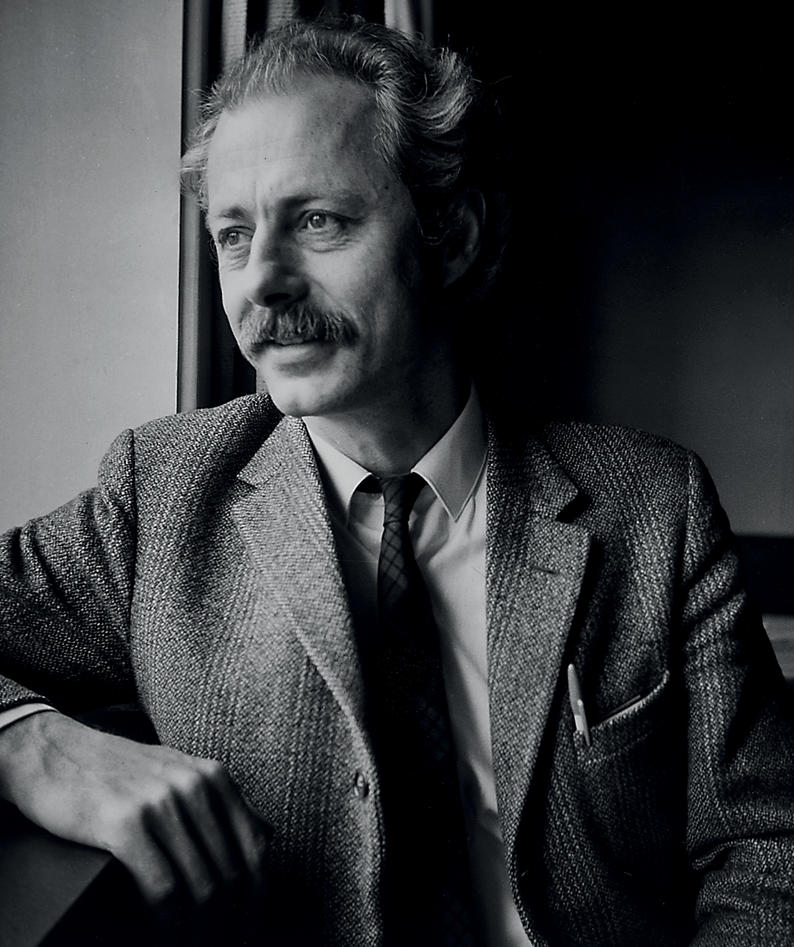
Fredrik Barth-forelesningen
Velkommen til den årlige Fredrik Barth-forelesningen!

Hovedinnhold
Fredrik Barth-forelesningen holdes fast om høsten, fortrinnsvis i oktober. Forelesningsrekken ble etablert i 2015 i forbindelse med Institutt for sosialantropologis 50‑årsjubileum. Fra og med 2025 arrangeres forelesningen annethvert år.
Akademikeren som inviteres står på en eller annen måte i relasjon til Fredrik Barths antropologiske fundament: utviklingen av teori basert på solid etnografi og deltakende observasjon, i tillegg til vektleggingen av komparasjon. Foredragsholderen kan både være en ung og lovende forsker eller en etablert akademiker, som i sin forskning er opptatt av noen av de samme regioner og/eller tema som Fredrik Barth selv utforsket i sin karriere.
Instituttleder og instituttets forskningskomité finner frem til aktuelle kandidatene basert på forslag og anbefalinger fra instituttets vitenskapelige stab.
2024 - Professor Dame Marilyn Strathern
The 2024 lecture was held by Professor Dame Marilyn Strathern, University of Cambridge.
- Time: Thursday, October 3rd, 15.00-16.00 pm
- Place: Egget auditorium, Student Center, Parkveien 1, 5007 Bergen
Journeying anew, with or without knowledge
Global consciousness of climate change and biodiversity loss endures in the face of what we know to be inadequate responses. For all the attempts to act on knowledge, failure to scale up reactions – by citizens, by governments - makes one wonder where the power of knowledge has gone. Not dealing very well with relations and connections is one widely acknowledged short-coming; it is of course a shortcoming to which many anthropologists would point (speaker included), in promoting the relational insights of their interlocuters. This makes Fredrik Barth’s 1975 monograph on the Melanesian Baktaman, then an unusual voice against the easy making of connections, now appear rather intriguing. His own search was for places new. Starting a twenty-first century journey there brings one to a point where the power of knowledge – when it is tied to action - is not quite what it promises.
2023 - Professor Harvey Whitehouse
The lecture was given by Professor Harvey Whitehouse, University of Oxford.
- See the full lecture: Against Interpretive Exclusivism
- Time: Thursday, November 9th, 15.00-16.00 pm
- Place: Egget auditorium, Student Center, Parkveien 1, 5007 Bergen
Against Interpretive Exclusivism
This Fredrik Barth Memorial Lecture argues against interpretative exclusivism – the dogma that we can only understand cultural systems by interpreting them, thereby ruling out reductive explanation and scientific methods. I will argue that the costs of interpretive exclusivism are heavy and the benefits illusory. Even though inclusivism is neither easy nor cheap, it is arguably the only way Anthropology can hope to realize its intellectual potential as a discipline.
I will show that the work of Fredrik Barth has served as a beacon for those seeking to develop an inclusivist approach by providing a rich foundation of theoretical ideas on which to build. Inspired by such figures, Anthropology would be less concerned about policing its borders or worrying about whether authors or their work should be counted as ‘anthropological’. Instead, it would be more open to methodological pluralism and intellectual diversity. It would contribute to interdisciplinary knowledge creation by providing much needed data for use in comparative analyses. It would maximize its practical relevance by embracing rather than excluding scientific methods. And a desirable by-product of this would be improvements to the long-term prospects of Anthropology as a discipline.
2022 - Associate Professor Diane E. King
The lecture was given by Associate Professor Diane E. King, University of Kentucky.
- See full lecture here
- Time: Thursday, December 1, 15.00 -16.00 pm
- Place: The University Aula, Muséplassen 3
Ethnic Groups and Quandaries: Thoughts on Modern States and Hereditary Belonging
In this lecture, I hope to both honor Professor Barth and to take up where he left off, drawing on my own research in Kurdistan conducted periodically since the mid-1990s. This lecture is about kinship (specifically descent reckoning), the state, and one of the main byproducts of kinship and state, sectarianism. As Barth noted and I also have found, in Kurdistan, many socially-inflected actions, possibilities, and values are shaped by, and flow out of, hereditary belonging in the form of patriliny. This is the idea that it is mainly men, not women, who socially and legally and ontologically make offspring. Patriliny, as this idea is known, is so powerful there, that I argue that it acts as a kind of third party, to which individuals are held accountable by themselves and others. Patrliny has mainly been looked at for the ways in which it organizes a society, which of course it does. But what if we shifted the focus both inward and outward, to look at patrilineal hereditary belonging in the lives of individuals, and as integral to citizenship in the state? That is what I plan to do in this lecture: to show patriliny’s role in the lives of my interlocutors, and to argue that while it is, yes, about quotidian social relations, it also makes possible sectarian Iraqi, and more broadly, Middle Eastern and West Asian citizenries. Patriliny is a survivor. It inhabited and maybe even gave rise to early states thousands of years ago, remained as a social and legal form through many empires, and now thrives in the twenty-first century, sovereign-yet-crisis-ridden and militarized and autocratic West Asian state.I believe we in anthropology are in a quandary: the world has thousands of ethnolinguistic groups, but only around 200 states. National groups are quickly absorbing smaller ethnolinguistic groups, with language death accelerating rapidly. And yet we in anthropology have turned to the very specific and shied away from generalizing. We work in the whole world, but it seems we are reluctant to talk about the whole world, except for those ways in which various global flows impact and inhere in our interlocutors. I think that Fredrik Barth, had he kept living and doing fieldwork well into this century, would have again turned to ethnic groups and boundaries, but in a way that was both less universalizing, and that acknowledged our present postcolonial and globalized moment. That is what I too hope to do in this lecture.
2021 - Professor Marianne Lien
The lecture was given by Professor Marianne Lien, Department of Social Anthropology, University of Oslo.
The Fredrik Barth Memorial Lecture 2021 took place on the occasion of the NAF Conference November 25-26.
Beyond the Ethnographic Presence; Landscapes as relational archives
Among the cherished legacies of Fredrik Barth is his emphasis on ethnographic fieldwork and on the ethnographic presence as a superb empirical entry point for understanding asymmetrical relations, ethnicity and social change. His approach shaped generations of scholars, as well as the anthropological understanding of ethnic identities in Norway, including in Finnmark.
In this lecture, I draw the attention to sites in Finnmark where traces of colonization and atrocities can still be noticed in the landscape, and where ethnic identity, for some, is still a ‘social stigma’. Mobilising material, archival, human and botanical remains, I ask what such artefacts can tell us about the making and un-making of subjectivites and ethnic identities, both past and present. Tracing the landscape as a relational archive, and the archive as a material site where relations are ordered and negotiated, I explore shifting conditions of possibility and hope in a landscape that holds the legacies of multiple life-forms and multiple losses.
Mindful of how silence is often the companion of shame, I search for ways to articulate the aftermath of colonizing policies. Towards this aim, I propose a multi-temporal ethnography that seeks not only to elicit the past as historical background, but to grasp material traces for what they reveal gaps and absences in the present.
2020 - cancelled
The Fredrik Barth Memorial Lecture 2020 was cancelled due to the Corona pandemic.
2019 - Dr. Mandana Limbert
The lecture was given by Dr, Mandana Limbert, City University of New York.
- Time: 18.10.2019 15:00-1600
- Place: Egget, Studentsenteret, Parkveien 1 5007 Bergen
On Homelands and History in Southern Arabia
Always thinking against the grain and from fieldsites considered on the margins of the Middle East, Fredrik Barth forced anthropologists of the region and beyond to question presumptions about the force of structuring principles as well as the dynamics of social and political relationships and arrangements. Inspired by Barth’s urging of a more robust “analytic description,” and from the shared margin of Southern Arabia, I will in this talk explore fundamental notions of political home and identity, “nation” and “Arabness,” as they transformed over the course of the 20th century.
Drawing on ethnographic and archival work in a town in interior Oman (a town about which Barth also wrote a fascinating article), I will in this lecture explore how ideas of and practices shaping such categories have shifted, connected to particular political, economic, and religious processes and debates that extend across the Indian Ocean. I argue that examining itineraries of and debates about travel and marriage across the ocean can challenge received understandings of identity and belonging in the Middle East.
2018 - Dr. Michael W. Scott
This lecture was given by dr Michael W. Scott, London School of Economics & Political Science.
- Time: 26.10.2018 16:15-17:30
- Place: Eggget, Studentsenteret, Parkveien 1 5007 Bergen
The Future of Prophecy: Transforming Temporalities in Melanesia and Anthropology
In Cosmologies in the Making, Fredrik Barth staged a playful yet illuminating comparison between the way anthropologists write about cultural others and the way they write about themselves. Anthropologists, he observed, write about others as though they were always repeating received cultural forms, but portray themselves as always composing ‘an emerging...tradition of knowledge with no pre-set and over-arching order’ (1987: 18-19). This comparison, he said, was about getting ontology right.
In a similar spirit, this lecture aims to get temporality right by staging a comparison between the thing the Arosi people of Solomon Islands call kastom profesi (traditional prophecy) and contemporary discourses about prophecy in anthropology. The latter, I suggest, announce a temporality of pure duration in which prophecy proliferates a limitless variety of new and unpredictable futures. In contrast, Arosi kastom profesi indexes a spatialized temporality in which prophecy reveals the coming realization of a hidden but intrinsically complete whole. In light of this comparison, and in keeping with an agenda I have developed for the comparative study of ontology, I argue that Arosi kastom profesi warrants theorization of what I call ‘totemic prophecy’.
Were the theoretical implications of Barth’s playful comparison at odds with those of my own, or did he prophesy the different trajectories the anthropology of ontology would take in the twenty-first century – or both?
2017 - Dr. Madeleine Reeves
This lecture was given by Dr Madeleine Reeves, University of Manchester.
- Time: 03.11.2017 16:15-17:30
- Place: Egget, Studentsenteret, Parkveien 1 5007 Bergen
Scaling sovereignty: intimate militarism and the anthropology of exception
What is at stake in contemporary calls to ‘take back control’ of state borders? What is being hoped for in demands to ‘regain sovereignty’ in places where it is felt to have been lost or compromised? In this essay I seek to situate state desire as a properly anthropological object of enquiry through an engagement with Barth’s work on scale. My starting point is a critical engagement, through the lens of scale, with recent ethnographic literature that has taken the production of legal exceptions as the starting point for an anthropology of contemporary sovereignty. Such literature has productively illuminated the legal, political and institutional mechanisms through which some human lives are systematically rendered ‘bare’.
Yet anthropology’s concern with sovereignty-as-exception has, I suggest, left us with fewer tools for exploring sovereignty-as-aspiration: with recognizing the bordered, territorially-integral, notionally-sovereign state as locus of material and affective investment. The concept of scale can be productive here, precisely by illuminating how ‘sovereignty’ might appear differently at different ethnographic and analytical scales. Drawing on research along Kyrgyzstan’s borders with neighbouring Uzbekistan and Tajikistan, I seek to develop this argument ethnographically by exploring what I call ‘intimate militarism’: the normalization of, and desire for, military presence as an index of social and geographical legibility in a context otherwise marked by consistent state withdrawal.
2016 - Professor Thomas Hylland Eriksen
This lecture was given by Professor Thomas Hylland Eriksen, University of Oslo.
- Time: 16.12.2016 13:00-14:00
- Place: Egget, Studentsenteret, Parkveien 1 5007 Bergen
Flows and boundaries in the Creole world
The boundary is a key concept in Fredrik Barth's work, not only in Ethnic Groups and Boundaries, but also in his earlier writings about ecology in Pakistan and Iran and his later writings about pluralism in Oman and Bali. He showed, famously, how ideas and concepts, practices and even people could cross boundaries without threatening their integrity.
In recent decades, however, the boundary itself has become a privileged site for anthropologial theorising and research. In symbolic or cultural anthropology, an influential tendency interrogates the nature/culture boundary (interestingly enough in ways sometimes reminiscent of Barth's study of Baktaman symbolism). In this lecture, I explore a different kind of boundary, or perhaps non-boundary, by looking at a social identity formation which eschews boundaries, embraces impurities and celebrates openness. Can the post-slavery peoples commonly known as Creoles be considered ethnic groups at all, or do they represent a social form unbeknownst to and incompatible with a social anthropology assuming that groups need boundaries in order to perpetuate themselves? Examples will be drawn from the Indian Ocean and the Caribbean, and I shall ask what Creoles could learn from Barth and vice versa.
Listen to the full lecture: Flows and boundaries in the Creole world
2015 - Professor Magnus Marsden
This lecture was given by Professor Magnus Marsden, University of Sussex.
- Time: 15.10.2015 16:15-17:15
- Place: Stort Auditorium, Lauritz Meltzers hus, Fosswinckelsgate 7
Revisiting Entrepreneurs: Afghan trans-regional trading networks across Eurasia and beyond
Marsden’s research focuses on Islam in Central and South Asia, the very same region where Barth conducted some of his first significant fieldwork. Marsden’s previous work has explored the Afghanistan-Pakistan-Tajikistan borderland as a setting for complex interactions between Muslims from across Cold War boundaries. In his latest book Trading Worlds: Afghan Merchants Across Modern Frontiers (2015) Marsden develops his interest in mobile individuals and families in the region further by looking at Afghan trading networks and the skills and values that people attach to trade and working life.
See the full lecture: Revisiting Entrepreneurs: Afghan trans-regional trading networks across Eurasia and beyond
OM FORELESNINGSREKKEN
The Fredrik Barth Honorary Lecture ble opprettet av Institutt for sosialantropologi ved Universitetet i Bergen i 2015 i tilknytning til instituttets 50-årsjubileum, og for å hedre grunnleggeren, professor Fredrik Barth.
Den 24. januar 2016 sovnet professor Barth stille inn og forelesningsrekken ble omdøpt til The Fredrik Barth Memorial Lecture.
Les mer om hyllesten til instituttets grunnlegger: