Methods
The nodes of the NorProteomics Consortium together offer courses, training, service and collaboration within the full range of proteomics methods available worldwide today. The methods available and the main areas of expertise varies from node to node. Please choose the method of interest to you and see which nodes you can consult. A detailed specification of the techniques available at each node is given for each main category.
-
Protein Identification
The amino acid sequence of proteins in biological samples can be determined by the use of mass spectrometry.
-
Targeted Protein Quantification
Protein quantification of a small set of proteins in a larger number of samples using Selected Reaction Monitoring (SRM). For example the verification of the expression differences between sample groups for disease marker candidates in a large sample set.
-
Quantitative Proteome Profiling
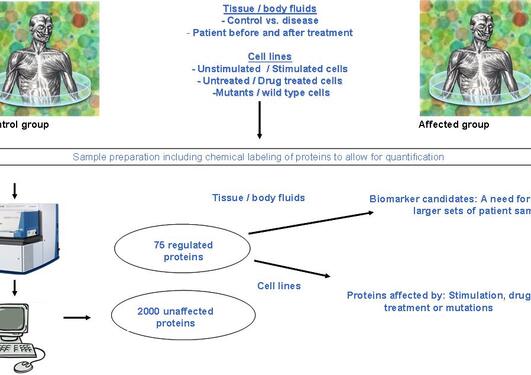
By quantitative proteomics methods we can identify and quantify protein expression changes in biological matrixes like cells, tissue and body fluids. A typical example is the comparison of proteins in plasma from a control group with a patient group to find specific disease marker candidates.
-
Posttranslational Modifications (PTMs)
Post translational modifications is a mechanism that allow a cell/tissue/organism to control the behavior of a protein, for instance activating or inactivating an enzyme. There are hundreds of different typesof modifications, with some of the most usual and widespread being glycosylation and phosphorylation. By the use of proteomics and massspectrometry we have the possibility to enrich proteins with some of these modifications, finding the modification site in the sequence and in some cases also quantify the modified and unmodified version of the protein.