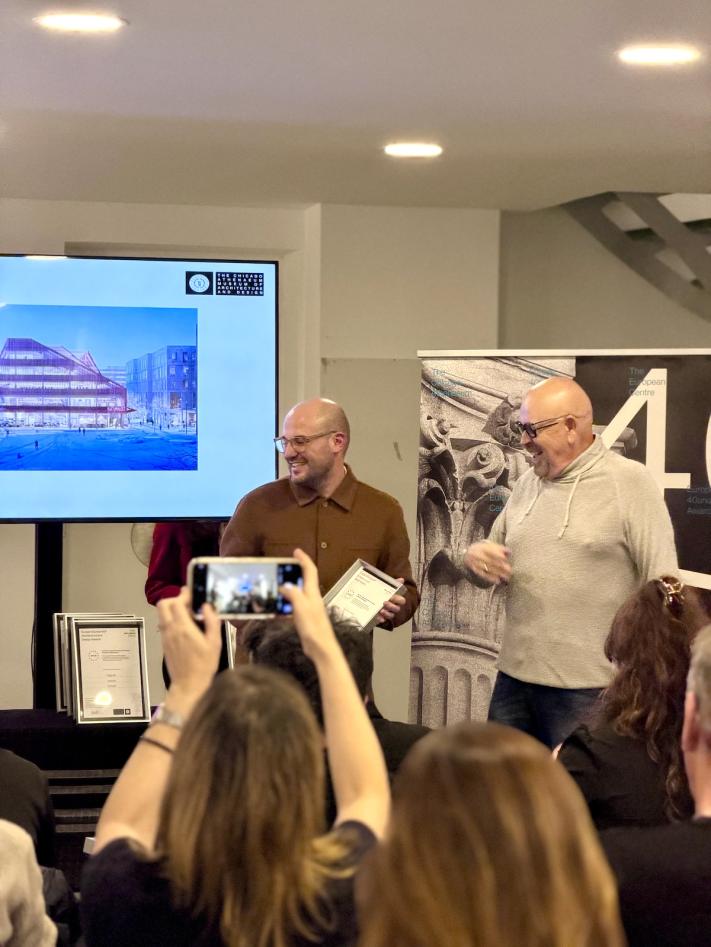
Jérôme Picard honored with prestigious European architecture award
For Jérôme Picard, Associate Professor at KMD, the ongoing architectural debate about what is ugly and beautiful is about more than façades. On Friday, December 5, he was awarded the Europe 40 Under 40 prize, which is given the 40 most promising architecture and design talents in Europe.

Main content
“I am very happy about the award. Through initiatives at the Faculty of Art, Music and Design, I have the opportunity to work with design-driven research, interdisciplinary innovation, and new forms of design practice in academia,” says Jérôme Picard, Associate Professor at the Department of Design, University of Bergen (UiB).
Friday 5th December, he received the renowned award given to 40 of Europe’s most promising architecture and design talents.
"Has made an international mark"
The award recognizes outstanding innovation, vision, and societal impact.
“We congratulate Jérôme Picard on the award. This is an important recognition for both KMD and UiB, and for the Norwegian architecture and design community, as he is the first Norwegian architect to receive this distinction in over 10 years. Jérôme is a great asset to our academic environment, and it is wonderful to see that he has also made an international mark with this award,” says Åsil Bøthun, Dean of the Faculty of Fine Art, Music and Design, UiB.
Beauty emerges over time—when different eras and styles combine, when buildings blend into everyday life and include design and interiors. Beauty must start from the inside out!
Ugly or beautiful?
The discussion about what is ugly and beautiful in architecture has gained new relevance. The Norwegian TV series “STYGT?" (Eng.:"UGLY?") explores public buildings in Norway considered ugly, while the organisation Architectural Rebellion recently named influencer Lothepus’ newly built stave church in Odda as Norway’s most beautiful building.
"Is there an answer to what is beautiful?"
“No,” says Picard firmly, and elaborates: "Beauty is important. But we need to broaden the definition of what is beautiful. A façade says little about quality, and aesthetics must be freed from the idea of a single clear answer. Beauty emerges over time—when different eras and styles combine, when buildings blend into everyday life and include design and interiors. Beauty must start from the inside out,” he says.
Picard believes we should begin with interiors, entrances, and courtyards—places that invite and include, and that show care for everyday life. It is at the domestic scale that architecture becomes alive.
Quality grows from the ground up
“To create beautiful and vibrant architecture, the state must prioritize and take ownership. We need to strengthen municipalities to shape ambitious, human-centered environments, rather than accepting market-driven minimum solutions,” he says.
Experiences from Denmark’s Neighbourhood for Generations, France’s Quartiers de demain, and forward-thinking social housing projects in Belgium and Spain show that this is possible when local authorities are empowered and residents are given agency in shaping their commons.
How will we live in the future?
These reflections shape Picard’s work with the EU initiative of New European Bauhaus (NEB) at KMD. NEB funds research, innovation, and projects through programs such as Horizon Europe.
At KMD, he now leads a research project that connects interior, architecture, design, future narratives, art, and music to develop new models for inclusive, generation-friendly, and sustainable communities—where healthcare services are integrated where people live.
Picard was also recently selected to participate in UiB’s Momentum program, the University of Bergen´s flagship for career development for early-stage researchers.
“This international recognition gives me the opportunity to continue working research-based on complex questions and put them into practice,” he concludes.
CV Jérôme Picard
French architect and urbanist based in Norway.
Assistant Professor at Faculty of Art, Music and Design, University of Bergen
The co-founder and a partner at LOCAL, an architecture and urbanism studio with offices in Bergen, Brussels and Paris.
Has worked for Architectural Association in London and the École Boulle in Paris, OMA in Rotterdam and Dominique Perrault Architecture in Paris.