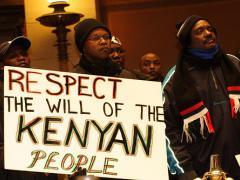
Kenya 2013: Just another election?
Main content
Åse Gilje Østensen (UiB) in conversation with Arne Tostensen (CMI) and Bård Anders Andreassen (UiO).
On the fourth of March 2013 the Kenyan people voted for the first time in a national election since 2007. In the aftermath of the last election, over 1.100 Kenyans were killed in election-related riots, and the election was therefore both greatly anticipated and somewhat feared.
The results showed that Uhuru Kenyatta (Jubilee Coalition) got 50.07% of the votes, just enough to defeat his rival and early favorite, Raila Odinga (CORD). But Odinga has not accepted the validity of the election results, and the Cord-alliance has submitted a legal complaint about the election process and results to the Kenyan Supreme Court.
Was the 2013 Kenyan election free and fair? Where does Kenya go from here, with a President-elect charged in the ICC in The Hague? How will the aftermath of the election play out, and who will be left with the power to rule Kenya for the next years?
With us in this breakfast-forum are Kenya-experts Bård Anders Andreassen (UiO) and Arne Tostensen (CMI). Andreassen is a professor at the Norwegian Centre for Human Rights, and has this year been a designated election observer for the European Union Observation Mission at the Kenyan election. Andreassen has carried out a number of research projects in Kenya over the past twenty years. Tostensen is a Senior Researcher at CMI, and has worked on Kenyan politics since the mid-1980s. He has observed and published extensively on past elections in Kenya.
As always, juice, coffee & croissants will be served - all welcome!