PhD programme at Faculty of Fine Art, Music and Design
On this website you will find information about the PhD programme in artistic research at the University of Bergen, Faculty of Art, Music, and Design (KMD). For information on the scientific PhD programme within the fields of musicology, music therapy, and music education, please see one of the red boxes.

Main content
Admission and financing
Admission to the PhD programme
Most PhD candidates are employed in fixed-term positions (3 or 4 years) as research fellows associated with one of the 3 departments at KMD. When the research fellows are employed, they are simultaneously admitted to the PhD programme and integrated into a research community.
Others, such as research fellows and employees in recruitment positions at other institutions, must apply to the faculty for admission to the PhD programme (attach link to the digital application form for admission to the PhD programme.
To be admitted as a PhD candidate at KMD, one must meet formal requirements for funding, qualifications, and project description.
Formal Requirements for Funding
All those not employed in a research fellow position at KMD, such as research fellows and employees in recruitment positions at other institutions (including other faculties/departments at UiB), must have secured funding in advance. The funding must cover the entire educational period and include both living expenses and costs related to the artistic research project.
It is not possible to apply for admission based on self/private funding. Other sources of funding can be by agreement with your regular employer or programmes/scholarships for external financing.
See budget template for the research fellow's operating budget.
Formal requirements for Qualifications
Applicats must, as a rule, have a five-year master's degree in performing or creative arts, in accordance with the descriptions of qualification frameworks at level 7. The faculty itself may, upon special assessment, approve other equivalent education as a basis for admission, including equivalent artistic competence.
Formal Requirements for Project Description
The application must include a project description (up to 3000 words) and a progress plan.
Other Factors
See more details about application requirements in the announcement text for research fellow positions at KMD on vacant positions at UiB. Candidates employed at the faculty normally have residency requirements.
PhD Agreement
Admission to the PhD programme at the faculty is valid for three or four years, depending on whether mandatory work is included in the funding period. All those admitted must enter into a written agreement about this. The PhD agreement is sent to the candidate along with the admission letter and must be returned to the faculty in completed and signed form. The PhD coordinator submits the agreement to the dean for signature.
Shortly after employment, the faculty will send the candidate a PhD agreement consisting of 2 parts (part A and B). However, PhD candidates not employed at UiB will receive an agreement consisting of 3 parts (part A, B, and C). The agreement should be concluded as follows:
Part A: A general part to be completed by all those admitted to a doctoral programme. The parties to the agreement in part A are the candidate and UiB through the faculty and department.
Part B: Agreement on academic supervision in the doctoral education to be completed by all students admitted to a doctoral programme. The parties to the agreement in part B are the candidate, supervisors, department, and faculty. All appointed supervisors must be included in the agreement. Any changes to the supervision agreement should be stated in part B, attachment 1.
Part C: Agreement between the external institution and UiB regarding the implementation of doctoral education. Only relevant for candidates who are employed at another institution.
Each candidate is responsible for ensuring that the agreements are signed and returned to the faculty within a specified deadline. After the PhD agreement is returned and signed by the faculty, the admission process is considered completed.
Admission Period and Study Rights
Candidates are admitted to the PhD programme for a specified period, usually 3 or 4 years, with a predetermined end date. The total admission period of 6 years includes any extensions of the admission period due to valid leaves (e.g., maternity leave, sick leave, etc.).
The PhD ducation is normed to three (3) full-time equivalent years.
It is not permitted to plan the completion of the PhD education with a progression that extends the agreement period beyond six (6) years. The faculty may have stricter requirements for progression in its supplementary regulations.
The agreement period is extended in accordance with legally mandated leaves. Candidates are responsible for reporting and documenting such interruptions themselves. The agreement period may be extended on other grounds upon application to the faculty.
Contact hrkmd@uib.no for information on extended funding dates after legally mandated leaves.
Semester Registration
Semester registration in Studentweb is mandatory for PhD candidates during the agreement period. Semester registration is important to maintain the right to study even though candidates in the PhD programme in artistic research do not enroll in courses or approve the education plan in Studentweb, as is done in the scientific PhD programmes. Note that there is no semester fee.
Deadline for semester registration: September 1st for the autumn semester and February 1st for the spring semester.
Have you missed the deadline?
Send an email to the faculty and request an extension of the semester registration.
Current Regulations
Regulations, section 5-3. Agreement period
Supervision
Upon admission to the PhD programme, at least one supervisor must be appointed. The faculty appoints a primary supervisor based on suggestions from the department. The appointment is formalised in the PhD agreement, part B Agreement Concerning Academic Supervision. Typically, the primary supervisor should be employed at the faculty. If the main supervisor is exceptionally external, a co-supervisor employed at the faculty must be appointed.
- All supervisors must hold a doctoral degree or equivalent artistic competence and be active in their field.
- External supervisors must present an academic CV (links to websites with biographies are not sufficient).
- The supervisor agreement for the primary supervisor typically includes a total of 180 working hours for the entire study period, estimated at 60 working hours per academic year, of which at least 20 hours per academic year should involve direct contact between the research fellow and the supervisor.
- For the co-supervisor, the agreement typically includes a total of 120 working hours for the entire study period, estimated at 40 working hours per academic year, of which at least 15 hours per academic year should involve direct contact between the research fellow and the supervisor.
- If multiple co-supervisors are appointed, their working hours should normally be covered within the total supervision resource of 300 hours for the entire study period. The distribution of this resource should be specified in such cases.
- PhD candidates are encouraged to meet with their primary supervisor once a month, either digitally or in person.
- The frequency of contact should be reflected in the annual progress reports.
Mandatory supervisor training
10 % of the supervisors' working hours should be allocated for participation in mandatory supervisor training and professional gatherings organized by the faculty or the National Research School in Artistic Research.
Appointment of external Supervisors
Supervisors are appointed by the faculty itself. The department sends information with a contact point and an academic CV to the faculty with details on when the supervision relationship is to commence, including a brief explanation and CV based on the Regulation section 6.2 Appointment of Supervisors. The PhD agreement Part B: Agreement Concerning Academic Supervision shall be used to formalise the appointment and should be signed by the candidate, supervisors, department head and the faculty. All external supervisors should receive an appointment letter detailing compensation, the total number of supervision hours, and the duration of the appointment (normally within the funding period). The faculty sends the external supervisor an appointment letter and collects personal information for payment. External supervisors are compensated in arrears.
Change of Supervisors/Co-supervisors
The candidate and primary supervisor can individually request the faculty to appoint a new supervisor for the candidate. The primary supervisor cannot resign until a new one is appointed. The faculty must be promptly notified of any changes in supervisors. As a rule, the supervisor agreement includes 60 working hours per year for the primary supervisor and 40 working hours for the co-supervisor during the agreement period. If supervision hours are to be distributed differently or within more than two supervisors, the distribution of hours must be specified in the PhD agreement, part B Agreement on Academic Supervision, which is signed by the candidate, supervisors, department/institute, and the faculty.
Current Regulations
Regulations section, 5-2 Admission decision
Training Component
The training component consists of two components:
1. Common Mandatory Component (20 ECTS)
2. Individual Component (10 ECTS)
Both components are generally to be completed after admission to the PhD programme and must be completed and approved before the artistic reflection is submitted.
The common mandatory component is organized directly by the National Research School. Registration for the research school’s activities is done through the institution (KMD) by filling out a progress plan with dates for the desired registration shortly after admission to the PhD programme. The progress plan is signed by the candidate and the main supervisor and sent to phd.kmd@uib.no for registration.The course plan and more information about the academic year can be found on the research school’s website.
Cancellation of courses must be reported to phd.kmd@uib.no no later than three months before an activity, except for unforeseen, such as illness.
You will receive information directly from the research school regarding preparations and practical matters regarding seminars and Artistic Research Forum. Contact the research school directly at pku@hkdir.no if you have questions about the content of the training.
The candidate and supervisor must, as soon as possible and no later than three (3) months after admission, together create a plan for the individual component.
The main supervisor and the head of the department are responsible for the academic assessment of the individual training plan. Both approve the proposal by signing before the plan is sent to phd.kmd@uib.no for archiving in the candidate's study file. At the bottom of the template, there are examples of activities that are approved in the individual training part. Examples of plans/activities that the programme usually cannot approve:
- Plans with too many ECTS (only activities equivalent to 10 ECTS are listed)
- Plans with incorrect ratios between the number of working hours and the number of ECTS (1 ECTS corresponds to 25-30 hours)
- Plans with activities that do not qualify as training, including:
- Publication of mid-term evaluation
- Solo exhibition
- Presentation for own research group (We assume that everyone presents their projects to KMD's academic environments without it triggering ECTS)
- Visit to art exhibition/biennale/festival
- Research trip
It is not inconceivable that a research trip or visit to an art exhibition, biennale, festival can qualify, but the candidate must explain which activities related to the trip, festival visit, etc., constitute training. Usually, it must be assumed that training involves the candidate receiving some form of instruction, assessment, critical feedback, etc.
Documentation of training
All components included in the training part must be documented. Please note: The candidate cannot register for courses or activities in Studentweb themselves. This is done by the faculty.
Common mandatory component: As soon as the candidate has completed all activities (20 ECTS) according to the progression plan, the course will be registered as completed in Studentweb. The registration is carried out by the institution based on confirmation from the research school that the candidate has fulfilled the common mandatory plan.
Individual training component: Documentation of activities completed in accordance with the approved individual training plan must be sent continuously to phd.kmd@uib.no for registration. Please see the guidance at the bottom of the individual training form for information on the required documentation when there is no course certificate available.
SAAR may replace training components from the research school or the individual training part
SAAR – Summer Academy for Artistic Research may replace one of modules 2–4, depending on the content of SAAR that year. For example, if the programme does not include specific content on ethics, it cannot replace module 3, but may potentially replace module 2 or 4. Each case must be assessed against the learning outcomes of the relevant module, and it is the institution that decides whether SAAR can replace a module.Applications to replace a module with SAAR must be sent to phd.kmd@uib.no and must include information about the course/programme content.
Participation in a presentation at an interdisciplinary, international conference may replace 1xARF, provided the workload is equivalent. Applications to replace an ARF with a presentation at another international, interdisciplinary conference must be sent to phd.kmd@uib.no. The application must include documentation confirming the interdisciplinary and international nature of the event.
SAAR and conference presentations may also be included in the individual training component. In general, we recommend that our candidates do not replace components from the National Research School. It is a well-developed programme that ensures interdisciplinary exchange and strong networks among candidates at Norwegian institutions.
Final approval of the completed training component
The training component must be completed and approved before the artistic reflection is submitted. All elements included in the training component must be documented.
When the candidate has been approved for 30 study points in their training plan, this will be visible in Studentweb. The main supervisor and department head shall confirm that the candidate has completed the mandatory training component (30 credits) in accordance with the requirements of the PhD programme in artistic research by signing the Final Approval of Training Component. The faculty makes a decision on the final approval of the training component by signing the form and attaching FS report 727.001 Education Plan, which is archived together with the form in the candidate's study folder.
Opplæringsdelen skal være gjennomført og godkjent før den kunstneriske refleksjonen innleveres. Alle elementer som inngår i opplæringsdelen skal dokumenteres.
Current Regulations
Progress Reportering
Annual and separate reporting on the progress of the project from the candidate and supervisor is required by November 1st each year. The candidate and supervisor share equal responsibility for reporting. Failure or inadequate progress reporting from the candidate may result in forced termination before the end of the agreement period. Supervisors who fail to follow up on reporting obligations may be relieved of their supervisory responsibilities. The faculty may, if necessary, demand separately reporting.
The faculty reviews and follows up on the reports. The reports will be made unavailable when the candidate is deregistered from the PhD programme.
Are you unsure whether you should report progress? (Norwegian text only)
Current Regulations
Midway evaluation
Midway evaluation typically takes place in the third or fourth semester (for a 3-year programme without mandatory work) and in the fourth and fifth semesters (for the 4-year study programme). Please see the faculty's guidelines for midway evaluation.
Preparations for the midway evaluation
THE MAIN SUPERVISOR:
- informs the faculty when the midway evaluation is planned (preferably 6 months before).
- suggests an external committee member to the department
- sends the completed for the supervisor's report to the faculty in due time for distribution to the committee one week before
THE HEAD OF DEPARTMENT:
- appoints the committee and sends an email to the faculty with information about the external member (name, position, institution, email address, and academic CV)
- Is the leader of the committee. The committeee writes a report which is sent to phd.kmd@uib.no.
THE CANDIDATE:
- sends documentation (or a link to the exposition in Research Catalogue) of artistic results and reflection, revised project description, updated and approved plan for the 10-credit individual training component, and updated budget in time for the faculty to forward the documents to the committee three weeks before
- sends information about the project to the communication group for calendar posting no later than two weeks before midway. See information about calendar postings below
- sends the completed form for the candidate's self-report to the faculty in due time for distribution to the committee one week before
The candidate shall present preliminary artistic results, as well as the status of the artistic reflection, focusing on contextualization, theory, method, and artistic choices and turning points. The presentation is public and scheduled to last approximately 45 minutes.
Calendar posting on the KMD website
The communication group creates calendar postings for the public midway evaluation. Two weeks before the midway, the candidate sends the following to kommunikasjon@kmd.uib.no:
- Title and summary
- A wide image/header image
- Date, time, and location of the mid-term evaluation
- Zoom link (if applicable)
- A text describing the project/presentation and preferably a short bio. It is advantageous if the texts are prepared in both Norwegian and English, but this is optional
Examples of previous midway evaluations:
https://kmd.uib.no/en/Calendar/Public-Lectures/midterm-assessment-karen-werner
https://kmd.uib.no/no/kalender/disputas-og-midtveisevaluering/midtveisevaluering-soren-thilo-funder
Current Regulations
Candidate's To-do List
- Familiarize yourself with the Regulations and Programme Description (pay special attention to section 3.1 Mandatory activities and work methods in the Programme Description).
- Attend an information meeting with the supervisor and the PhD Coordinator.
- Sign the PhD agreement.
- Plan for interdisciplinary training at the National Research School and set up a progress plan for registration for the research school's activities as soon as possible.
- As soon as possible and no later than three (3) months after employment/admission, review the project description and budget with the main supervisor to assess any need for adjustments, in addition to preparing a plan for the individual training component (10 ECTS). Significant changes to the project description must be approved by the faculty itself. Revised documents and the individual training plan (signed by the main supervisor) should be sent to the faculty.
- Submit documentation of individual training continuously to the faculty for approval and registration in Studentweb.
- Credit the institution when it has made a necessary and substantial contribution to or basis for the published work, such as in public exhibitions/concerts.
- Plan for the midway evaluation (preferably 6 months in advance) in the 4th/5th semester (4-year programme) or 3rd/4th semester (3-year programme).
- Submit the revised project description, individual training plan, and budget to the faculty 3 weeks before the midway evaluation.
- Submit the candidate's self-report to the faculty 1 week before the midway evaluation.
- Sign the committee report for the midway evaluation as confirmation that it has been read.
- Prepare for the obligatory final seminar 3 months before applying for the assessment of the PhD result.
- Attend a follow-up meeting after the end seminar if the committee identifies significant weaknesses in the project. The meeting is held within two months after the end seminar and before applying for the final assessment.
- Decide whether the reflection part is submitted 4 weeks before or simultaneously with the presentation of the artistic result (to be specified when applying for assessment).
- Apply for assessment 5 months before the public presentation of the artistic result.
- Submit written comments no later than five (5) working days after the proposal for the composition of the assessment committee has been made known to the candidate.
- Submit a brief written summary of the PhD result in English and Norwegian, and a press release in Norwegian, which must be publicly available at least two (2) weeks before the public defence.
- After submission or presentation of the artistic result, apply for permission to correct formal errors, but only in the reflection part. The application must be accompanied by a list (errata list) showing the corrections desired.
- Archive the PhD result collectively through the faculty's research portal on researchcatalogue.net (or another approved system for public disclosure and permanent archiving) no later than two weeks after the public defence.
- Participate in the doctoral promotion at UiB for new doctors.
Supervisor's To-do List
- Familiarize yourself with the regulations (especially section 6. Supervision) and the programme description (especially part 3.2 Supervision).
- Start regular supervision (60 working hours per year for the primary supervisor and 40 working hours for the co-supervisor during the research period of 3 years, adding up to 300 hours over a 4-year period).
- Attend an information meeting with the candidate and the PhD coordinator.
- Sign the PhD agreement - Part B Agreement on academic supervision, which is sent by the candidate.
- Guide the candidate to plan for obligatory training with National Research School and sign the progress plan.
- Guide the candidate to set up an individual training plan and sign the document.
- Assist the candidate to review the project description and budget within 3 months after admission to the PhD programme.
- Participate in mandatory supervisor training organized by KMD or the National Research School (10% of working hours).
- Introduce the candidate to research groups, networks and professional environments
- Deliver progress report within November 1st each year by responding to systemmail from Surveyxact in October.
- Notify the faculty when the candidate is ready for the midway evaluation.
- Submit the supervisor's report to the faculty 1 week before the midway evaluation.
- Sign the committee report for the midway evaluation.
- Budget - follow up on expenses and the need for external funding.
- Supervision on research ethics (UiB RETTE, Etikk ved UiB, Research ethics at KMD)
- Involve in the planning of duty work/Dissemination (research group, conferences and networks)
- Sign the candidate's final approval of the training plan (30 credits)
- Notify the department head when the candidate is ready to conduct the final seminar.
- Write the minutes of meeting from the final seminar.
- Notify the faculty when the candidate is ready to apply for assessment.
- Check the attachments in the application and confirm that the artistic PhD result is at such a level that it can be submitted for assessment, and sign.
- Make sure the candidate’s description (Attachment 1) is precise enough for the committee to understand it, while not promising too much, giving the candidate some flexibility in finalizing the result.
- Check the list of attachments in programme description section 4.2 , particularly “Statement from cooperating partners” where this is required.
- Suggest assessment committee candidates to the department head.
- Assist the candidate if the assessment committee requires presentation of the candidate’s source material and additional information for the purpose of supplementation or clarification.
- Assist international candidates with Norwegian translation if needed (written summery of the PhD results and press release in Norwegian).
- Attend the public defence.
Regulations
National level
- Forskrift om ansettelsesvilkår for stipendiater (KD)
- Guidelines for Research Ethics in the Socal Sciences and the Humanities (NESH)
University of Bergen
Faculty of Fine Art, Music and Design
Guidelines and routines
Application and admission
Guide to writing a project description
Implementation
Guidelines for midway evaluation
Completion
Guidelines for obligatory final seminar
Guidelines for the Assessment Committee
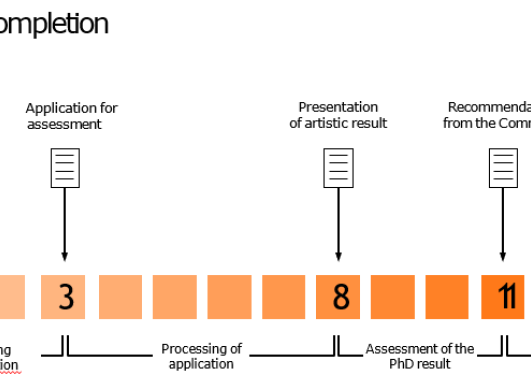
Timeline Public Defence
Procedure and manuscript for public defence
Routine for applying for additional operating funds
Various links
Avhandlingsportalen for the press release
Nasjonal forskerskole i kunstnerisk utviklingsarbeid
Grieg Research School in Interdisciplinary Music Studies
Forms
Application and admission
Application for admission to the PhD programme in artistic research
Agreement on admission to the PhD programme
Agreement on admission to the PhD programme - part B changes in supervision
Plan for the individual training component (10 ECTS)
Progression plan mandatory component (20 ECTS)
Template financial plan
Implementation
Midway evaluation - The candidate´s self report
Midway evaluation - The main supervisor´s report
Midway evaluation - The comittee´s report
Completion
Final seminar - Evaluation committee´s report
Final approval of the completed training component (30 ECTS)
Application for assessment of the PhD result
Declaration from collaborating partner
Proposal for members of Asessment Committee
Recommendation from the Assessment Committee - template
Errata - template
Declaration of impartiality