Marineholmen Innovation District: Scaling Blue Innovation
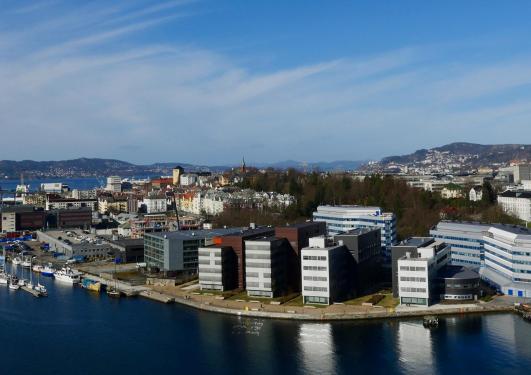
At the heart of Bergen’s marine knowledge cluster, Marineholmen exemplifies how co-located research, entrepreneurship, and sustainable infrastructure can accelerate the EU’s mission for a climate-resilient, innovation-driven blue economy.

Main content
For more than 130 years, Marineholmen has served as a driving force in Bergen’s marine science community. The city’s first biological station was established here in 1892, laying the foundation for world-leading research by pioneers like Michael Sars, Fridtjof Nansen, and Vilhelm Bjerknes. Today, Marineholmen is home to one of Norway’s most active innovation environments — a place where research, education, and entrepreneurship meet in close collaboration.
An Innovation Ecosystem Rooted in Science
Marineholmen is one of the most dynamic parts of Bergen’s innovation district. Located just across Damsgårdssundet from the University of Bergen’s main campus, the area brings together researchers, students, start-ups, investors, and public actors in close physical proximity. This co-location fosters interdisciplinary collaboration and knowledge exchange — key ingredients for research-based innovation.
With modern infrastructure, shared laboratories, incubators, and informal meeting spaces, Marineholmen supports the full pathway from basic research to applied solutions. For the University of Bergen, it is a strategic arena for developing partnerships and driving impact from scientific knowledge.
From Lab to Market
Through UiB’s collaboration with innovation partners such as VIS (Vestlandets Innovasjonsselskap) and StartupLab Bergen, researchers are supported in translating their work into new services, products, and companies. The innovation support system includes guidance on intellectual property, access to funding instruments, and tailored business development programs for science-based start-ups.
Marineholmen’s marine focus is reinforced by the presence of national and regional actors working in areas such as aquaculture technology, marine monitoring, and ocean sustainability — further strengthening the ecosystem’s role in blue innovation.

ILAB: Enabling World-Class Aquaculture Research
A cornerstone of this ecosystem is the Industrilaboratoriet (ILAB), which provides critical infrastructure for research and innovation in aquaculture. Located at Marineholmen, ILAB operates advanced research facilities that allow scientists and companies to test, monitor, and optimize biological and technical processes under controlled marine conditions.
ILAB’s facilities are essential for applied experiments in fish health, feed development, and environmental monitoring. These include state-of-the-art Recirculating Aquaculture Systems (RAS), experimental seawater tanks, and technical pilot-scale systems used by researchers, start-ups, and established industry actors alike.
We are dependent on ILAB to bridge cutting-edge research and industry needs, where ILAB provide a safe and scalable environment where new solutions can be tested, verified, and brought closer to market.
says Aina-Cathrine Øvergård, Associate Professor at the Department of Biological Sciences of the University of Bergen.
Technicians and engineers at ILAB work closely with research groups from UiB and other institutions to maintain optimal conditions for experimentation, ensuring high data quality and animal welfare standards. This enables long-term studies on everything from fish behavior to the efficiency of new aquaculture technologies.
In recent years, ILAB has supported projects ranging from sustainable feed trials to real-time data systems for aquaculture monitoring — contributing directly to Norway’s leadership in the blue economy.
A Place for People and Ideas
Marineholmen is not only a workplace, but also a meeting place. The area hosts a wide range of events and activities that connect research with education, public engagement, and societal needs. The annual “Et Hav av Muligheter” outreach event introduces high school students to career paths in ocean-related technology and science, while the “Passion for Ocean” festival raises awareness about marine sustainability.
These initiatives help ensure that UiB’s research environment is not only excellent, but also accessible and relevant to the wider community.
Built for Collaboration and Sustainability
Marineholmen’s physical environment has been designed to support collaboration and sustainability. Many buildings are environmentally certified, and cooling is provided using seawater drawn from the nearby fjord. Solar panels, bike infrastructure, and flexible workspaces contribute to an open and low-impact urban environment.
This combination of research infrastructure and sustainable design supports UiB’s goal of reducing its environmental footprint while fostering innovation.
Part of UiB’s Strategic Future
Marineholmen plays an important role in the University of Bergen’s strategy for innovation and external engagement. It enables researchers to connect more easily with industry, startups, and public partners — and to test and apply new knowledge in real-world contexts.
As challenges related to the ocean, climate, and sustainability become more urgent, the ability to collaborate across sectors and disciplines will be increasingly important. Marineholmen offers a model for how research environments can be embedded in broader ecosystems that support innovation, relevance, and societal benefit.