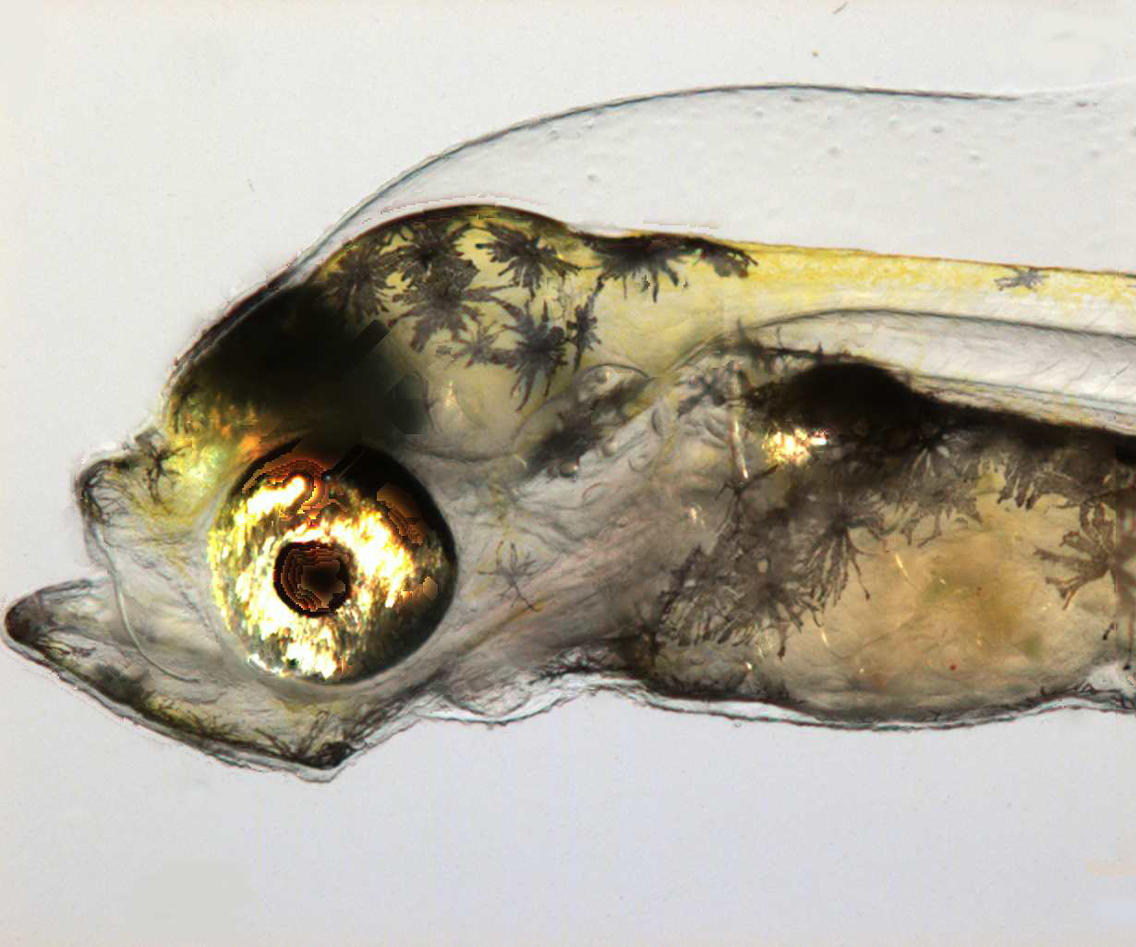
Increasing ocean acidification affects cod larvae
Two BIO researchers are authors on a Nature Climate Change paper.

Main content
Arild Folkvord and Audrey Geffen have been working with the effects of increasing seawater acidification on critical early life-history stages in cod. Their work shows that ocean acidification results in detrimental development effects in cod larvae; concerns that are relevant as given cod’s high economic importance. (Read article in Nature Climate Change)
Larval survival is critical to recruitment in fish populations – in the case of cod these populations are already at critical exploitation levels due to over fishing. At their earlier development stages the young can be particularly vulnerable to environmental changes as young larvae do not yet have fully developed organs and organ systems that can regulate chemical changes.
Folkvord and Geffen et al.’s results showed that critical phases in organ developments and internal re-adjustments coincided with visible damage being observed in cells and tissues especially that found in the liver, pancreas, kidney, eye and gut. The amount of damage increased significantly with level of acidification. Such damage also makes the young more vulnerable to bacterial infections and parasite attack.
While much of the damage disappeared after the gills matured and were then able to manage the acid regulation, questions can be raised about mortality rates for the early stages, and how many fewer larvae will survive to maturity in acidic ocean waters. This concern is particularly relevant for fish species such as cod that are relatively long-lived and have a relatively long generation time.
The experiments were carried out with German colleagues at the mesocosm facilities at UiB’s Marine Biological Station at Espegrend.
Read more in Nature News