Marine bio-optics and remote sensing
This aim is to get the best possible understanding about the optical properties of the ocean, and how this may be used to improve the methods for monitoring the marine resources. At the Department of physics and technology we have worked within this field for several years, and we are cooperating closely with the Department of biology at the UoB, and with research groups in the U.S., France, China and Uganda.
Main content
Did you know that light is one of the most important factors for growth of algae in the ocean, and that the algae are the primary food source, direct and indirect for nearly all organisms living in the ocean? The algae produce large amounts of the earths oxygen, and at the same time they absorb carbon dioxide, hence they may contribute to reducing the global warming. They are the original basis for the oil, they may be used as food, and they may give industrial products. An enhanced understanding of how the algae grow may be the key to a future industrial development.
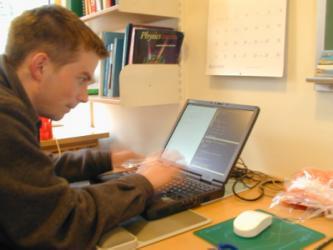
The visible part of the solar spectrum makes the algae capable of doing photosynthesis, while the ultraviolet (UV) part of the spectrum inhibit their growth. Hence, at the Optical physics group we investigate how the UV and the visible light propagates through the ocean, and how the intensities at different depths in the ocean influence the growth of the algae. This work is done by combining computer simulations, field measurements, and controlled experiments in our marine-optical laboratory.
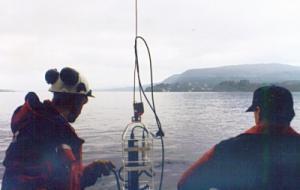
An important part of the field work is to measure the intensity of light at different depths in the ocean, and to take water samples that we analyze to find the amount of, and which species of algae the water contains. Another way to measure the amount of algae is to use instruments onboard satellites to measure the intensity of light at different wavelengths that are reflected from the ocean.
Algae exists in different sizes and shapes (the figures above give examples on spherical and cylindrical shapes). To be able to simulate propagation of light we need information on how light is absorbed and scattered when it interacts with various kinds of algae. Therefore, we also work on calculating and measuring how light is absorbed and scattered when it hits particles of various shapes.
Not all algae growth are beneficial. Occasionally we observe blooms of harmful algae. These blooms may have unfortunate consequences for the fish farming industry. It is therefore important to develop methods that make us capable of discovering and monitor the growth of harmful algae.
One of our long-term goals is to be able to use a combination of measurements from satellites, measurements from boats, and computer models to obtain increased knowledge about how light affect the growth of algae in the ocean. This knowledge will be used to monitor and manage the marine resources in the best possible manner.