Systems thinking and creative problem solving
This course fosters new thinking and practical solutions for sustainable development, preparing PhD candidates to make a meaningful impact. Collaborating with private and public sector institutions, candidates work on real-world problems, gaining hands-on experience.

Main content
This course works with both private and public sector institutions (problem owners) who furnish PhD candidates with an applied context and specific sustainable development problems. The problem owners vary from one course to the next.
The PhD candidates receive practical guidance as well as input on theory, methods and techniques in systems thinking and creative problem solving. They apply this knowledge in interdisciplinary groups to explore, generate new thinking and develop solutions for these problems. The goal is to produce a policy brife of real value to the private or public sector institutions providing the problem of the year
This course equips PhD candidates with both theoretical and practical skills to tackle complex sustainable development challenges.
Systems thinking over the years
During the pandemic (2020 - 2022), when the summer scool was organised as an online event with interactive sessions, we recruited facilitators to lead the groups (10-15 participants in each group) in the hands-on experience with systems mapping. In the facilitation manual (pdf) you may check out the sample maps we used in the group sessions.
The systems thinking course has been an integral part of the Bergen Summer Research School since 2021. Here are some highlights from past years:
2021: Science and society towards the Sustainable Development Goals
In the interdisciplinary sessions at BSRS 2021, we collaborated with SDG Bergen, and specifically focused on the SDG Bergen Policy Brief series.
The task for our participants was to develop their own policy brief about a Sustainable Development Goal (SDG) nexus, that is, the interlinkages between targets and goals, optimising positive interactions and minimizing negative ones. Specifically, participants were asked to:
- select specific targets / indicators and give policy recommendations directly on these, based on own and/ or others’ research
- think "local experience – global relevance" when preparing their briefs, something that is particularly important for making the policy brief relevant to policy makers
The policy briefs:
- We need to discuss degrowth
- Educating the Public on sustainable fish consumption
- Community access to renewable energy
- Leveling the playing field for women in STEM
- Climate displacement education
- Marine plastic pollution
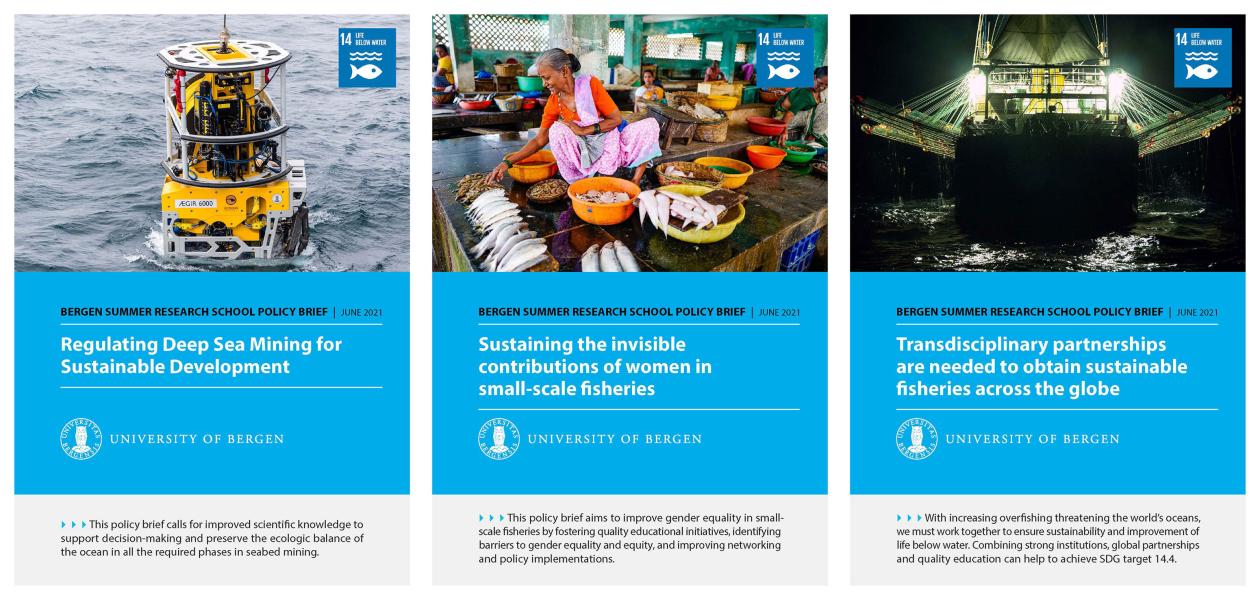
- Women in small-scale fisheries
- Sustainability vs Starvation
- Deep sea mining
- Sustainable fisheries
- Equal access to quality education
- Fishers’ climate knowledge
- Water scarcity and gender
- Transport systems for gender equality
- Poverty and equality during the pandemic
- Food and nutrition education
- Subsidies and fishing
The 17 BSRS policy briefs produced entered a competition in which up to three would be turned into SDG Bergen Policy Briefs. These were:
2022: Understanding and addressing inequality
At BSRS 2022, we collaborated with UNICEF with the challenge to envision policies to address individual citizens, institutional managers, national policy makers and private sector executives – seeking to give every citizen the possibility to live up to their potential, starting with a satisfaction of their basic needs. Specifically, the participants were asked to shape policy recommendations that:
- embrace each dimension (individual, family, society, planet)
- allow a gradual implementation by international organisations (i.e.UNICEF)
- are underpinned by the understanding that individual wellbeing is the cause and consequence of collective wellbeing
Heare are the ten policy briefs:
- A holistic approach to child welfare in addressing the root causes of child labour
- Ensuring children’s wellbeing: A special focus on the poverty issue of Rohingya refugee community in Bangladesh
- Influencing inequality through immunisation
- Target female access to education to reduce childhood poverty
- Equitable access to quality education in Nairobi, Kenya
- Policy recommendations addressing child poverty in Indonesia with a focus on education
- Tackling the burden of malnutrition arising from child poverty in LMICs. A holistic approach
- Increasing immunisation in the Sub-Saharan countries
- Poverty, children and the use of information and communications technology
- Reducing child poverty through child education
2023: Childhood — Nurturing care for building the future
In 2023, we collaborated with SOS Children’s Villages. The challenge this time was to develop policy briefs on some burning questions related to child protection and welfare, like:
- Should a child's party status change from age 15 to age 12?
- How to deal with the right of children and parents to reunification and contact?
- Should Norway strengthen services for unaccompanied refugee minors between the age of 15 and 18 years?
After three years, the summer school was back as an in person event with about 70 participants. The nine groups each delivered a policy brief:
- Reunification & child protection rights
- A child’s rights to a family right
- Voice but no choice
- No child should be left behind
- Family reunification is the right of every child
- The quest for identity
- Where do we belong
- Towards a more equitable Norway
- Right of children and parents for reunification and contact
2024: Education 2030 and beyond —Addressing global challenges
This year, we collaborated with UNESCO International Institute for Higher Education (UNESCO IESALC) with the challenge to develop policy briefs on the contribution of higher education institutions to the Sustainable Development Goals.
The briefs were to focus on the social, environmental or economic goals and their most important nexuses. Participants explored the role of teaching, research, engagement, and governance in achieving SDGs.
Teams with high-quality drafts would be turned into short blog posts on UNESCO IESALC’s website, or be invited to co-author a publication with a UNESCO policy analyst. Here is an overview of the ten BSRS policy briefs:
- The role of Higher Education Institutions in improving early warning systems for global health risks in case of a novel pandemic
- Advancing green campus initiatives through a decolonial approach
- Closing the gap between academia and policy: Enhancing Higher Education Institutes’ engagement for Public Health and the SDGs
- The contribution of Higher Education Institutions to decent work and economic growth
- Engaging global communities: The role of Higher Education Institutions in combating antibiotic resistance for a healthier future
- Environmental education in Higher Education Institutions
- Higher education’s role in reducing the burden of non-communicable diseases by promoting health literacy in low and middle-income countries
- Higher education institutions as change agents in climate action for people with disabilities
- Enhancing research funding efficiency and equity in higher health education institutions
- Rethinking higher education in light of climate action (SDG13): Harnessing traditional knowledge to mitigate and adapt the impact of climate change

Learning festival: One of the BSRS 2023 teams presenting their systems thinking work.
Key components
- Systems thinking & creative problem solving
Candidates receive guidance on theory, methods, and techniques, applying this knowledge in interdisciplinary groups to develop innovative solutions. - Hackathon
A three-day event where candidates use early-stage design concepts like empathise, define, ideate, prototype, and test to solve problems.
More information about the course
Course stages
- Understanding the problem
Research and workshops with problem owners to grasp the problem's context, including power dynamics, incentives, and cultural norms. - Literature study
- Creating and preparing for impact
Intensive hackathon sessions to develop and test solutions.
This integrated approach fosters new thinking and practical solutions for sustainable development.