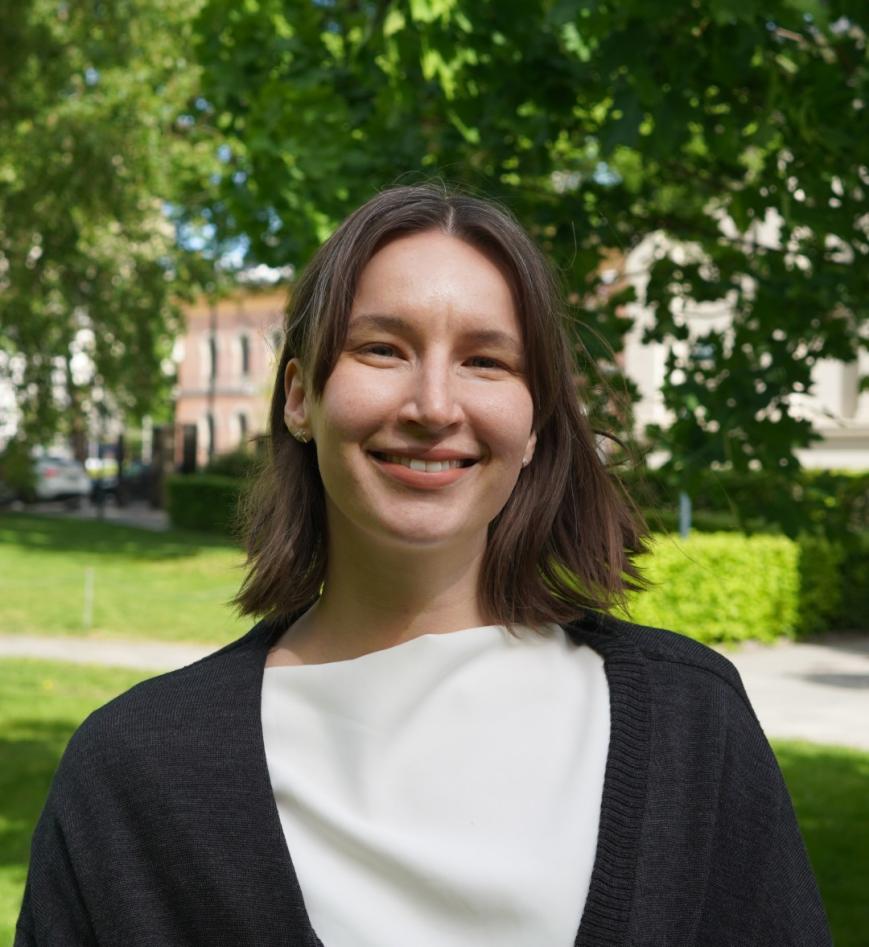
Kelly Solem-Young presented at the University of Oslo
Kelly Solem-Young recently presented key aspects of her doctoral research project to the Faculty of Law at the University of Oslo.
Main content
Solem-Young recently gave a presentation at the Department of Public and International Law at the University of Oslo, titled “The Significance of the Purpose of Punishment in Selected Penal Sanctions and Aspects of Sentence Enforcement.” In her talk, she examined how the purpose of punishment influences the courts’ choice between unconditional imprisonment and community sentences, as well as the Correctional Services’ decisions to grant or deny applications for electronic monitoring (ankle bracelet) for individuals sentenced to imprisonment.
In her presentation, Solem-Young raised several questions concerning the interpretation of the purpose of punishment as a legal condition under the Penal Code and the Execution of Sentences Act, and more broadly, the relationship between the role of the courts and the tasks of the Correctional Services.
– In order for the courts in Norway to impose a community sentence, the “purpose of punishment” must not weigh against it. The courts often state that “the purpose of punishment does not preclude the imposition of a community sentence,” without elaborating on what that purpose entails beyond referring to “general prevention and individual prevention” – a formulation I myself used while serving as a deputy judge. But what do these expressions actually mean, and why do they support one form of sanction over another? And what does it tell us about the coherence of the legal framework when the courts may impose an unconditional sentence based on the purpose of punishment, yet the Correctional Services may subsequently decide that the same individual is eligible to serve the sentence with electronic monitoring, in part because the purpose of punishment does not speak against it? These are, in my view, highly interesting questions that I intend to explore further in my doctoral research – questions for which I also received valuable input from the audience at the University of Oslo.