Quantum physics may hold the key to detecting cancer early
Imagine a blood test that works like a car’s dashboard, warning you before cancer develops. Researchers in Bergen are using quantum physics and diamonds to make that possible.

Main content
“Think of your car’s dashboard. Warning lights tell you when something is wrong. Our bodies don’t have that kind of dashboard. Fever or pain can mean many things – but nothing tells you if cancer is developing at a very early stage. We want to create those missing indicators,” physicist Justas Zalieckas at the University of Bergen says.
Why early detection matters
Around 11,000 people in Norway die from cancer every year, making it the country’s most common cause of death. Many treatments work far better if the cancer is detected at an early stage – long before symptoms appear.
But to detect cancer that early, we need tools that can spot extremely small amounts of biological molecules (biomarkers) in the bloodstream. Quantum physicists at UiB believe their methods can be part of the solution.
The second quantum revolution meets cancer biology
About a hundred years ago, in 1925, Werner Heisenberg introduced quantum mechanics. That milestone triggered the first quantum revolution, leading to lasers, transistors and MRI scanners – the foundation of today’s technology.
Researchers are now talking about a second quantum revolution, where quantum states are not only observed but actively manipulated for computation, communication and sensing.
A study, led by researchers at the University of Bergen in collaboration with colleagues from other institutions, is part of this shift.
The researchers use tiny defects inside diamonds, called nitrogen-vacancy (NV) centres, to detect microRNAs that are otherwise extremely difficult to measure. We can think of NV centres as tiny quantum ‘ears’ inside a diamond, listening for faint signals from molecules.
MicroRNAs: tiny molecules with big diagnostic potential
MicroRNAs are very short RNA molecules that help regulate gene activity. When diseases like cancer develop, the levels of certain microRNAs become abnormal. Small amounts of these molecules leak into the bloodstream, making them promising biomarkers.
“But the concentrations are extremely small. It can be detected using advanced laboratory methods, but this is far too labour-intensive and expensive for large-scale, everyday screening. We need another type of technology,” physicist Justas Zalieckas says.
The researchers’ idea was to use defects inside diamonds as quantum sensors. NV centres are extremely sensitive to magnetic noise – and this is the key.
By preparing NV centres with laser light, manipulating them with microwaves and reading out their quantum states, the team can infer what is happening directly on the diamond surface.
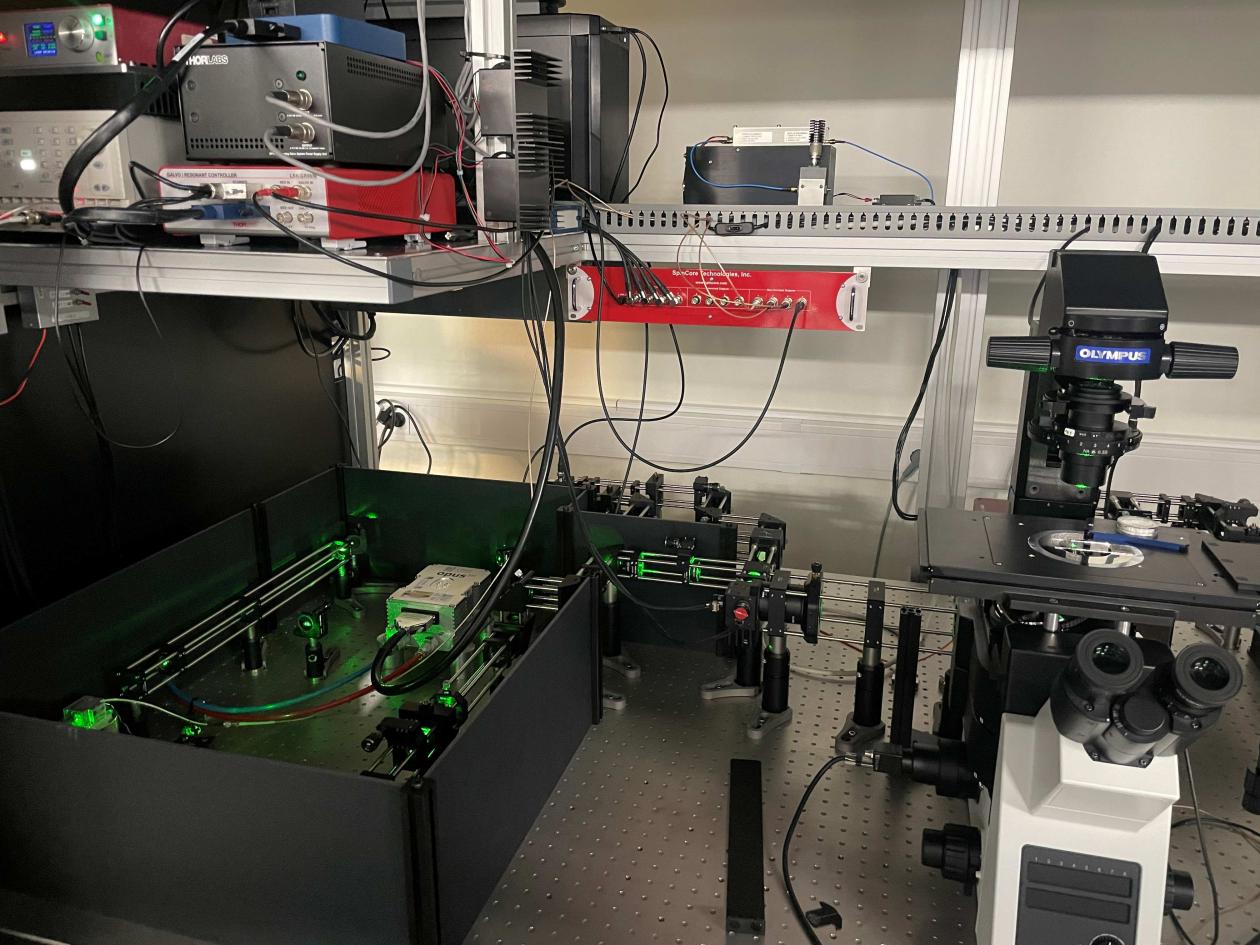
Built a new microscope
To check if the method works, the team combined lab experiments with computer simulations.
“We built a quantum diamond microscope and demonstrated that NV centres can pick up the magnetic noise signature created by microRNAs interacting with ions. Our molecular simulations confirmed what we measured. This gave us full confidence that the effect is real,” Zalieckas explains.
The researcher’s method allows for multiplexing – meaning that they could detect many different microRNAs at once.
“That is important. There are thousands of microRNAs, and the more you can sense simultaneously, the more precise the diagnostics can be,” Zalieckas says.
Focusing on pancreatic cancer
Zalieckas and colleague Martin Møller Greve are initially focusing on one of the deadliest cancers – pancreatic cancer.
“Studies show that a panel of around 30 different microRNAs can be used to detect it early and with high accuracy. We want to develop a technology that can make this kind of screening available to everyone. But this will take time. Years of development and regulatory approval before anyone can use it, Zalieckas says.
A long road of trial and error
Building the quantum diamond microscope and testing the method took years.
“Nothing works in the beginning. You tune, tweak, try again. You have to get used to failing every day. It’s part of the process. But every mistake teaches you something,” Zalieckas says.
The next step is to demonstrate detection of several types of microRNA at the same time, especially those linked to pancreatic cancer. If successful, the researchers hope to eventually move toward commercial applications.
“Quantum phenomena are profoundly strange. They don’t behave like anything in our everyday experience. The fact that we can use them for our benefit is remarkable,” Zalieckas says.
Reference:
Justas Zalieckas, Martin M. Greve, Luca Bellucci, Giuseppe Sacco, Verner Håkonsen, Valentina Tozzini og Riccardo Nifosì: Quantum sensing of microRNAs with nitrogen-vacancy centers in diamond. Commun Chem, 2024