Joefest
Celebrating Joseph Tabbi and 30 Years of electronic book review.

Main content
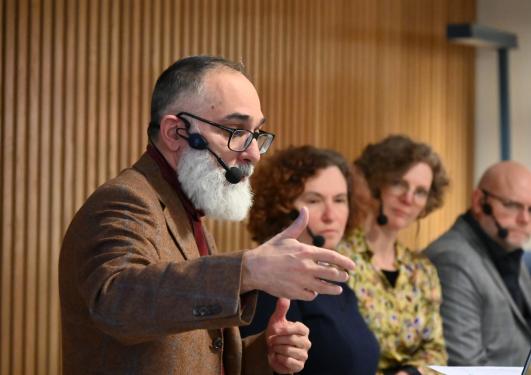
Joseph Tabbi is the founder of electronic book review, which is now celebrating 30 years of continuous publication, making it one of the first scholarly open access journals on the web. We celebrate him with Joefest, a seminar to his work.
See all recorded talks on our Youtube channel:
Joefest
Keynote by Steve Tomasula: "I Always Wanted to Be a Media Theorist Who…. Or, Reading with Joe Tabbi across Three Decades"
Steve Tomasula is the author of the novels Ascension; The Book of Portraiture; VAS: An Opera in Flatland, an acclaimed novel of the biotech revolution; TOC: A New-Media Novel and IN&OZ (University of Chicago Press). His short fiction has been published widely and is collected in Once Human: Stories. He is also the editor of Conceptualisms: The Anthology of Prose, Poetry, Visual, Found, E- & Hybrid Writing as Contemporary Art. More at: www.stevetomasula.com.
Speeches by Anna Nacher, Nick Montfort, Jill Walker Rettberg, Martin Paulsen, Eric Dean Rasmussen, Tegan Pyke, and Daniel Johannes Rosnes.
Followed by reception at the Center for Digital Narrative in Langes gate 1-3 from 16.00.
Joe Tabbi and ebr
Joe Tabbi is the author, most recently, of The Cambridge Introduction to Literary Posthumanism. He wrote the biography of the novelist William Gaddis, one of the most important modern/postmodern writers of the 20th century, Nobody Grew but the Business: The Life of William Gaddis. Tabbi is a scholar who has been consistently critically engaged with the various intersections of science and literature, as evinced in his monograph on cognition, self-reflexivity, and autopoiesis Cognitive Fictions.
electronic book review was founded by Tabbi and Mark Amerika, one of the first literary journals to be invented online, and remains a central locus for cutting-edge critical discourse, methods that challenge the status quo, and in-depth work addressing the digital future of literature, theory, criticism, and the arts.