Moving with children
Norway is considered to be a family-friendly country where the welfare politics makes it easier for couples and single-parents to combine work and family life
Main content
♦ Registering your child in Norway
Immigration
EU/EEA citizens: Register the child's right of residence with the police, then register the move with Skatteetaten if staying more than 6 months.
Non-EU/EEA citizens: Obtain a residence permit for the child through UDI, then register the move with Skatteetaten if staying more than 6 months.
Health care
General Practitioner (GP)
Children will be assigned a GP (fastlege) once registered in the National Population Register and becomes a member of the Norwegian National Insurance Scheme.
Child Health Centre (Helsestasjon)
Children aged 0–5 should be enrolled with their local helsestasjon, which offers routine health checks, vaccinations, developmental assessments, parental guidance.
Parents usually contact the local municipality's helsestasjon directly after arrival.
Child benefit
Many families may qualify for child benefit (barnetrygd) through the National Insurance Scheme, contact NAV to register your child if eligible.
♦ Childcare
Kindergarten
In Norway, kindergarten (known as barnehage) is a popular childcare option for families with young children.
It is designed for children aged 1 to 5 years, with many children starting when they turn one, as parental leave almost covers an entire year. In August of the year they turn six, children start primary school.
There are both public and private kindergartens, though in most cases they are very similar as they all follow national guidelines. Most commonly, parents choose the kindergarten that is the closest to their home or work due to logistical reasons. In addition, the fees are similar because they are capped by the government, making the costs low to ensure all families can afford the service.
Kindergarten is optional, but the vast majority of families use it. There is a legal right to a kindergarten place (rett til barnehageplass) from the August after your child turns one, provided you applied during the main application period.
The application process
You apply for kindergarten placement through the municipality where you live. In Bergen, this is done via the Bergen municipality's website. Main application deadline is March 1, for placement starting in August. You can apply outside of this period, but availability may be limited. If you need placement before or after August, it is suggested to contact the kindergartens directly for availability.
If you do not yet have your Norwegian ID number and BankID/MinID, you must contact the municipality at innbyggerservice@bergen.kommune.no.
Kindergarten for employees at UiB
Many kindergartens, especially those linked to universities or international communities, are familiar with helping families from abroad. Staff often assist with settling in, explaining Norwegian childcare culture, and supporting your child’s language development.
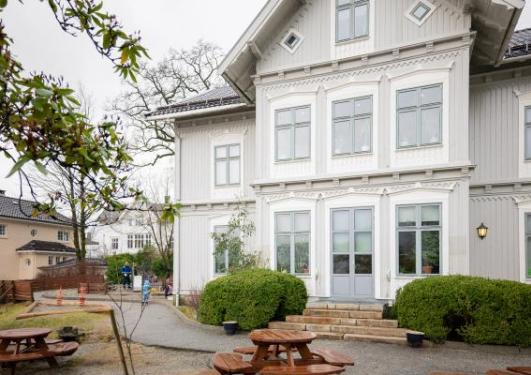
The university has an agreement with Fagertun kindergarten which is run by the Student Welfare Organisation (Sammen), but is owned by the University of Bergen. The kindergarten prioritizes children of employees and visiting researchers.
You can also find the list of all kindergartens in Bergen at the municipality webpages.
Other alternatives
Staying home
It is an option to stay home with your child/children if you have a partner that has this option. If you do this, you may be eligible to receive support in terms of child care benefit from the National Insurance Scheme (Nav).
An option to meet other children and parents is open kindergartens (åpen barnehage). Children are always accompanied by a parent or carer and has limited opening hours. It is an arena for children to play and socialize and for parents to meet others in similar situations.
Nanny (dagmamma)
Hiring a "dagmamma" is often the only way to take care of your child/children if both parents are working and do not have a placement in kindergarten. It is not very common, as it can be quite expensive, but you can still find some alternatives.
♦ The Norwegian school system
Norway offers a high-quality, publicly funded education system that focuses on inclusion, equality, and student well-being. Education is free and compulsory for all children aged 6 to 16, but schooling continues beyond that with a variety of options.
- Primary School (barneskole) – Grades 1 to 7 (Ages 6–13)
- Lower Secondary School (ungdomsskole) – Grades 8 to 10 (Ages 13–16)
- Upper Secondary School (videregående Skole) – Typically Ages 16–19
After upper secondary schools: higher education, apprenticeships for vocational students, entering the workforce.
Admission
For admission to public primary and secondary school, you should contact the school directly. The rule for childen in primary school age is that they attend the school closes to their home. If you are unsure which school to contact, reach out to Bergen municipality.
Language
Pupils in primary/lower secondary school and upper secondary school are entitled to special tuition in the Norwegian language, tuition in their mother tongue and/or bilingual tuition in school subjects if they do not have sufficient Norwegian skills to follow ordinary tuition. Read more about Norwegian language tuition at bergen.kommune.no.
Children may also receive this training through;
- parents or guardians who take responsibility for the training under municipal supervision
- admission to a private elementary school approved by the Ministry for Private School Act
Change of Public School
Pupils may move to another school than their local school when there is a good reason for this. In most municipalities, it is common that such applications will be met as long as there is an open spot at the requested school.
Public Schools
A list of public schools in Bergen
Private Schools in Bergen
Private schools are not common in Norway, but in the Bergen area there are some options:
- The International School of Bergen
- St.Paul´s Catholic school
- The Rudolf Steiner´s School in Bergen
- The Montessori Society in Bergen
Homeschooling
Home schooling, or home education, is not common in Norway. Parents who opt for homeschooling take full responsibility for their child’s education. The municipality must be notified, and local authorities have a duty to ensure that the child receives an education equivalent to the national curriculum. This typically involves periodic supervision or assessments.
General Information:
Ministry of Education and Research: The Norwegian Education System
New in Norway: The school system
Kindergarten application deadline
The enrollment in kindergarten is not flexible. Be aware that the application deadline is March 1st and that assumed starting time is in August. For flexible starting time, contact the kindergartens in your area.
Daycare
UiB staff and guests can apply for childcare at UiB's kindergarten Sammen.
Guest researchers
Guest researchers who are staying in Norway for a limited time may contact UiB's kindergarten Sammen for children aged 1-5. From age 6 you may look into The International School of Bergen. Remember to get national IDs for you children so they may attend kindergarten/school.