Functional Metagenomics

Main content
*Project name: Functional Metagenomics to Study Prokaryotes from Arctic and Subarctic Springs of Hydrothermal Origin
*Project coordinator: Christa Schleper
Researchers involved: Laila Reigstad
*Project period: 2005-2010
*Project's main Objectives:
Prokaryotes comprise two of the three Domains of Life, the Archaea and Bacteria. Having evolved about 3.8 billion years ago, 2 billion years longer than eukaryotic organisms, they have an extraordinary diversity and habitat range compared to the eukaryotes.
The principle objective of this project is to uncover and compare the genomic diversity and physiological potential of as yet uncultivated hyperthermophilic archaea and bacteria from high temperature environments of the Arctic and Subarctic using cutting-edge metagenomic and functional metagenomic technologies.
1) Explore the phylogenetic diversity and physiological potential of hyperthermophiles through sequence analyses of large genome fragments. A major focus lies on the characterization of genes that give hints to key metabolic functions or even whole metabolic pathways of hitherto unknown hyperthermophilic species. A second focus is the identification of genes that are involved in specific adaptations to extreme growth conditions (protein folding, DNA repair).
2) Explore the diversity of hyperthermophilic communities and compare it to that of similar and to that of other environments by using EGT (environmental genome tags) signatures.
3) Characterize biochemically novel proteins of hyperthermophiles involved in lithotrophic or heterotrophic metabolisms, including proteins that might be useful in biotechnological applications
4) Assist cultivation or enrichment efforts of novel hyperthermophiles by making predictions of their metabolism
5) Determine the abundance and activity of predicted novel lineages in the original environment using quantitative molecular methods (reverse transcription qPCR).
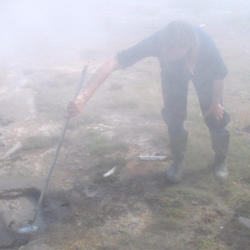
Sampling trips to terrestrial hot springs: Kamchatka peninsula (2005), Iceland (2005, 2006) and Svalbard (2006).