Africa Charter: Roadmap for transformative research
Africa–Europe research collaborations must move beyond narrow notions of “equitable partnerships” and towards a research system in which African institutions shape agendas, methods and benefits on equal terms.

Main content
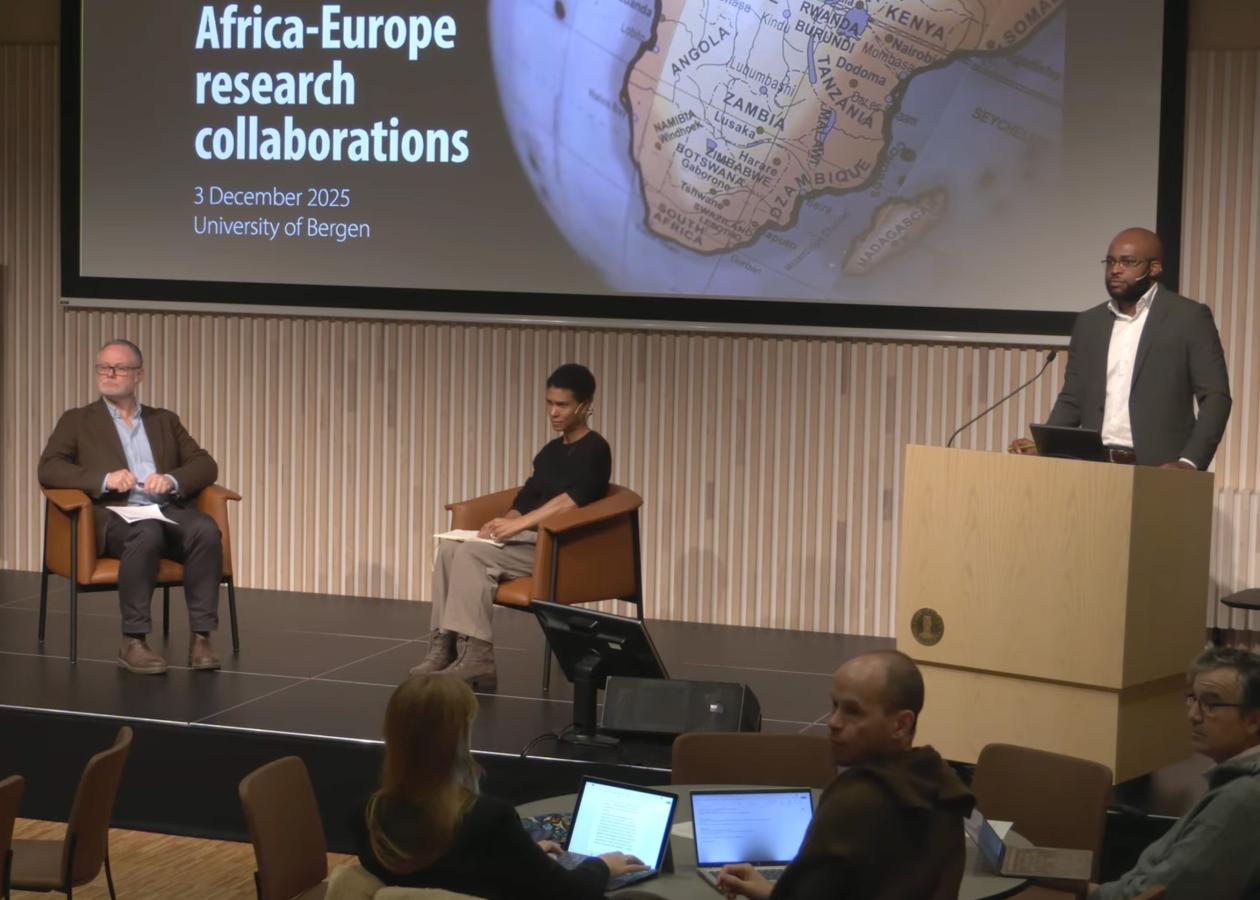
In her keynote about the Africa Charter for Transformative Research Collaborations, at a symposium hosted by the University of Bergen in November, Professor Isabella Aboderin of the University of Bristol argued that Africa–Europe research collaborations have the potential to help build a more "pluriversal" body of academic knowledge, in which European and African epistemologies stand in dialogue rather than hierarchy.
The Africa Charter was introduced as an Africa-centred normative framework for understanding how reserch universities need to reconfigure collaborations between academic actors in Africa and, in particular, the global North.
Reframing Africa-Europe partnerships
The charter was created by Africa’s major higher education constituencies, including African Research Universities Alliance (ARUA), African Academy of Sciences (AAS) and CODESRIA among others. It was launched in 2023 and has been endorsed by more than 120 signatories, incuding the University of Bergen.
"It asserts the need to shift the locus of considering what equity in research partnerships needs to entail," Aboderin said, underlining that African institutions should not only host projects but also shape research questions, concepts and theories in collaboration with partners in the North.
Although Africa is highly internationalised, "collaborations with the North dominate Africa’s scientific effort," she said, pointing to the way historical ties and funding patterns have positioned most African countries at the periphery of the global knowledge system.
She argues that this reflects an uneven playing field in the production of academic knowledge, where Eurocentric epistemologies, English and other former colonial languages often define what kind of research is seen as relevant or fundable.
"To change this, the Africa Charter calls for a transformative mode of partnership that really seeks to redress each layer of power imbalance," she said.
This transformation should occur at multiple levels: in individual consciousness and capabilities; in shared norms of what counts as excellent collaborative research; in resource streams and funding practices; and in the policies and assessment frameworks of universities, funders, publishers and governments on both continents.
Towards a shared, pluriversal knowledge base
Professor Aboderin argues that research collaboration has the potential to build a more "pluriversal" body of academic knowledge, in which European and African epistemologies stand in dialogue rather than hierarchy.
By recognising indigenous, community-based and locally grounded knowledge from Africa as central to global scholarship, joint Africa–Europe projects can generate new perspectives on global challenges and contribute to reducing inequalities within and between regions.
She frames the Africa Charter as both a justice project and a project for better scholarship. A research system in which African scholars are fully recognised experts and African knowledge frameworks help shape global agendas could, she suggested, strengthen Africa’s position in the global political economy and contribute to more diverse, responsive solutions to shared crises.
Describing the Charter as "a living document," she said she hoped to see the emerging community of interest around Africa–Europe research collaborations grow into "a community of action" through institutional roadmaps, a new web portal and upcoming convenings of Charter signatories.
"We have networks of interested scholars and research managers and practitioners who are all keen to engage with the Charter and perhaps very importantly we have serious engagement of funding agencies, publishers, even governmental and international bodies with interest in engaging with the Charter," she said.
Coimbra Group
The symposium was organised by Global Challenges, one of three priority areas at the University of Bergen, and the Global Partnerships Working Group of the university network Coimbra Group.
The Coimbra Group
- Founded in 1985
- 39 Universities from 22 European countries
- 1,4M students / 232 000 staff members (teaching, research, admin.)
- UiB contact: Nils Gunnar Songstad
Africa-Europe Research Collaborations