The Importance of Laboratory Instruction in Physics
Main content
Ian Bearden, Niels Bohr Institute, Copenhagen
Abstract:
As laboratory instruction comes under increasing pressures due to budgetary issues and overfilled curricula, how do we justify the time and expense of laboratory instruction? Often, the justification is rather tautological: physics is and experimental subject, so physics students must do experiments. While this is true, it is not sufficient. I will discuss what I think are better justifications of laboratories in the physics curricula together with some examples of how one can transform traditional laboratory exercises into genuine scientific investigations.
Bio:
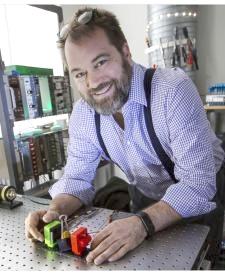
I am a faculty member at the Niels Bohr Institute, University of Copenhagen. I came to Copenhagen in 1994 as a post-doc in high spin gamma-ray spectroscopy after receiving my PhD from Purdue University based on research performed as a graduate assistant at Argonne National Laboratory. In 1995, I moved up in energy and joined the High Energy Heavy Ion group, where I have been since. I am a member of the ALICE collaboration at the LHC. In 2020, I was appointed Professor of Experimental Particle Physics and Development of Teaching in Experimental Physics at the Niels Bohr Institute. From 2013-1023, I was the director of the NBI’s outreach lab “Ungdomslaboratorie” (Lab for Youth). I am the founding chair of the Danish Physical Society’s section for Outreach and Teaching, and a member of the European Physical Society’s Physics Education Division board. I currently serve as the Honorary Secretary of EPS Executive Committee and President of the Danish Physical Society. My interests include improving laboratory-based teaching and developing low-cost apparatus for use in teaching.