Master theses
Here is a list of currently available topics for Masters theses in the Meteorology group. As a Masters student you are highly encouraged to talk to us about your own ideas for a thesis topic.
Main content
The moisture origin during extreme event "Hans"
Atmospheric moisture transport is a major factor in extreme floods. In this thesis project, you will use different numerical methods to identify the sources which provided the large amounts of water that lead to the flood caused by storm event "Hans". Moisture source calculations from backward trajectory analysis will be compared to a set up with moisture source diagnostics. The event-based results will be placed into the context of a climatological study. While identifying the factors that made "Hans" so extreme, it is also expected to quantify the probability with which such an extreme event can happen.
Relevant literature: The moisture source diagnostic of Sodemann et al. (2008). Application of the moisture source perspective to Central Europe (Sodemann and Zubler, 2010). Moisture sources for Atmospheric Rivers (Sodemann and Stohl., 2013)
Contact: Harald Sodemann (Numerical Modeling, Atmospheric Water Cycle)
Convective cold pools and gust fronts over the Nordic Seas in the AROME models
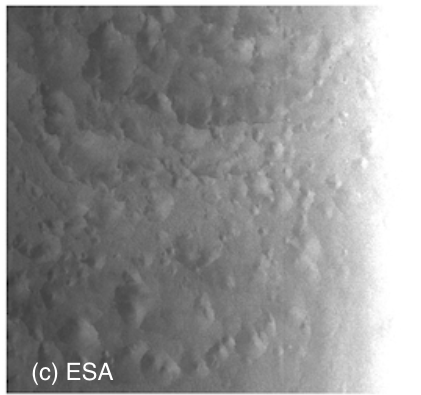
When cold, stable arctic air masses encounter open sea, the warmer sea surface temperatures lead to large fluxes of sensible and latent heat. The fluxes produce an unstable, rapidly growing boundary layer characterized by convective clouds with snow and rain showers. Evaporative cooling of rain and snow below the clouds produces downbursts of air, that when encountering the sea surface can result in potentially hazardous wind gusts, impact wind energy production and shipping. The main objective of this thesis is to investigate convective cold pools in AROME (MEPS and AROME Arctic) with regard to their properties (wind speed, temperature, relative humidity) and occurrence (frequency, extent) in the Nordic Seas. A comparison of the properties of model-simulated cold pools with wind measured from SAR satellite will allow to assess model performance and identify potential biases and deficiencies. This thesis is co-supervised by Birgitte Furevik (MET) and can also be relevant for Master students in the Renewable Energy programme.
Relevant literature: Kruse et al., 2021, Alpers et al., 2016, Furevik and Haakenstad, 2012.
Contact: Harald Sodemann (Numerical Modeling, Atmospheric Water Cycle) and Birgitte Furevik (Meteorologisk Institutt)
Moisture source variability during periods of low predictability
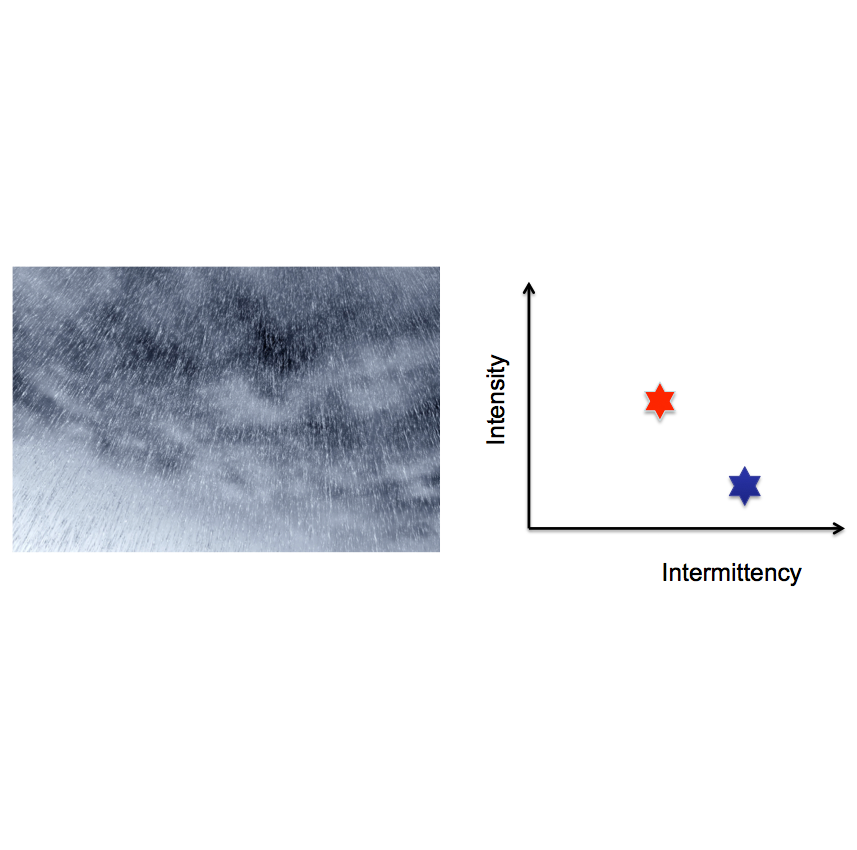
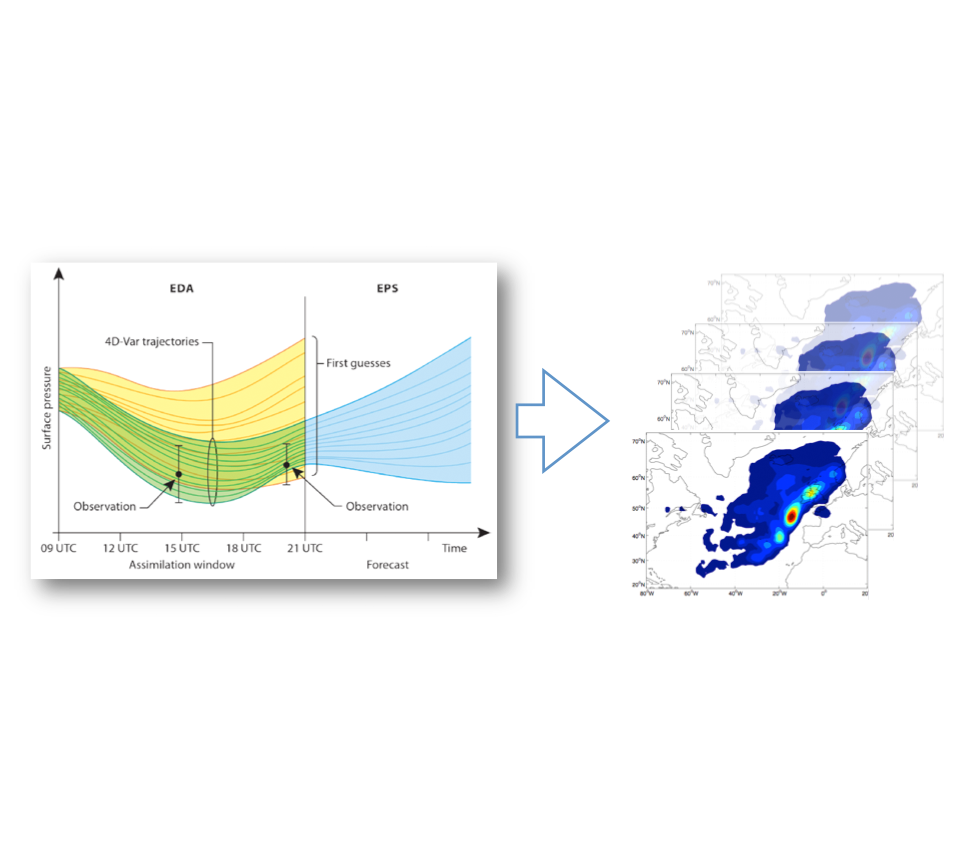
The aim of this thesis is to investigate what role moist processes play during periods of low predictability. A moisture source identification is applied to data from the ECMWF 51-member ensemble to examine the variability of moisture sources and transport in each member. A keen interest in learing and applying ensemble methods as well as advanced atmospheric diagnostics based on backward trajectories are needed for this project.
Relevant literature: The moisture source diagnostic of Sodemann et al. (2008). Application of the moisture source perspective to Central Europe (Sodemann and Zubler, 2010). Measuring uncertainty in the ECMWF ensemble prediction system (Buizza et al, 1999).
Contact: Harald Sodemann (Numerical Modeling, Atmospheric Water Cycle)
Drying of airmasses during the passage over the Norwegian coastal mountain range
The steep orography along the west coast of Norway is a key contributor to the annual rainfall total. Microphysical processes are triggered by the orographic lifting that ultimately remove water vapour during the passage of airmasses. This thesis aims to explore relation of changes in total column water to the efficiency of cloud processes in high-resolution model simulations and observations. In particular, one will explore the hypothesis that the total condensation in an airmass is reflected in gradients of the water vapour isotope composition across the mountain range. Measurements of total column water from GPS stations (in collaboration with Kartverket) will be compared to operational forecasts from MEPS and AROME Arctic, and water vapour isotope measurements from the SNOWPACE and ISLAS projects.
Relevant literature: The AROME forecast model (Seity et al., 2011).
Contact: Harald Sodemann (Numerical Modeling, Atmospheric Water Cycle)
Evaporation "hot spots" and the Deuterium excess signature in high-resolution climate models
The atmospheric water cycle is a key component of weather forecasting and climate models. This work is about identifying the regions where strong latent heat flux, or evaporation occurs, and how this affects the Deuterium excess, a stable isotope indicator of evaporation conditions. We have 6-hourly data from several current climate models which allow to compare how the evaporation process is simulated in each of them. A possible outcome of the work is to better understand where uncertainties in the water cycle of models are located, and how we can use additional measurements to improve them.
Relevant literature: Deuterium excess in the global water cycle (Pfahl and Sodemann, 2014). The NorESM climate model's water cycle (Bentsen et al., 2012).
Contact: Harald Sodemann (Numerical Modeling, Atmospheric Water Cycle)
Validation of remotely sensed wind profiles against radiosoundings
The marine atmospheric boundary layer is in the altitudes relevant for state-of-the-art and future expected wind turbines (0-300 m) not yet well understood. To improve our understanding of the complex interaction between wind shear, atmospheric stability and turbulence characteristics offshore, the offshore measurement campaign OBLEX-F1 (Offshore Boundary Layer Experiment at FINO1) has been initiated. It is an intensive observational campaign within the German Bight and is carried out by NORCOWE and several international partner institutions. The data from the experiment allows for an intensive and detailed study of the marine atmospheric boundary layer under various synoptic conditions.
Within this master project, wind profiles from a scanning lidar system (Leosphere WindCube 100S) should be validated against radiosoundings from two sites in the vicinity, Schleswig and Norderney. It will include a statistical analysis of the observed differences as function of the synoptic situation, in particular wind speed, wind direction, and atmospheric stability.
More information on the project can be found here.
Contact: Joachim Reuder (Boundary layer meteorology, Energy meteorology)
The importance of longwave radiation flux divergence on stable boundary layer development
Radiation divergence is often assumed negligible in investigations of the atmospheric boundary layer. While this assumption might be applicable for many typical conditions, e.g. convective or near-neutral boundary layers, it might be often violated in the case of the stable boundary layer (SBL). Based on radiation measurements at two levels (1 m and 7 m) and eddy covariance measurements at 3 levels of a 10 m mast during a field campaign in February 2018 (Hailuoto, Finland) as part of the ISOBAR project (https://isobar2018campaign.w.uib.no/) the proposed master thesis will investigate the effect of radiative flux divergence close to the ground on turbulence and thus on structure and dynamics of the SBL.
Advisors: Joachim Reuder, Stephan Kral
Modeling the energy balance of the snowpack in the non-melt zone of the Greenland Ice Sheet.
The objective of this research project is to close the energy budget for the snow pack and be able to simulate the snow temperatures of the Greenland Ice Sheet. This is important for our ability to predict when melting occurs on the ice sheet and hence our ability to accurately simulate the mass balance of the Greenland Ice Sheet. More information can be found here https://steenlarsen.w.uib.no/student_opportunities/ or in the pdf-file. This project is related to field work in Greenland.
Advisors: Hans Christian Steen-Larsen and Joachim Reuder
Measuring the mass balance in the interior of the Greenland Ice Sheet.
The objective of this research project is to quantify the mass balance of the interior of the Greenland Ice Sheet where a sublimation and condensation plays significant roles. Through a combination of snow height measurements, gradient measurements, and multiple Eddy-Covariance measurements, the project will determine the magnitude and uncertainties of the different components of the mass balance. For our ability to simulate the mass balance of the Greenland Ice Sheet and its contribution to sea level rise it is important to know the relative uncertainties of the mass balance components. More information here https://steenlarsen.w.uib.no/student_opportunities/. This project is related to field work in Greenland.
Advisors: Hans Christian Steen-Larsen and Joachim Reuder
Understanding the physical processes governing the formation of precipitation.
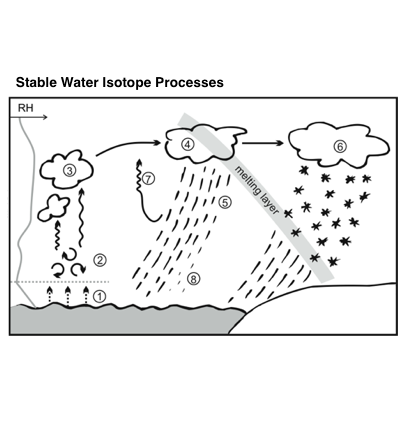
This research project focuses on understanding the processes involved in moisture uptake and storage in the atmosphere. Using water stable isotopes the objective is to understand the physical processes between atmospheric water vapor and precipitation. We have at Bermuda the longest calibrated record of continuous atmospheric water vapor isotopes and daily precipitation isotope measurements giving us a unique opportunity to combine theoretical calculations and model simulations with observations. More information here https://steenlarsen.w.uib.no/student_opportunities/. This project is related to field work in Bermuda.
Advisor: Hans Christian Steen-Larsen
Quantifying how the climate is recorded in the ice core water isotope signal.
This research project is closely linked with the funded European Research Council project SNOWISO and H2020 project BEOI and is focused on understanding the climatic drivers of the water isotope signal in the snow, which falls on top of the Greenland and Antarctic Ice Sheet. Through a combination of moisture tracking, climate models, and direct observations of the water isotopic composition of the precipitation and the surface snow the aim is to improve our ability to understand the paleoclimate record from the ice cores by understanding the climate fingerprint in the water isotopes. More information here https://steenlarsen.w.uib.no/student_opportunities/. This project is related to field work in Greenland.
Advisors: Hans Christian Steen-Larsen
Understanding the drivers of the hydrological cycle over the Tibetan Plateau.
The ‘third pole’ is the planet’s largest reservoir of ice and snow after the Arctic and Antarctic. Meltwater feeds ten great rivers, including the Indus, Brahmaputra, Ganges, Yellow and Yangtze, on which almost one-fifth of the world’s population depends. However, we still lack a quantitative understanding of the role of each process in the overall water budget. The research project focuses on obtaining a better understanding of the relationships between the third pole’s complex terrain and the weather patterns and processes that affect precipitation and ice-melting. As models struggle to reproduce the climate over the third pole the overall objective is improve the models to guide regional strategies for adapting to climate change, for preserving and restoring ecosystems and conserving biodiversity. More information here https://steenlarsen.w.uib.no/student_opportunities/ . This project is in collaboration with Institute of Tibetan Plateau Research and China’s Pan-TPE research program and is related to field work in Tibet.
Advisor: Hans Christian Steen-Larsen
Wind estimation by unmanned aircraft system measurements and machine learning models
The GFI research group on Boundary layer and wind energy meteorology lead by Joachim Reuder links research with boundary layer meteorology and unmanned aircraft systems (UAS). The subjects range from boundary layer meteorology, orographic effects to solar UV radiation. As a part of an R&D project we are offering a master's thesis.
The Innovative Strategies for Observations in the Arctic Atmospheric Boundary Layer Program (ISOBAR) is a research project investigating stable atmospheric boundary layer (SBL) processes, whose representation still poses significant challenges in state-of-the-art numerical weather prediction (NWP) models. In ISOBAR ground-based flux and profile observations are combined with boundary layer remote sensing methods and the extensive usage of different unmanned aircraft systems (UAS). During February 2017 and 2018 we carried out two major field campaigns over the sea ice of the northern Baltic Sea, close to the Finnish island of Hailuoto at 65°N.
The motivation of the Master Thesis is to apply machine learning to predict the wind direction and wind speed based on the pitch, roll and yaw angles using drone data from the ISOBAR campaign. Wind observations from a 10-m mast, lidar and sodar profiles may serve as training and validation data. You will work in an innovative interdisciplinary project and make significant contributions to the advancement in drone measurements. During your thesis you will work in close collaboration with the scientific and technical staff on the following tasks:
- Literature study on machine learning.
- Evaluate the ISOBAR data.
- Construct a machine learning model
- Writing report and presentation.
The candidate should have programming experience. You are a good team player, communicative and highly motivated. You enjoy taking responsibility of tasks and executing them in an autonomous and careful manner.
If you have any questions, please don’t hesitate to contact Stephan Kral (stephan.kral@uib.no). We will be happy to answer any questions or offer further information.
Experimental Analyses of Snow Metamorphism on the Stable Water Isotope Composition in Snow/Ice and Air
Since the 1960s, stable water isotopes in polar snow and ice have been used as proxies for both local and global temperature records. The interpretation of ice core data and the comparison with atmospheric model results implicitly rely on the assumption that the snowfall precipitation signal is perfectly preserved in the snow-ice matrix ignoring snow-vapor exchanges between surface snow and atmospheric water vapor. However, a recent study carried out on top of the Greenland Ice Sheet combining continuous atmospheric water vapor isotope observations with daily snow surface sampling documented a clear day-to-day variation of surface snow isotopic composition in-between precipitation events. This effect was interpreted as being caused by uptake of the synoptic driven atmospheric water vapor isotope signal by individual snow crystals undergoing snow metamorphism. However, the impact of this process on the isotope-temperature reconstruction is not yet sufficiently understood, but crucial, compared to interstitial diffusion, and will alter the isotope mean value.
In order to fully understand and interpret the ice core proxy it is important to understand the mechanisms possibly changing the snow signal even after deposition. Therefore, the goal of this Master Thesis is to analyse how post-depositional processes like snow sublimation and snow metamorphism can affect the isotopic composition of the snow which forms later the ice. In this thesis, an experimental study on the effect of snow metamorphism and snow sublimation on the snow isotopic composition in controlled laboratory conditions has to be done in the laboratory at GFI. You will work in an innovative interdisciplinary project and make significant contributions to the advancement of stable water isotope research in snow and ice. During your thesis you will work in close collaboration with the scientific and technical staff.
Advisors: Hans Christian Steen-Larsen (hans.christian.steen-larsen@uib.no)
Modelling the impact of Snow Metamorphism on the Distribution of Stable Water Isotope in Snow/Ice.
Since the 1960s, stable water isotopes in polar snow and ice have been used as proxies for both local and global temperature records. The interpretation of ice core data and the comparison with atmospheric model results implicitly rely on the assumption that the snowfall precipitation signal is perfectly preserved in the snow-ice matrix ignoring snow-vapor exchanges between surface snow and atmospheric water vapor. However, the isotopic profile in ice cores, from which the climate signal is extracted, is subject to alterations induced by processes occurring right after snowflake deposition and until the complete compaction of snow grains into ice. In ice sheets, the effect of these so-called post-depositional processes is reflected mainly in the diffusion of isotopes along concentration gradients, created by the succession of layers with distinct isotopic composition. On the other hand, snow metamorphism, the process of grain coarsening that transforms snow to ice, also alters the isotopic composition in the ice matrix. Transport of water vapor molecules and continuous phase changes, the two mechanisms involved in metamorphism, impact isotopes on slightly different magnitudes. This modifies the abundance of isotopes in the coexisting phases. This phenomenon of partitioning of isotopes in the different coexisting phases, called fractionation, typically leads to the enrichment of heavier isotopes in ice.
A better assessment of diffusion and fractionation occurring during metamorphism is necessary to further leverage the data gained from ice core analysis. Therefore, this thesis seeks to fill this gap by refining the existing diffusion equation, that described the transport of heavy isotopes in firn, so that fractionation occurring during metamorphism also imprints its effect on simulated isotopic profiles. The goal of this Master Thesis is to set up a numerical model to analyze the impact of snow metamorphism on the distribution of stable water isotope in snow. You will work in an innovative interdisciplinary project and make significant contributions to the advancement of stable water isotope research in snow and ice. During your thesis you will work in close collaboration with the scientific and technical staff
Advisors: Hans Christian Steen-Larsen (hans.christian.steen-larsen@uib.no)