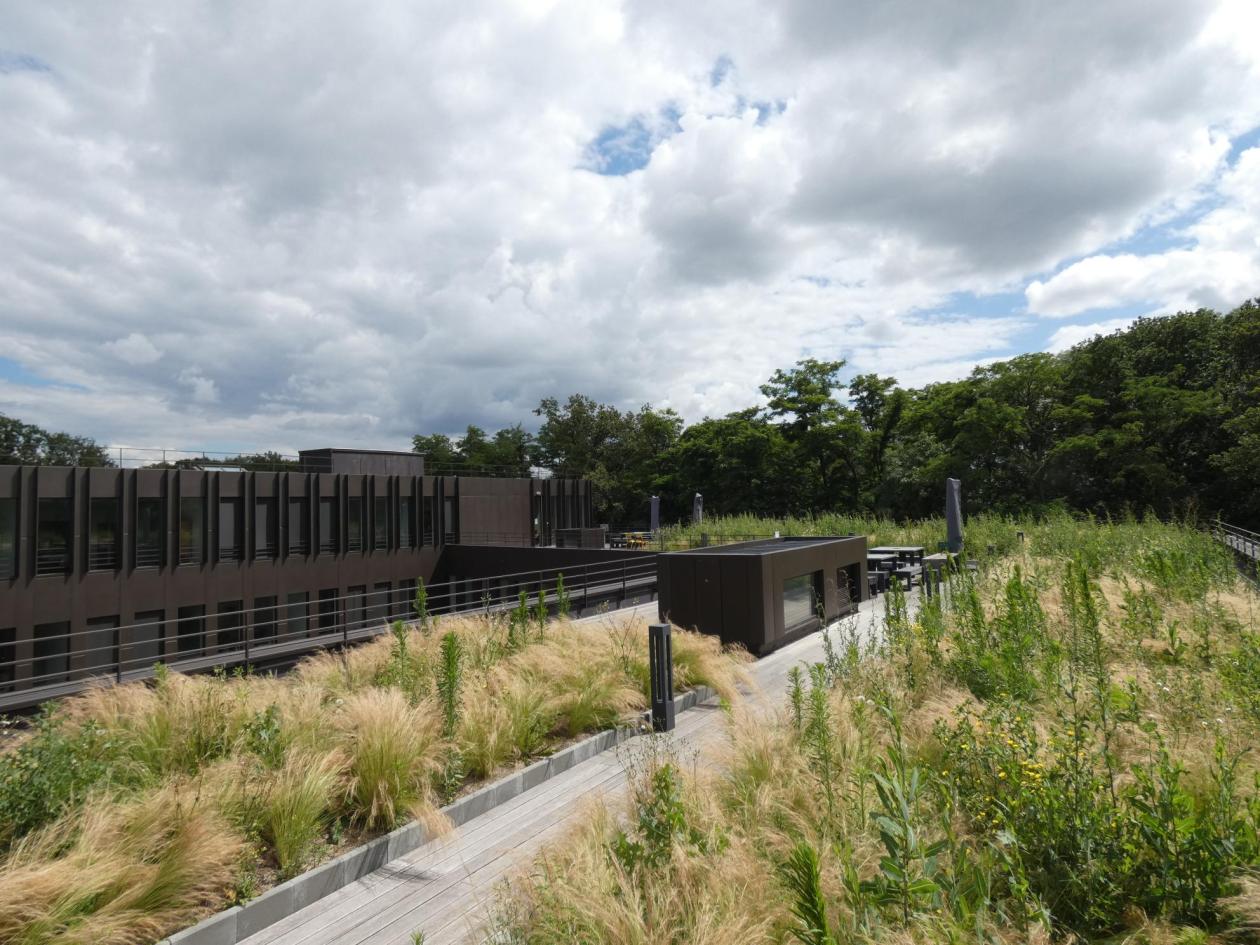
ACDC 2026 Institute Pascal
The summer school will take place at Institute Pascal, Universite Paris-Saclay, from Monday the 31st of August to Wednesday the 16th of September 2026. The topic is "Past Warm Greenhouse Climates of the Cenozoic - Implications for the Future"

Main content
IPCC AR6 scenarios project atmospheric CO₂ concentrations of 400–1200 ppm by 2100. Understanding climates under such high pCO₂ levels requires looking beyond the Quaternary, since the past million years were dominated by glacial–interglacial cycles with CO₂ varying only between 180 and 280 ppm. Warmer periods earlier in the Cenozoic therefore offer essential analogues for studying climate dynamics, model–data mismatches, and interactions within the climate system under elevated CO₂.
Part I: Learning from Past Warm Climates
During the first two weeks, lectures and discussions will introduce Cenozoic warm periods—specifically the mid‑Pliocene, mid‑Miocene, and early Eocene—drawing on both climate model simulations and empirical reconstructions. We will review the strengths and limitations of these datasets, including uncertainties in reconstructions and age models.
We will combine short invited presentations with group project work on key topics such as:
- Reconstruction of greenhouse gases
- Equator‑to‑pole temperature gradients: model–data comparison
- Ocean circulation and the role of gateways
- Cryosphere dynamics in the Pliocene and Miocene
- Exotic greehouse climates, including the PETM and the future
Students will work in 6–8 groups with mentors to analyse these topics and prepare presentations.
Part II: Future Climate on Centennial–Millennial Timescales
After the initial two weeks, the workshop will expand to include additional experts and science communicators. Over three final days, we will examine possible long‑term climate trajectories following major anthropogenic CO₂ emissions. Central questions include:
- At what CO₂ levels, cryosphere states, and ocean circulation patterns will Earth’s climate eventually equilibrate?
- How might different transient emission pathways lead to different long‑term climate equilibria?
- How should these outcomes be communicated to broader audiences?
Students will present their group projects during these final days to the wider scientific community.
Application process
The application deadline is May 1st, 2026. Applications are to be submitted online.
Practical info on the school can be found here: Institute Pascal www
For questions regarding applications or the program contact acdc@uib.no. If you have any practical questions, please contact institutpascalteam@gmail.com.
Each admitted course participant will be expected to contribute with a nominal registration fee of 5000NOK. Those who cannot cover this cost can apply for financial support thru the application portal. Accomodation at the venue, as well as the cost for excursions and social events is covered by the organisers. All participants are required to attend the full course.
Target
Advanced graduate students (PhDs). Other applications will be considered on a case by case basis if there is space (admission is competitive). Note that there will additional spaces allocated for media students during the final 3 days of the school this year.
Goal
To mix students and lecturers with empirical and dynamical training within climate science and focus on understanding the basic principles and dynamics relating to warm greenhouse climates.
Confirmed lecturers
Ray Pierre-Humbert (University of Oxford)
Gilles Ramstein (LSCE, CEA Paris-Saclay)
David Battisti (University of Washington)
Jean-Louis Dufresne (LMD, Sorbonne University)
James Rae (University of St. Andrews)
Bjørg Risebrobakken (NORCE Climate)
Julia Tindall (University of Leeds)
Kerim Hestnes Nisancioglu (University of Bergen)
Margret Steinthorsdottir (Swedish Museum of Natural History)
Ning Tang (Institute of Geology and Geophysics, CAS)
Rodrigo Caballero (Stockholm University)
Jean-Baptiste Ladant (LSCE, CEA, Gif-sur-Yvette)
Apply here by the 1st of May: