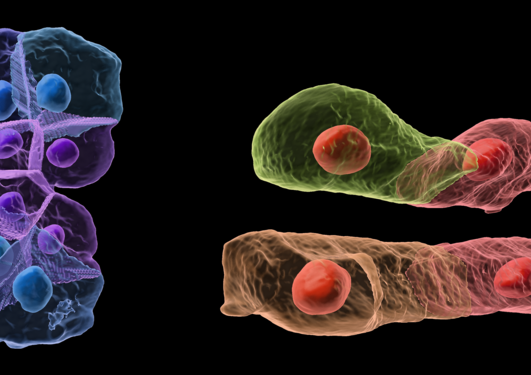
A transformative embryology summer course
This summer, PhD candidate Max Jordi Makem Pekouankouang from the Christiaen group at the Michael Sars Centre attended the prestigious Embryology course at the Marine Biological Laboratory in Woods Hole, USA. He shares how this experience transformed his approach to science.

Main content
This summer, I had the incredible opportunity to spend six weeks at the Marine Biological Laboratory (MBL) in Woods Hole, Massachusetts, attending the Embryology: Concepts and Techniques in Modern Developmental Biology course. This course brought together students and researchers from all over the world, each with different backgrounds but a shared passion for developmental biology. It was an unparalleled environment to learn cutting-edge techniques and work with a wide range of model organisms from invertebrates to vertebrates.
I chose this course for many reasons. I wanted to see what research looked like beyond my own model organism and to explore how different systems can answer the same biological questions. By the end, I was not only more confident but also more creative in how I approached experiments, thanks to the patience, guidance, and invaluable advice of the course assistants and faculty.

A sea star embryo seen under a fluorescent microscope. Students in the course had the opportunity to experiment and learn from different model organisms and microscopy techniques.
One of the biggest highlights was how we learned together. None of us were experts in every model, in fact, we were all diving into unfamiliar territory almost every day. During this course, I also significantly improved my microscopy skills, gaining both technical precision and a deeper understanding of image acquisition and analysis. Each organism had its own quirks, and teaming up made a huge difference. Sometimes we even worked with the same model and tools, yet each participant took a unique approach and produced distinct results. This exchange of perspectives and techniques deepened my understanding of developmental biology and highlighted the creativity and adaptability within our field. We came from different fields and worked with very different models, and that diversity made the collaborations incredibly rewarding. It pushed me to design my experiments in new ways and to approach my questions with a fresh perspective.
If anyone asked me whether they should take this course, I’d say yes without hesitation. You don’t just learn techniques; you learn to see your work differently. You join a network of scientists you’ll encounter again in conferences, collaborations, and maybe even your next lab. For some, this course becomes the turning point where they discover the model organism or technique that will shape their career. For me, those six weeks were more than an academic exercise, they were a reminder of why I fell in love with biology in the first place.
EMBRYOLOGY AT THE MARINE BIOLOGICAL LABORATORY
The Marine Biological Laboratory (MBL) is dedicated to scientific discovery – exploring fundamental biology, understanding biodiversity and the environment, and informing the human condition through research and education. Founded in Woods Hole, Massachusetts in 1888, the MBL is a private, nonprofit institution and an affiliate of the University of Chicago.
The prestigious 'Embryology: Concepts and Techniques in Modern Developmental Biology' course, running since 1893, is an intensive six-week program introducing students to a wide variety of embryonic systems. It has a rich history of shaping the field, with six students and eight faculty becoming Nobel Laureates.