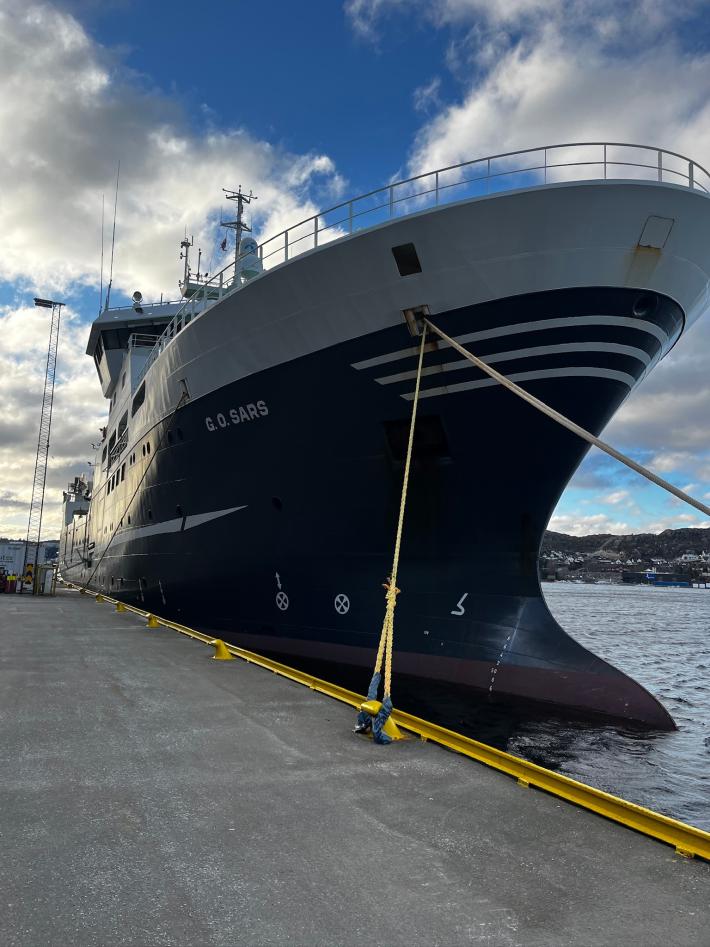
On the hunt for sea cucumbers on board the G.O. Sars
Postdoctoral researcher Emily Claereboudt recently joined an Institute of Marine Research (IMR) expedition in the North Sea. Her goal - collect as many sea cucumbers as possible to find out how they communicate with each other.

Main content
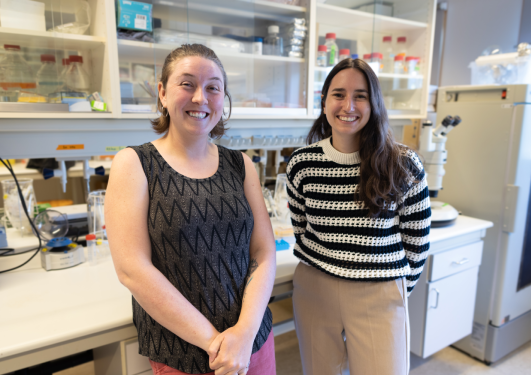
Emily Claereboudt, a postdoctoral researcher in the Lynagh group at the Michael Sars Centre, was recently awarded a prestigious Marie Skłodowska-Curie Postdoctoral Fellowship to study the molecules used by sea cucumbers to communicate with each other, and the receptors that detect those signals. Deciphering these secret conversations requires collecting animals, and when colleagues at IMR suggested she joins their annual shrimp survey, she did not hesitate. “We have no idea what chemicals Norwegian red sea cucumbers are using to communicate”, she explained. “We need a large amount of biological material to give to the chemists to do their extractions, quantifications and chemical descriptions.”
Life and work on board
The cruise brought together IMR researchers from Bergen, Trondheim, and Tromsø, and a small group of guest scientists from the University of Bergen. Work on board the G.O. Sars followed a demanding schedule, with trawling operations running around the clock. “Every time a trawl comes in, that’s when the science gets activated and we go down to the fish sorting room,” Claereboudt said. “I was in charge of picking out all the benthic stuff, taking pictures, weighing it, quantifying it, and then keep my sea cucumbers for myself.”
In addition to collecting samples for her own research she supported IMR colleagues with survey work, gaining new skills in sexing and staging shrimps. “It was a learning experience for me as well of what these surveys consist of”, she said. “I was also measuring and sexing sharks. It was fun, it was interesting!”

In the fish sorting room, Claereboudt was responsible for sorting and documenting organisms that live on the sea floor - including sea cucumbers.
Rough weather in sea cucumber land
The crew had planned to first sample off the southwestern coast of Norway before heading for Skagerrak, the strait running between Denmark and Norway. Unfortunately, rough sea and strong winds greatly limited the vessel’s sampling grounds. “The weather got too bad and we docked for three or four days”, Claereboudt recalled. “I ended up catching like eight or nine sea cucumbers. Because of the weather, we couldn't go to ideal sea cucumber land.”

The Red Norwegian sea cucumber Parastichopus tremulus is exploited as a food source in several countries around the globe. Researchers in Norway are currently evaluating the potential of the species for aquaculture.
Challenging conditions made it difficult to carry on experiments on board, and collected animals had to be frozen. When the vessel returns, they will be sent to the Department of Chemistry at the University of Bergen for analysis. Little is known about the Norwegian red sea cucumber, an emerging commercial species, and several stakeholders and collaborators, including researchers at Møreforskning, are eager to obtain the chemical profile to better understand and culture the animals. Despite challenges, “It was still worth it”, Claereboudt said. “I made some good connections, I met some nice people. It was fun to see what comes up!”
SensHolo - A Marie Skłodowska-Curie Actions Postdoctoral fellowship
Marie Skłodowska-Curie Actions Postdoctoral Fellowships (MSCA-PF) is a mobility programme for doctoral researchers who wish to carry out their research activities abroad, acquire new skills, professional contacts and develop their career. The mobility programme is part of the EU's Horizon Europe research and innovation programme.
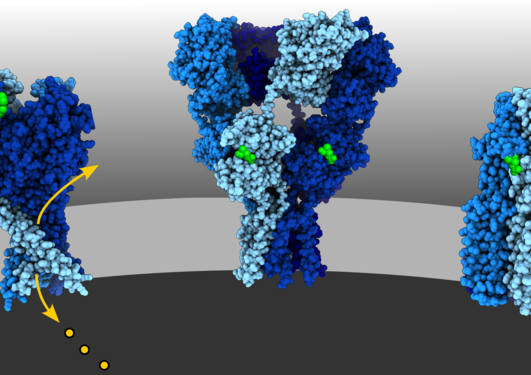
During the “Chemosensation in Holothuroids (SensHolo)" MSCA-PF project, Emily Cleareboudt will use a range of behavioral, molecular and electrophysiological assays to characterize the receptors of messenger molecules in two local sea cucumber species, including the commercially relevant Norwegian red sea cucumber.