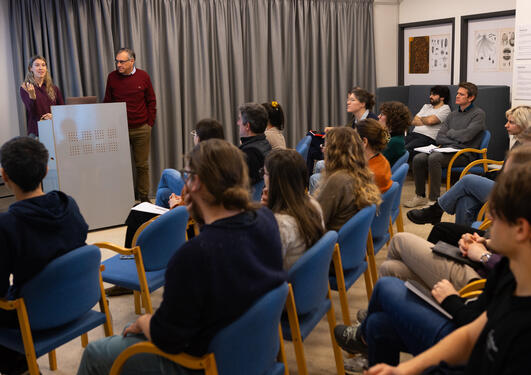
Prof. Dr. Alexander Gottschalk, Goethe University, Frankfurt, Germany
Prof. Dr. Alexander Gottschalk, Institute of Biophysical Chemistry and Buchmann Institute, Goethe University, Frankfurt, will present: "Unusual proteins and protein complexes enabling light sensation and electrical signaling in the nematode Caenorhabditis elegans"
Main content

Caenorhabditis elegans is a 1 mm long nematode living in decomposing plant material, feeding on bacteria. Since the 1960’s, the animal was turned into one of the best studied model systems in cell, molecular and neurobiology. In my lab, we are interested in light-mediated processes, that can be harnessed by transferring light-sensitive proteins to other cells, e.g. neurons, thus making them light responsive (optogenetics), and allowing to study aspects of nervous system function. We are also interested in basal questions of neuronal communication at synapses.
Even tough C. elegans is eye-less, it can sense light, particularly high-energy UV and blue light, which poses a danger signal and can be harmful for an unpigmented, transparent organism. Light sensation is mediated by the protein LITE-1, which uses a previously unknown mechanism for photon absorption. Since no molecular structure was known, we used AI-based structure prediction to derive a model for LITE-1. It appears to be a tetrameric ion channel, similar to insect odorant receptors. LITE-1 may carry a chromophore in the ligand binding pocket, by which it perceives blue photons, while UV photons may be absorbed through a network of aromatic amino acids throughout the protein. Also, LITE-1 is sensitive to oxidative conditions, like reactive oxygen species (ROS) generated by UV photons being absorbed by cellular molecules. LITE-1 gating may require both, photon absorption and ROS production, acting as a coincidence detector. I will discuss how detailed structure-function analyses support these conclusions, and also present proof that LITE-1 is an ion channel.
The second part of the talk will address our recent structural analysis of electrical synapses, also termed gap junctions, in cultured C. elegans neurons, using cryo-electron tomography. Gap junctions (GJs) are hexameric ion channels spanning the plasma membranes of adjacent cells. They connect their cytosols, and enable direct transfer of ions and small molecules, as well as electrical signals. GJs are important for fast electrical synaptic transmission between neurons, and are also used in muscular organs like the heart to coordinate the activity of cellular ensembles. Even though GJs have been studied for several decades, no direct in-situ structural information of GJ channels and their arrangement in patches of hundreds or thousands of channels was known. We identified GJs in cellular contacts and analyzed their structure by sub-tomogram averaging. Interestingly, we found that some channels are associated with a cytosolic cap structure. We show that this structure is made from a ring of stomatin proteins, including (or solely comprising) the UNC-1 protein. Stomatins form compartments at the plasma membrane. Their association with a GJ channel indicates a function in gating or directional signaling of the GJ, or in their biogenesis and turnover. I will discuss these possibilities in the talk
Visit Prof. Dr. Alexander Gottschalk's website