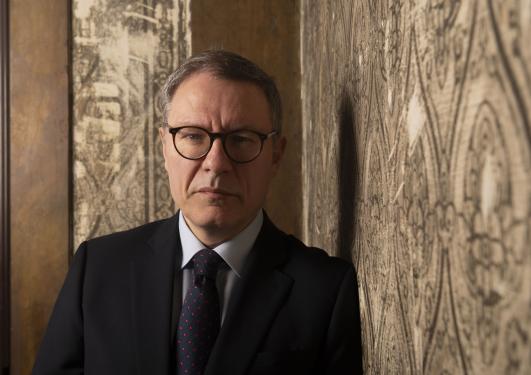
Public lecture by Luciano Floridi
Welcome to a public lecture with our new honorary doctor professor Luciano Floridi.

Main content
The University of Bergen has appointed Professor Luciano Floridi of Yale University as an honorary doctor, following a nomination from the Faculty of Social Sciences and the Department of Information Science and Media Studies.
The honorary doctorate is the University of Bergen’s highest distinction and is awarded to individuals without formal affiliation to the university who have made outstanding contributions to research, society, or culture. Floridi, along with nine others, will be formally conferred honorary doctorates during a ceremony in the University Aula on 21 May 2026.
If you want to know about Floridi's response to the appointment, please read this interview.
"What is the impact of AI on Democracy?"
Professor Floridi will give a public lecture drawing on his foundational contributions to information ethics, the philosophy of AI, and digital society. The title of the lecture is: "What is the impact of AI on Democracy?". Here is a summary of Floridi's argument in the lecture.
"The impact of AI on democracy is a complex and multifaceted topic. On the one hand, AI can enhance democratic processes by improving efficiency, transparency, and citizen engagement.
For example, AI can be used to analyse large amounts of data and provide insights that can inform policy-making and decision-making processes. It can also facilitate citizen participation and deliberation through platforms that enable direct communication and feedback.
AI can be used to analyse large amounts of data and provide insights that can inform policy-making and decision-making processes.
On the other hand, AI can exacerbate existing inequalities and power imbalances. AI algorithms can be biased or discriminatory, leading to unequal treatment or exclusion of specific groups. Additionally, the use of AI in political campaigns and elections raises concerns about the manipulation of public opinion and the spread of misinformation, including deepfakes.
In this talk, I shall analyse these issues and argue that AI could help to solve the current crisis of democracy."
Welcome!
The lecture is open to the general public. Everybody is welcome!
- Time: Wednesday May 20th from 15.30 to 16.15.
- Place: Storsalen in Nygårdsgaten 5.
Please arrive five to ten minutes before the starting time.