Course Descriptions and Dates 2026 fall
Here you will find the course descriptions and dates for all the UPED courses offered fall 2026
Main content
The courses in fall 2026 will soon be open for registration in Studentweb
What do I need to do?
If you wish to take courses in the UPED program, you must go through the following 6 steps to successfully register:
- You must apply to be a participant in the UPED program through Søknadsweb. Please be sure to use either the Feide or ID Porten login option. If you are a new international employee and do not yet have either of these login options, please contact UPED at uniped@uib.no for how to proceed.
- Please provide accurate and current information in the application (e.g., current job title). This is used to determine your eligibility to join the program.
- In Søknadsweb, choose "Study: Universitetspedagogikk, Application code 5170". - if you apply before 30.07., you must choose the semester “spring 2025” (even if you will attend courses in the fall of 2025)
- After you have applied to be in the program, you must wait for approval from the UPED program administrator. Approvals are done twice per week – this means you may have to wait a couple of days for your application to be approved.
- If you have waited more than 5 workdays to hear if you have been accepted to the program or you have not been accepted into the program and wish to inquire, you can contact UPED at uniped@uib.no.
- You will receive notification by email from Søknadsweb when you have been admitted to the program.
- While you wait for approval, please review information about the course offerings and dates on the UPED website. The UPED website is the only place where you will find up-to-date information about the courses; this information is not in the registration system.
- After you have been notified of your admission to the program, you must go to Studentweb and search for the courses you would like to take. You must register for each course individually. Remember to "sign up for class" in Studentweb for the courses where it is mandatoy. If you have successfully registered in Studentweb, you have completed your registration. You will not receive additional confirmation information from Studentweb.
- If you are external to UiB, you can register for courses, and we are often able to include you in our program. However, in exceptional circumstances, we may not be able to accommodate you because of space limitations. Unfortunately, this can also mean you receive last minute notifications that you will not be able to join a course.
- Mark and block all dates for courses you have registered for in your calendar. Our courses usually run as half or full-day meetings unless indicated otherwise, with substantial work to be done before and between meetings. In case there are any changes to the course, such as adjustments to dates/times or cancellations, you will receive information on this as soon as possible.
- Approximately between 1 to 3 weeks before a course begins, you will receive a message from your course instructor. Keep in mind that many of our courses start with preparatory work before the first meeting, so usually you will have to do work soon. The message from the instructor can come by email and/or Mitt UiB (Canvas) announcements, so please make sure your contact information and your notification settings in Mitt UiB are accurate.
What if I need to…
- Withdraw from a course
- If you need to withdraw from a course, you must de-enroll from the course in Studentweb. Several UPED courses have very high demand and we ask all participants to de-enroll as soon as they know they are unable to join a course to ensure available course spaces are provided to those who need them.
- Notify and discuss my accessibility needs for an UPED course
- If you need to discuss your accessibility needs for an UPED course, contact the instructor of your course directly. Course instructors are listed with the course information on the UPED website.
- Ask a question about a course
- If you have a specific question about a course that is not answered on the UPED website, you can contact the instructor for a course directly. Course instructors are listed with the course information on the UPED website.
General program registration information
- Consult the course timetable, noting dates/times, mode of instruction (face to face, online, blended) and language of instruction (norsk, English)
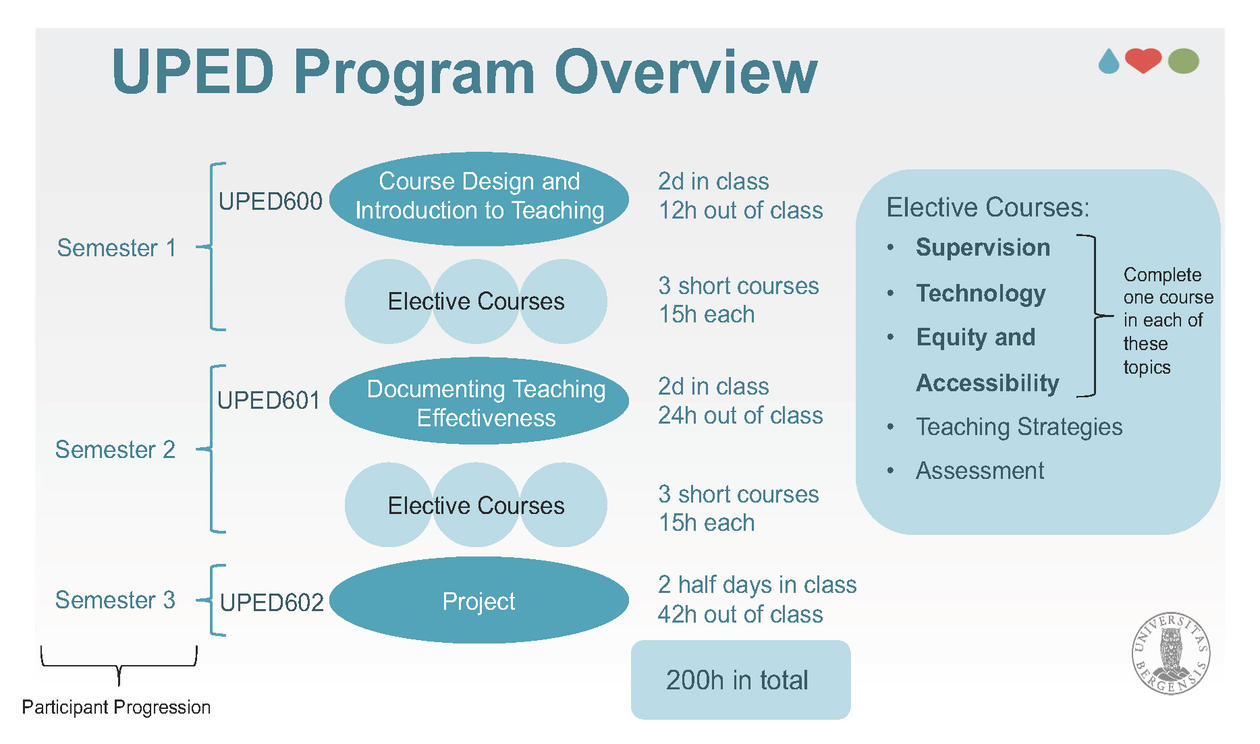
- For those beginning the program, you must register for UPED600 first. You can enroll in Elective courses synchronously with UPED600 if you wish.
- Note that courses are open to all staff and PhD researchers.
- Note that all courses require a minimum of 80% attendance for all synchronous activities. If you are unable to meet the attendance requirements, please do not register for a class. In addition, course coordinators will specify certain times, days, or activities where attendance is required.
- Please consult the FAQ about the program and the program registration for additional information
Click on the tabs below to see each course's dates, registration and course descriptions.
Introducion/core courses:
THIS COURSE IS FULL: UPED600N Introduksjon til universitetsundervisning og kursdesign (norsk) 24 timer
Undervisere: Robert Kordts og Marie van der Kloet
Todagers kurs:
11. september (09.00-15.30) og
25. september (09:00-15:30)
Emnekode / tittel | UPED600: Introduksjon til universitetsundervisning og kursdesign ***Kjerneemne |
Mål og innhold | For å nå de planlagte læringsmålene kommer emnet til å være konsentrert om to kjernespørsmål: «Hva er læring?» og «Hva er god undervisning?» For å besvare disse spørsmålene skal deltakerne vurdere forskjellige teoretiske og empiriske kunnskaper om undervisning og læring, og reflektere kritisk over egne erfaringer som lærere og studenter. Vurderingen av disse spørsmålene er nær knyttet til praktisk veiledning om emnedesign. |
Læringsmål | Etter å ha fullført emnet skal deltakerne kunne: |
| Kunnskaper |
|
|
| Ferdigheter |
|
|
| Generell kompetanse |
|
|
Metoder for undervisning og læring | Kursdeltakerne kommer til å tilbringe cirka 12 timer i undervisningsrommet og 12 timer utenfor undervisningsrommet i arbeid med emnerelaterte oppgaver. I undervisningsrommet skal deltakerne delta i par- og gruppeaktiviteter, inkludert diskusjoner om undervisnings- og læringsteori, skriving av tekster og tilbakemeldinger fra fagfeller, korte presentasjoner og andre engasjerte læringsaktiviteter. Det kommer til å bli noen korte forelesninger eller presentasjoner fra forelesere om bestemte temaer. Utenfor undervisningsrommet skal deltakerne lese utvalgt litteratur, delta i nettdiskusjoner eller andre forberedende aktiviteter, fullføre oppgaver med å revidere eller designe et emne de skal undervise i, og/eller skrive reflekterende og kritiske analyser av teorier og undervisningspraksis. |
Vurderingsformer | Deltakerne må ta del i engasjerte læringsaktiviteter og forberede seg til arbeidet i undervisningsrommet ved lesing, korte skriveaktiviteter og andre identifiserte oppgaver. Deltakerne forventes å fullføre alle vurderingsoppgaver innenfor de tidsrammene som er angitt for et gitt semester. Forlengede frister for innleveringer må eventuelt avtales.
Deltakerne i emnet får to kjerneoppgaver som må utføres:
I tillegg til disse to kjernekravene skal deltakerne delta i og produsere mange mindre, formative former for vurdering – for eksempel deltakelse i diskusjoner, korte, reflekterende skriveaktiviteter, utkast til komponenter i emnedesignen samt fagfelletilbakemeldinger. |
Timer | 24 |
UPED600E Introduction to Teaching at University and Course Design (English) 24 hours
Instructors: Kenan Dikilitas and Yael Harlap
Two day course:
17. September (09:00-15:30) and
15. October (09:00-15:30)
Course Code / Title | UPED600: Introduction to Teaching and Course Design ***Core Course |
Goals and Content | In order to achieve the intended learning outcomes, the course will focus on two core questions: “What is learning?” and “What is good teaching?” To answer these questions, participants will consider different theoretical and empirical scholarship on teaching and learning, and critically reflect on their own experiences as teachers and as learners. The consideration of these questions is interwoven with practical guidance on course design. |
Learning Outcomes | At the completion of the course, the participants will be able to: |
| Knowledge |
|
|
| Skills |
|
|
| General Competencies |
|
|
Teaching and Learning Methods | Course participants will spend approximately 12 hours in class and 12 hours outside of class working on course related tasks. In class, participants will engage in partner and group activities including discussions of scholarship on teaching and learning, writing texts and peer feedback, short presentations, or other engaged learning activities. There will be some short lectures or presentations from instructors on particular topics. Out of class, participants will read selected literature, engage in online discussions or other preparatory activities, complete tasks to revise or design a course that they will teach, and/or write reflective and critical analyses of scholarship and teaching practice. |
Forms of Assessment | Participants must take part in engaged learning activities and prepare for classwork through reading, short writing activities, and other identified tasks. Participants are expected to complete all assessment tasks in the timelines identified for a given semester. Extensions for assignments must be negotiated.
Participants in the course will have two key assessments that they must produce:
In addition to these two core assessments, participants will participate in and produce many smaller, formative forms of assessment – such as participation in discussions, short reflective writing activities, drafts of components of the course design, and peer feedback activities. |
Hours | 24 |
UPED601N Dokumentering og evaluering av undervisningseffektivitet (norsk) 36 timer
OBS: man må ha fullført UPED600 før man kan ta UPED601
Undervisere: Robert Kordts og Yael Harlap
Tredagers kurs, 09.00-15.30 alle dager:
1. september,
15. september og
29. september
Emnekode / tittel | UPED601: Dokumentering og evaluering undervisningseffektivitet ***Kjerneemne |
Mål og innhold |
|
Læringsmål | Etter å ha fullført emnet skal deltakerne kunne: |
Kunnskaper | |
| |
Ferdigheter | |
| |
Generell kompetanse | |
| |
Metoder for undervisning og læring | Kursdeltakere vil tilbringe omtrent 12 timer med undervisning (ansikt til ansikt eller online) og 24 timer utenfor klassen med å jobbe med kursrelaterte oppgaver. Klassetiden vil fokusere på ideutveksling, peer feedback, introduksjon av målrettede vitenskapelige og praktiske tekster for å fremme deltakernes prosjekter. Dette kurset vil være sterkt samarbeidende, og deltakernes arbeid i kurset vil fokusere både på hva de produserer hver for seg og hvordan de kan bidra til deres jevnalders læring. Det blir noen korte forelesninger eller presentasjoner fra instruktører. Utenfor klassen vil deltakerne lese valgt litteratur, produsere skriftlig materiale (f.eks. Reflektert skriving om vurdering, undervisningsfilosofi), gjennomføre peer observasjonsaktiviteter og fullføre andre forberedende oppgaver. |
Vurderingsformer | I emnet brukes følgende vurderingsformer: Deltakerne i kurset vil ha tre vurderinger som de må produsere eller delta i:
I tillegg til disse vurderingene, vil deltakerne delta i og produsere mange mindre, formative vurderingsformer - som deltakelse i diskusjoner, korte reflekterende skriveaktiviteter og utkast til komponent i undervisningsporteføljen. |
Hours | 36 |
UPED601E Documenting and Evaluating Teaching Effectiveness (English) 36 hours
PLEASE NOTE: in order to attend UPED601 you have to have finished the UPED600 course
Instructors: Marie van der Kloet and Tanya Ershova
Three day course, 09:00-15:30 all days:
26. August,
11. September and
16. October
Course Code / Title | UPED601: Documenting and Evaluating Teaching Effectiveness ***Core Course |
Goals and Content | This course is comprised of three core areas of teaching development: reflective writing on teaching, peer evaluation and feedback on teaching, and refining assessment design for student learning. Participants will: work on writing or refining their teaching philosophy and creating a teaching portfolio, engage in peer observation of the teaching process, and analyze their understanding of student learning in one or more of their course assessments. |
Learning Outcomes | At the completion of the course, the participants will be able to: |
Knowledge | |
| |
Skills | |
| |
General Competencies | |
| |
Teaching and Learning Methods | Course participants will spend approximately 12 hours in class (face to face or online) and 24 hours outside of class working on course related tasks. Class time will focus on peer exchange of ideas, peer feedback, introduction of purposeful scholarly and practical texts to advance participants’ projects. This course will be highly collaborative, and participants’ work in the course will focus both on what they produce individually and how they can contribute to their peers’ learning. There will be some short lectures or presentations from instructors.
Out of class, participants will read selected literature, produce written materials (e.g. reflective writing on assessment, teaching philosophy), undertake peer observation activities, and complete other preparatory tasks. |
Forms of Assessment | Participants must take part in engaged learning activities and prepare for class work through reading, writing or organizational preparation and other identified tasks. Participants are expected to complete all assessment tasks in the timelines identified for a given semester. Extensions for assignments must be negotiated.
Participants in the course will have three assessments that they must produce or participate in:
In addition to these assessments, participants will participate in and produce many smaller, formative forms of assessment – such as participation in discussions, short reflective writing activities, and drafts of component of the teaching portfolio. |
Hours | 36 |
DETTE KURSET ER FULLT/THIS COURSE IS FULL: UPED602 Pedagogisk prosjekt/Pedagogical Project (norsk/English) 50 timer/hours
OBS: for å delta på UPED602 må man ha fullført BÅDE UPED600 og UPED601
Note: in order to attend to UPED602 you need to have finished BOTH UPED600 and UPED601
Undervisere/Instructors: Robert Gray & Kenan Dikilitas
Tredagers kurs/three day course
Datoer/dates:
17. august (09.00-12.00),
14. september (09.00-12.00) &
30. november (09.00-16.00)
Course Code / Title | UPED602: Pedagogical Project |
| ***Core Course |
Goals and Content | The objective of the course is to design, develop, and present a course project, either individually or in a group of two or three, that is either a scholarship of teaching and learning (SoTL) research project or a teaching development project. The course content is self-directed and/or identified in conjunction with the participants to suit their specific projects. Although some general course materials are identified, most content will be specific to projects and is thus necessarily varied and unidentifiable in advance. |
Learning Outcomes | At the completion of the course, the participants will be able to: |
| Knowledge |
|
|
| Skills |
|
|
| General Competencies |
|
|
Teaching and Learning Methods | The teaching methods are primarily focused on the facilitation of peer feedback and providing direct feedback to participants in the design of their pedagogical projects. This course is highly dependent on self-direction and initiative in the development and completion of the participants’ projects. The course will include a small number of face-to-face meetings and a substantial amount of independent and group work. |
Forms of Assessment | Participants must design, propose, undertake, and report on a pedagogical project (e.g., a scientific paper, poster, presentation, etc.) related to their own or their colleagues’ teaching. The project will be completed in stages. Stages of the project will be interspersed with either course group meetings or meetings with the course instructors:
Participants will produce a final report in the form of a paper, poster or other agreed upon (with the course instructor) medium to communicate the outcomes of their project to their peers. Participants will lead a final presentation on their project with course participants Projects can be done alone or in groups of two or three. Participants are expected to complete all assessment tasks in the timelines identified for a given semester. Extensions for assignments must be negotiated. |
Hours | 50 |
Valgfrie emner:
For å fullføre UPED trenger man (minst) ett kurs i hver av disse temaene:
- Teknologi (Educational Technology): UPED65X
- Likhet og tilgjengelighet (Equitiy and Accessability): UPED67X
- Veiledning (Supervision): UPED69X
Emner merket ** teller som to enheter/emner
DETTE KURSET ER FULLT/THIS COURSE IS FULL: UPED652D Student Interaction with Content and Each Other (English) 15 hours
Field: Educational Technology
Instructors: Robert Gray
Two half days:
23. October (09:00-12:00)
06. November (09:00-12:00)
| Course Code / Title | UPED652d Advanced Teaching in MittUiB: Student Interaction with Content and Each Other ***Elective Course: Technology |
| Goals and Content | This course is for instructors at UiB who would like to use Mitt UiB / Canvas to strengthen their courses and increase student engagement with the addition of more intentional interaction opportunities. The course will provide opportunities for participants to explore multiple approaches to employ interaction strategies through the use of online and blended learning. Participants will learn about best practices, develop course activities, receive feedback, and share their ideas and experiences with colleagues. Participants will develop learning materials and/or activities inside and outside of class sessions that address either specific content or a specific learning objective in their course(s) and that participants will give each other feedback on those materials in the sessions. |
| Learning Outcomes | At the completion of the course, the participants will be able to: |
| Knowledge | |
| |
| Skills | |
| |
| General Competencies | |
| |
| Teaching and Learning Methods | The course consists of a minimum of 15 hours of work, including two partial days of face-to-face teaching and additional online activities. Teaching and learning methods in the course will include the following:
|
| Forms of Assessment | Assignments will include the development, presentation, and justification of online course materials presented in and via Mitt UiB / Canvas. The course will use the following forms of assessment:
|
| Hours | 15 |
UPED650 Online and Blended Learning (English) 30 hours **
Field: Educational Technology
Instructors: Robert Gray and Kenan Dikilitas
Three half days:
16. September (09:00-12:00)
14. October (09:00-12:00)
04. November (09:00-12:00)
| Course Code / Title | UPED650: Online and Blended Learning ***Elective Course, Educational Technology |
| Goals and Content | This course is for instructors at UiB who would like to design and teach online or blended courses. “Blended” courses are courses where a significant amount of the teaching and learning occurs online, often to the extent that some of the face-to-face time is reduced, replaced by online activities. Content: The course will provide opportunities to explore multiple approaches to online and blended learning. Participants will learn about best practices, develop course materials and activities, receive feedback, and share their ideas and experiences with colleagues. Participants will develop learning materials and/or activities in the periods between training sessions that address either specific content or a specific learning objective in their course(s) and that participants will give each other feedback on those materials in the sessions. |
| Learning Outcomes | At the completion of the course, the participants will be able to: |
| Knowledge | |
| |
| Skills | |
| |
| General Competencies | |
| |
| Teaching and Learning Methods | The course consists of a minimum of 30 hours of work, including two full days of face-to-face teaching and additional online activities. Teaching and learning methods in the course will include the following:
Participants will be expected to develop course materials outside class meetings and share them with the class. |
| Forms of Assessment |
Participants have to attend minimum 80% of sessions and complete all assignments to receive credit. Assignments will include the development, presentation, and justification of online course materials presented in and via Mitt UiB / Canvas. The course will use the following forms of assessment:
|
| Hours | 30 |
DETTE KURSET ER FULLT/THIS COURSE IS FULL: UPED672 Universal Design for Learning: Instruction and Assessment (English) 30 hours **
Field: Equity and Accessibility
Instructor: Marie van der Kloet & Ellen Lien
Three day course:
15. October (09:00-15:00)
20. October (09:00-12:00)
27. October (09:00-12:00)
Course Code / Title
UPED672 Universal Design for Learning Instruction and Assessment
***Elective Course
Goals and Content
The course objective is to develop knowledge and understanding of the principles and practices of Universal Design for Learning and apply them to instruction and assessment. The content of the course is focused on texts that outline universal design principles and will use illustrative case studies focus on instruction and assessment to develop our abilities to identify and remove barriers in higher education teaching. This ability will further solidify our capacity to design our own teaching practices in ways that are accessible and inclusive.
Learning Outcomes
At the completion of the course, the participants will be able to:
Knowledge
will understand and apply UDL principles to instructional practice and assessment design
Skills
Will be able to design classroom activities guided by Universal Design for Learning principles (multiple means of engagement, expression & represesentation)
Will be able to design or redesign assessments to be more accessible
Will be able to identify barriers to access in one’s own and others’ courses and propose workable solutions
General Competencies
Will develop a working understanding of ableism and the social model or gap model of disability (and be able to apply these models in their teaching context.
Will improve their capacity to employ good accessibility practices in their teaching
Teaching and Learning Methods
This course will be designed as a blended course including both self-directed online activities including: reading scholarship, watching videos, reviewing case studies and related discussion board questions and analysis, and development of classroom teaching practices for peer review. Face to face activities will include short lectures on UDL, ableism and accessibility in teaching and learning, peer activities focused on design of accessible and engaging teaching activities, design of accessible assessment practices and case study exercises. When face to face activities are not possible, these activities will be organized as video lectures, asynchronous individual tasks and synchronous small group activities.
Forms of Assessment
Participants will be assessed on the basis of their work in three areas:
Attendance (in synchronous online and face to face meetings) and participation (in asychronous and synchronous online tasks and face to face classroom activities
Development of accessible teaching materials/lesson designs for one’s own courses
Including development of accessible MS office materials and simple digital resources (e.g. images or video)
Development of accessible assessments for one’s own courses
Analysis of teaching contexts through case study activities to identify both barriers to accessibility and pedagogical strategies to address these barriers.
Hours: 30
UPED687C Approaches to Sustainability Education 15 hours - ONLINE COURSE
Instructors: Robert Kordts
No meetings, the course will be open from 27.08. till 30.11.
This course will be online
Course Code / Title | UPED 687C: Approaches to Sustainability Education ***Elective Course |
Goals and Content | The course aims at developing sustainability-related competencies in University of Bergen’s instructors by offering them five distinct approaches to Sustainability Education: teaching about and with sustainability, teaching in sustainability, teaching through sustainability and teaching for sustainability. The course offers a low-threshold self-directed learning experience where the participants decide about the space and time of their studying. Through its self-directed nature, the course reacts to the increasing demands for university pedagogy offers related to sustainability. It is structured by the five approaches, each of which offers a variety of situated and reflective learning opportunities, based on Kolb’s theory of experiential learning. |
Learning Outcomes | At the completion of the course, the participants will be able to: |
| Knowledge |
|
|
| Skills |
|
|
| General Competencies |
|
|
Teaching and Learning Methods | Participants work through the self-directed course that is established as a Mitt UiB online course that consists of several chapters that cover the main approaches to Sustainability Education and work with a diversity of Mitt UiB activities (texts, videos, discussions, smaller assignments, quizzes etc.). This mode guarantees participants maximum flexibility regarding studying time and space. The extensive material offered online follows Kolb’s model of experiential learning, it will guide the participants through steps with foci on practice (experience), reflection, theory and planning, for each of the five approaches to Sustainability Education. These learning steps are pre-defined to some extent, at the same time participants have a lot of opportunities for choosing pathways and selecting topics of interest. In addition to working through these tasks, participants will complete larger assignments at two points in time: The Mid-Way Reflection must be delivered mid-semester, while the Sustainability Education Portfolio and the Final Reflection have to be delivered at the end of the semester. |
Forms of Assessment | The course will use the following forms of assessment: Ca. mid-way of the semester, participants submit their Mid-Way Reflection to Mitt UiB, i.e., a video where participants discuss sustainability-related teaching in their own discipline, based on examples they have researched. At the end of the semester, participants will submit a Sustainability Education portfolio, that consists of at least four work products the participants have produced during the course. At the same deadline, participants also submit a Final Reflection text (max. 1 page or video of equivalent length) in which they discuss their own approach to Sustainability Education, considering the course’s content. For a pass on the course, participants must submit the Mid-Way Reflection and both final assignments. |
Hours | 15 |
DETTE KURSET ER FULLT/THIS COURSE IS FULL: UPED695 Supervising bachelor and master theses 15 hours - ONLINE COURSE
Field: Supervision
Instructors: Robert Kordts
Two days course:
27. October (09:00-12:00)
10. November (09:00-12:00)
| Course Code / Title | UPED695 Project Management for Bachelor and Master Thesis Supervision ***Elective Course |
| Goals and Content | This course is based on the idea that student theses are projects, both for the students and for the supervisors. In addition, the success of a thesis depends strongly on the cooperation between supervised students and supervising lecturers. The course therefore combines these two aspects and builds on a process model of supervision, in order to deal with the peculiarities of supervision in the individual phases of the process, as well as with the interpersonal aspects of care. Participants acquire practical knowledge about the communication of expectations and the conscious design of the supervision phases. |
| Learning Outcomes | At the completion of the course, the participants will be able to: |
| Knowledge | |
| |
| Skills | |
| |
| General Competencies | |
| |
| Teaching and Learning Methods | Course participants will spend approximately 6 hours in class and 9 hours outside of class working on course related tasks. Class time will focus on group discussions, individual work as well as presentations. Out of class, participants will read selected literature, produce materials, and complete preparatory tasks. |
| Forms of Assessment | The course will use the following forms of assessment: In addition to attending the meetings and discussions, participants will read two scholarly works on supervision and pedagogy and complete two formative and one summative assignment related to supervision.
|
| Hours | 15 |