Congratulations, Dr. Fournon Berodia!
On the 22nd of August 2025, PhD candidate Inés Fournon Berodia successfully defended her thesis titled “Epithelial cell extrusion drives cell loss during starvation-induced shrinkage in a sea anemone”.

Main content
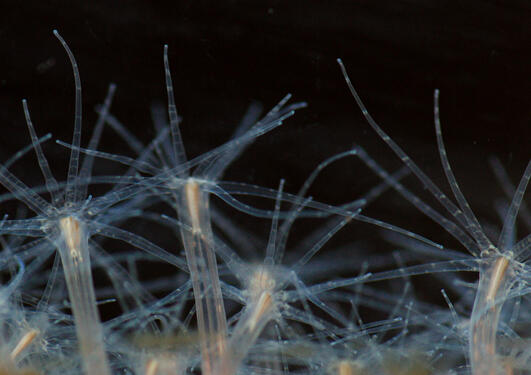
An epithelium is a tight layer of cells that acts as a protective barrier, shielding an animal’s body from the outside world. Epithelial cells renew continuously, and expelling dying cells while maintaining the integrity of the tissue is a tricky process. During her PhD, Inés Fournon Berodia took advantage of the unique ability of the sea anemone Nematostella vectensis to shrink rapidly when food is scarce. “How they are able to lose as many cells as they do proportionately and orderly without disintegrating was a mystery”, Inés explained. “I found that they are able to lose cells by a process called epithelial cell extrusion, which squeezes cells out from an epithelium and avoids holes from forming.”
Inés’ work revealed the first example of epithelial cell extrusion in a non-bilaterian species (bilaterians include vertebrates, flies, worms…). She was also able to identify molecules involved in the process and discovered striking similarities between cell extrusion in sea anemones, flies and even humans. “The beauty of Inés’ work lies not only in the significance of the cell biology, but also in the compelling evolutionary story it tells. Her findings suggest that the fundamental mechanisms of tissue renewal in our bodies are evolutionary ancient”, explained Patrick Steinmetz, her thesis supervisor.
A science community
Originally from Spain, Inés decided to pursue a PhD in marine sciences after working with sea urchins during her master’s in Marine Biological Resources. At first skeptical to move to Bergen, where she had previously spent a rainy exchange semester, she was head-hunted when a position opened in the Steinmetz lab. Positive feedback on the Centre from collaborators and a meeting with the Steinmetz team convinced her to come back to Norway. “In the lab, working alongside my colleagues made my PhD experience incredibly positive and memorable. Attending and organizing social events made me connect with researchers from other labs early on”, she observed.
“In the lab, working alongside my colleagues made my PhD experience incredibly positive and memorable."
- Inés Fournon Berodia
Finding a community of science-enthusiasts outside of the laboratory also contributed to making her time in Bergen special. “I very much enjoyed volunteering with the popular science organization Pint of Science”, she added. “The goal was to inspire others but in a way, I got so inspired by hearing other researchers share their work too.”
Pursuing research under sunnier skies
While she admits that leaving friends behind will be difficult, Inés is happy to see her project reach a satisfying conclusion and ready to move on to the next challenge as a postdoctoral researcher – in a dryer climate. “I must admit I have had enough rain here in Bergen, so I am looking to move away from the country, but I will stay in Europe where my family, friends and scientific network is!”
Reflecting on the past four years, Patrick concluded, “It has been very rewarding to witness Inés’ remarkable development as a scientist. Coming from an ecology background with limited cell biology knowledge, she brought exceptional enthusiasm, resilience and a strong eagerness to learn”. We have no doubt that these qualities will allow Inés to thrive in her next position and wish her all the best for the future!