Starved sea anemones put their cells in ‘deep sleep’ mode
New work from the Steinmetz group at the Michael Sars Centre unveils the secrets behind the starlet sea anemone's extraordinary ability to adjust its body size according to food availability.

Main content
The sea anemone Nematostella vectensis has the remarkable ability to change its body size throughout its life, growing when food is available and shrinking when it becomes scarce. In a new study published in PLoS Biology, EMBO postdoctoral fellow Eudald Pascual Carreras took a closer look at this process to find out how stem-like cells adjust their proliferation activity according to food availability. “We uncovered a mechanism that had previously only been observed in yeast and cell culture. From an evolutionary perspective, showing this behaviour in a whole animal is a major step forward”, Pascual Carreras said.
Focusing on a recently characterized stem-like cell population suspected to contribute to the animal’s extraordinary growth plasticity, the team showed that cells in starved individuals stop dividing and enter a resting state called quiescence. “The aspect that surprised me the most was the depth of quiescence - the temporal dimension of how cells enter and exit a resting state”, Pascual Carreras continued. “When I began the project, I was mainly interested in understanding stem cell cycle regulation in Nematostella. I did not expect to uncover a cellular behaviour that changes progressively over time.”
“We uncovered a mechanism that had previously only been observed in yeast and cell culture. From an evolutionary perspective, showing this behaviour in a whole animal is a major step forward” - Eudald Pascual Carreras
The longer the animals went without food, the deeper their resting state became, and the longer it took to resume a normal cell cycle. Upon refeeding, they only began dividing again after activation of the TOR signalling pathway, a nutrient-sensing mechanism. In addition, starved quiescent stem cells gradually lost an important epigenetic mark associated with active genes. “This tells us that a population of stem cells carries a memory of the feeding history in their nucleus”, explained Kathrin Garschall, researcher in the Steinmetz group and a co-author of the study. “To understand how food and starvation regulate these cellular processes we are studying their effect on metabolism and gene expression next.”

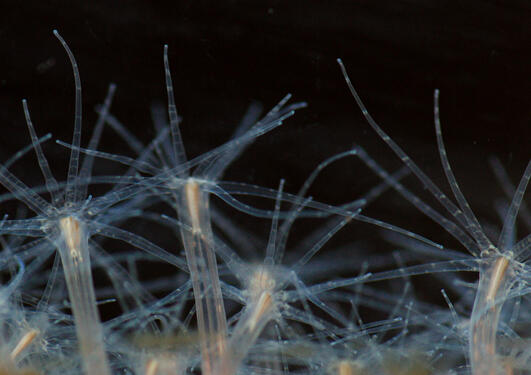
The starlet sea anemone grows and shrinks throughout its life according to food availability. Researchers have discovered that it has the ability to put some of its cells in 'deep sleep' mode when food is scarce.
The team used flow cytometry, cellular and molecular biology techniques to uncover the findings, which sometimes required expertise around the clock. “Some experiments in this paper needed sampling at 3-hour intervals over 24 hours, which is very challenging to do in one go”, group leader Patrick Steinmetz commented. “Eudald was very ingenious in designing the timing of the experiments. I am grateful he did because this ‘intense’ dataset has really become the heart of the paper.”
Being able to tune quiescence depth across the whole organism is likely to act as a protective strategy to keep cells healthy under stressful environmental conditions, and allows them to resume proliferation when food becomes available again. The new study suggests that nutrient-controlled quiescence may be a fundamental evolutionary strategy, an exciting new insight into the cellular mechanisms at play in animals with lifelong growth.
New publication
Title: Prolonged starvation deepens quiescence in Vasa2/Piwi1-expressing cells of a sea anemone
Journal: PLOS Biology
Authors: Eudald Pascual Carreras, Kathrin Garschall, Patrick R.H. Steinmetz