200 years of neurobiology at the University of Bergen
As the University Museum celebrates its 200 years jubilee, researchers reflected on breakthroughs in biological sciences made at UiB and how they relate to today’s research.

Main content
In 2025, the University of Bergen celebrates the milestone 200th anniversary of the University Museum with a special edition of the Museum yearbook, and a ‘Kunnskapfest’ (‘knowledge festival’) where Bergen citizens were invited to discover the collections and interact with scientists. With research projects carrying on the legacy of renowned local scientists, the Burkhardt group at the Michael Sars Centre joined in on the celebrations.
Standing on the shoulders of giants
During the open day organized by UiB on April 27th, outreach stations filled the museum with lively exhibits and activities. The event was a success, with a record number of 3,346 participants. For Michael Sars PhD candidate Brian Wehner, presenting his work on cell type diversity in ctenophores – also called comb jellies – in the majestic whale hall felt particularly meaningful. “It was an amazing opportunity to present our current research among all those fascinating specimens”, he said. “I enjoyed that we were able to show both the historic and recent research on ctenophores here in Bergen, from the first drawings of Michael Sars to the stunning photography of Alexandre Jan.”

Researchers from the Burkhardt group presented their work in the University Museum's Whale Hall during the Museum open day on April 27, 2025. From left to right: Anna Ferraioli, Brian Wehner, Alexandre Jan, Paula Miramón-Puértolas.
Zoologist Michael Sars discovered more than 200 species along the Norwegian coastline during his career, and published illustrations of both jellyfish and comb jelly species. “It is truly fascinating how detailed those monographies were, despite the fact that most ctenophores do not preserve well and are difficult to image”, Wehner added. “Museum collections in general are very important because they archive biodiversity changes over time and can be used as a resource both by scientists and by the public to spark interest in lesser-known species and their conservation.”
A connection across centuries
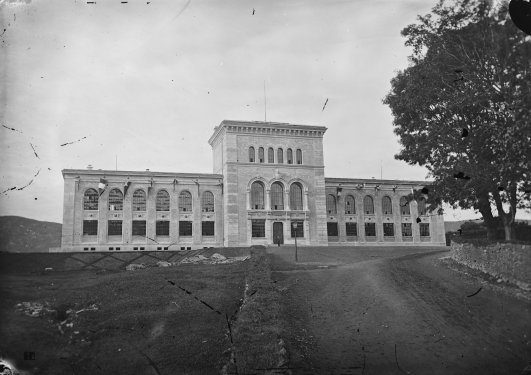
Initially intended as a cabinet of curiosities, the University Museum of Bergen was founded in 1825 under the auspices of politician Wilhelm Frimann Koren Christie. It quickly became a central institution for biological research in Norway, attracting prominent scientists such as Fridtjof Nansen whose observations of the structure of invertebrates’ central nervous systems revolutionized the field of neurobiology. He was the first to accurately describe neurons as individual units, disproving the prevalent theory of the time that postulated that they were interconnected.
“This story goes from Michael Sars, the vicar and marine zoologist, to Michael Sars, the Centre.”
- Prof. Anders Goksøyr
200 years later, researchers in the Burkhardt group at the Michael Sars Centre made a shocking discovery, highlighted in the Museum’s jubilee yearbook. The nerve cells of comb jellies, the oldest animals on the planet, are organized in a continuous network. This fascinating study using today’s state-of-the-art techniques echoes beautifully the work conducted by Nansen and his peers in the 1800’s. Yearbook co-author Prof. Anders Goksøyr points out that this story illustrates the international aspect of science and the importance to pursue the best methods available at a point in time, as both Nansen and Burkhardt traveled abroad to learn and develop methods that allowed for the breakthroughs. “It also shows how science evolves through the collection of specimens and the detailed description of organisms, to the understanding of life processes such as evolution, development and reproduction”, Goksøyr added. “This story goes from Michael Sars, the vicar and marine zoologist, to Michael Sars, the Centre.”

The University Museum's 2025 yearbook links current and past research into invertebrate nervous systems, including ctenophores. The photograph on the right was taken by Alexandre Jan, aquarist in the Burkhardt group.
Looking ahead
With six research groups working to better understand the biology and evolution of marine animals, scientists at the Michael Sars Centre continue to build upon the foundations laid by their predecessors at the University of Bergen and around the world. "It’s humbling to see how the questions first posed by Fridtjof Nansen in 19th-century Bergen continue to inspire our research today as we explore the mysteries of marine life", Pawel Burkhardt concluded. As we celebrate 200 years of knowledge, we look with anticipation to many more discoveries to come.
200 years of knowledge
In 1825, Wilhelm Frimann Koren, President of the Norwegian Parliament, founded the Bergen Museum. The museum was an important precursor to and foundation for the establishment of the University of Bergen in 1948.
In 2025, the museum has over 5 million objects in its collections. The University of Bergen has a total of 8 faculties with 4,000 employees and 20,000 students.
The 200 year jubilee is marked by a series of events and exhibitions in and around the University Museum throughout 2025. Go to the jubilee calendar for a complete overview of upcoming events.