Master’s in Sustainability – a study program for the future
The master’s program explores how researchers, politicians, lawmakers, and other societal actors can collaborate to create a more sustainable world.

Main content
We only have one planet, with limited resources. If we continue living as we do now, we will harm the living conditions of future generations and much of life on Earth.
“We need to be able to face the challenges that the rest of the 21st century will bring. Today’s students are tomorrow’s citizens, professionals, and decision-makers, so it’s crucial that they have knowledge about sustainable development,” says Associate Professor at the Centre for the Study of the Sciences and the Humanities (SVT), Kjetil Rommetveit.
Together with colleagues from a variety of disciplines, he has developed a dedicated master’s program in sustainability.
Collaboration across disciplines is essential
“Sustainable living means trying to live within the limits of the planet and its ecosystems, in ways that are socially and democratically responsible and acceptable. We must achieve this without destroying the possibilities for good lives for future generations of living beings on this planet,” says Rommetveit.
“The entire world faces challenges related to climate and biodiversity loss. Here in Norway, for example, we need to move away from fossil energy sources. That’s not easy when at least a third of our economy is tied to the production and sale of fossil fuels,” he explains.
Reaching the sustainability goals is challenging, and there are no obvious answers. No single academic discipline can reach these goals alone—we need to work together across fields, and science and society must collaborate.
In the new master’s program, students will gain knowledge about sustainability from various academic perspectives, including biology, law, climate science, history, and social sciences.
Technology alone is not enough
If we aim to change large parts of society, it’s not just a question of solving a scientific or technological problem. The challenges involve fundamental societal institutions. Rommetveit highlights a highly relevant issue where law and politics intersect in the context of sustainability.
“Legal frameworks are central to policymaking, and they exist at multiple levels—local, national, and international. For future politicians, researchers, activists, entrepreneurs, or businesspeople, it’s essential to understand these structures. Moreover, both in Norway and internationally, we’re seeing more and more cases where various actors actively use the legal system—take Klimasøksmålet (the 2016 Norwegian Climate Lawsuit), for example. Here, environmental activists argue that traditional political channels are insufficient, and they seek to advance their cause through the courts.”
“In the new master’s program, we’ll address real-world problems, often those involving contentious issues,” Rommetveit says, offering some examples.
Should land be used to capture CO₂, for agriculture, or to develop infrastructure for renewable energy? Should wind turbines and the global climate system take precedence, or should local landscape conservation be prioritized? Who should be involved in these decisions, and based on what types of knowledge? What is the relationship between scientific and political expertise in the UN’s Intergovernmental Panel on Climate Change (IPCC)?
Contributing to sustainability efforts
Rommetveit believes the program will suit students with an active interest in societal and environmental issues, and in the connections between society and ecosystems. Students can choose to specialize in one of three areas: climate and energy transition, marine sustainability, or global societal challenges.
“Teaching will be broad-based, with contributions from excellent lecturers across disciplines, combined with a practical and problem-based focus. As a comprehensive university, we’ll emphasize knowledge, the uniqueness of each discipline, and what happens when these disciplines come together in closer collaboration,” he says.
“But also, more concretely, what does it mean to work together in interdisciplinary projects, and which practical and theoretical skills does this type of collaboration require?”
Students will work alongside other engaged peers to gain a deeper understanding of global sustainability challenges. The program emphasizes active learning, both in groups and individually, with students playing a key role in shaping their own study experience.
The goal is for students to graduate with skills and knowledge in science and society that are relevant for contributing to sustainability efforts.
This is a translation of a Norwegian original article which was published 28 January 2021.
About the program
- Degree: 2-year Master’s
- Start: Autumn semester
- Admission requirements: Completed bachelor’s degree from an accredited institution, with a specialization relevant to the field of sustainability.
- Number of places: Approximately 20
The program is interdisciplinary. Lecturers come from fields such as theory of science, geography, law, psychology, biology, climate science, and energy studies.
The program is coordinated by the Centre for the Study of the Sciences and the Humanities.
UiB and sustainability
The University of Bergen has a responsibility to prepare future generations for tackling emerging challenges.
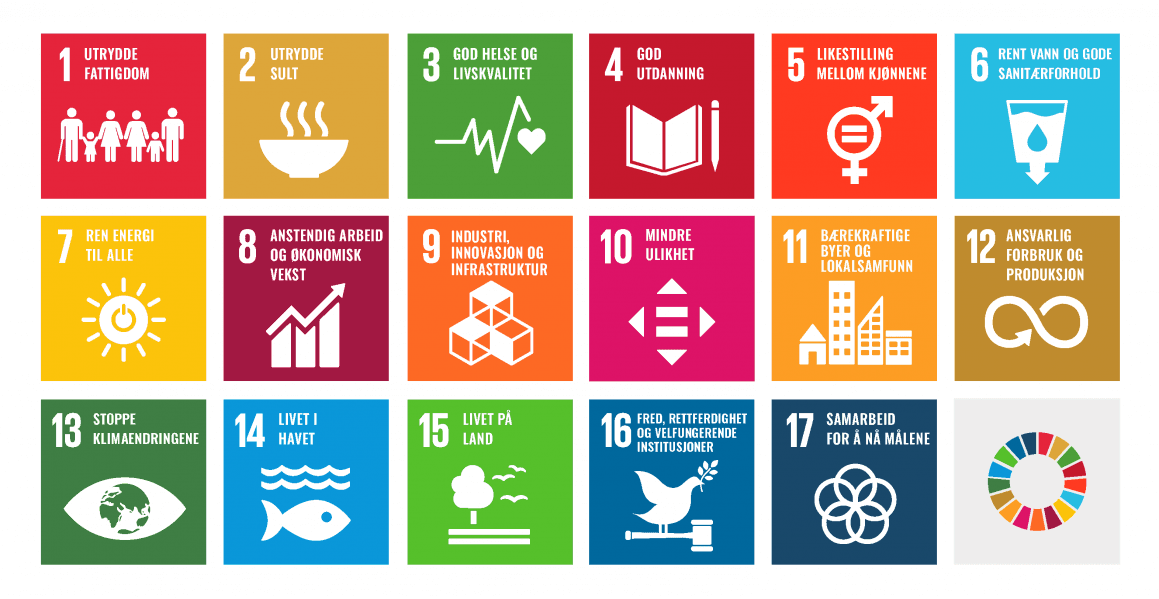
UiB is strongly committed to research and education in global societal challenges and is recognized as a hub in academic efforts to promote the UN Sustainable Development Goals (SDGs), through initiatives such as SDG Bergen and the annual SDG Conference.
The UN Sustainable Development Goals
The UN SDGs are the world’s shared action plan to eradicate poverty, combat inequality, and halt climate change by 2030.
Sustainable development consists of three dimensions: economy, environment, and social conditions. It is the interplay between these three dimensions that determines whether something is truly sustainable.