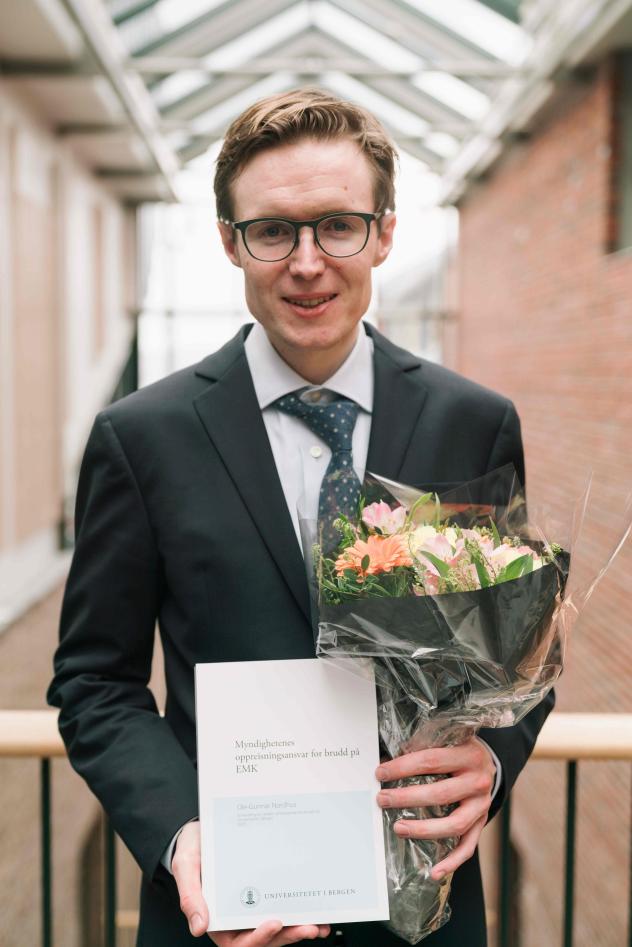
– The greatest reward is presenting my work
Ole-Gunnar Nordhus has written his doctoral thesis on the Norwegian authorities' tort liability for human rights violations. He compares the research process to competing in a marathon, where the greatest reward is getting the opportunity to present his work in front of an audience.

Main content
– Could you start by briefly describing what your doctoral project is about?
– My project is about when Norwegian authorities should provide financial compensation for violating someone's human rights under the European Convention on Human Rights (ECHR). Violations of the ECHR by the authorities often have consequences that cannot be precisely measured in monetary terms (non-economic damage), such as the feeling of injustice or discomfort individuals may experience when subjected to a human rights violation. I have examined the authorities' obligation to pay compensation for non-economic damage in cases of ECHR violations.
– Why is this relevant to research? Do Norwegian authorities commit many such human rights violations?
– In recent years, several lawsuits have been filed in Norway demanding compensation for violations of the ECHR by the authorities. Two of these lawsuits resulted in the Supreme Court clarifying in June last year that the authorities are required to pay compensation for ECHR violations to the extent necessary to provide sufficient reparation for the violation (ECHR compensation liability). At the same time, the Norwegian government has initiated a process to assess whether, and if so how, the ECHR compensation liability should be codified in legislation.
– This development highlights the need to assess how the ECHR compensation liability can and should be operationalized.
– What are your most important research findings?
– One of my main findings is based on the fact that compensation cases in Norway have traditionally been between private individuals. Many of the considerations that have argued for limiting the compensation liability of private individuals cannot similarly justify a limitation of the authorities' compensation liability for violations of the ECHR. For example, the authorities must, in principle, be required to pay a higher compensation amount when they violate someone's physical or psychological integrity (including through murder and abuse) in contravention of the ECHR, than private individuals who commit comparable integrity violations.
– Another main finding is related to the fact that it is not necessarily required to remedy a violation of the ECHR by awarding compensation to the person or persons affected by the violation (the injured party). In some cases, the injured party may receive sufficient reparation through Norwegian authorities (typically the courts) recognising that a violation has occurred. Even if a recognition of a violation is not sufficient, there may be several alternative forms of reparation to compensation. In the dissertation, I show which specific criteria can be applied to assess whether it is necessary to provide reparation in the form of compensation. Although the assessment must be based on the severity of the violation of the Convention, the injured party's own conduct can also be taken into account.
– At the same time, the dissertation shows that the ECHR in several contexts only provides a framework for assessing whether, and if so, by what amount, compensation should be awarded for violations of the ECHR. Therefore, in the dissertation, I provide recommendations on how we should operationalize the ECHR compensation liability within this framework in Norwegian law. For example, I argue that there should be no requirement that the authorities can only be required to pay compensation if they have caused harm intentionally or negligently (fault requirement).

Ole-Gunnar Nordhus together with the evaluation committee, the defense chair, and supervisors. From left: Bjarte Askeland (supervisor), Sandra Friberg (second opponent), Jørgen Aall (chair of the assessment committee), Ole-Gunnar Nordhus, Halvard Haukeland Fredriksen (defense chair), Michael Reiertsen (supervisor), and Kjetil Mujezinović Larsen (first opponent).
– What led you to want to write a doctoral thesis on this particular topic?
– Fundamentally, my dissertation is about the correction of injustice. I grew up in a family where this topic was often discussed. During my law studies, the subject of human rights was among those that interested me the most. The connection to tort law was related to the fact that, as a newly graduated lawyer, I began teaching tort law and writing several articles on the subject. In this context, I also came into contact with professor Bjarte Askeland. It was in a conversation with him that I first talked about the need to write a dissertation on the government's liability for violations of the ECHR, and he encouraged me to write an article on the topic before becoming a research fellow. This was an important part of the preparation for starting a doctoral project on the subject.
– Askeland later became a supervisor for my project, along with Judge Michael Reiertsen from the EFTA Court. I have learned a lot from both of them about tort law and the ECHR, and it has been a great privilege to have them as my supervisors.
– For a period before becoming a research fellow, I was also employed as a lawyer in the Patient Injury Compensation Board's secretariat at the National Appeal Body for Health Services (Helseklage). This gave me insight into the application of the compensation rules in the Patient Injury Act, and it was a valuable experience when I began working on my doctoral dissertation.
– In the broader perspective of your life then: How did you find that academia could be a suitable career path for you?
– I became acquainted with the academic path early on through my mother, Inger Hilde Nordhus, who has been a professor at the Faculty of Psychology (UiB). I enjoy the various steps in the research process: gathering sources, drafting text, and presenting findings in different forums.
– Academia is also about competition. That suits me well. I have long been interested in competing in long-distance running, preferably half marathons. This is transferable to the work on the doctorate and academia in general.
– What has been the most inspiring part of writing a doctoral dissertation?
– It is engaging in the two fundamental academic exercises: researching and disseminating. Although I enjoy delving into legal issues, I equally enjoy giving lectures and teaching. Ever since we started doing oral presentations in elementary school, I have liked that format. It triggers my competitive instinct. It is part of the 'reward' in a research process. For example, I remember how inspiring it was when I gave a lecture in the University Aula (UiB) last fall.
– At the same time, the position as a research fellow is not just a job, but also an education in how to adopt a scientific approach to legal issues. Upon completing the doctoral program, one will have developed methodological insight that will be beneficial whether one chooses to continue in academia or not.
– And the most difficult part?
– My dissertation deals with a topic that has been continuously evolving recently. This is both a benefit and a challenge. The benefit is that the development shows the relevance of the topic. The challenge is that one must continuously incorporate legal developments into the dissertation manuscript. When the Supreme Court clarified in June last year that there is a specific ECHR compensation liability in Norwegian law, it was necessary to review the dissertation to adjust the text to reflect the Supreme Court's clarifications.
– Part of the exercise when writing about a continuously evolving topic is to think several steps ahead. What questions will need to be considered, regardless of the legal clarifications that may come from the legislature and/or the courts?
– That sounds like a challenging exercise indeed. What are your best tips for maintaining motivation throughout such a process?
– I think it is wise to continuously present your work in various academic contexts throughout the process, whether it is at research group meetings or conferences. Both the work you put into preparing for such presentations and the feedback you receive can make you see your manuscript with fresh eyes when you sit down in front of the computer to continue writing.
– I have also found it useful to work on different sections of the dissertation throughout a workday. My ideal was to spend a certain number of hours on three different subsections of the dissertation each day. It's not always possible to maintain this ideal, and sometimes you have to focus on just one section. But as a general rule, I believe the ideal is useful because it ensures progress on multiple 'fronts.' If you hit a wall with one section one day, it can be inspiring to work on a section where things are going more smoothly.
– Finally, how would you describe the research environment for a research fellow at the law faculty in Bergen?
– The faculty's research education helps to prepare you well for the research process of the doctoral dissertation, and several different social arenas have been established for the research fellows. Here, you become part of a strong legal academic community and a good environment with the other research fellows.
The candidate
Ole-Gunnar Nordhus defended his doctoral thesis on March 28, 2025, with the dissertation:
"The Authorities' Tort Liability for Violations of the ECHR"
Nordhus holds a Master's degree in Law from the Faculty of Law (UiB). His doctoral project stems from the Research group for Tort Law and Insurance Law. Before becoming a doctoral fellow, he taught at the faculty, published several scientific articles, and worked in the secretariat of the Patient Injury Compensation Board.
Nordhus is currently employed as a researcher at the Faculty of Law (UiB), affiliated with the Centre on the Europeanization of Norwegian Law (CENTENOL).