The Historic Walk
For 2025, on the occasion of the 200th anniversary of both the University Museum and the University of Bergen: a renewed and updated exhibition of our old-fashioned and heritage roses

Main content
Heritage roses
Along Mildevegen there are roses that are often found in old gardens in Western Norway: hardy, tried and tested roses that can withstand the weather in Western Norway but have become rare. We preserve many of these here as part of a national genetic resources collection. Also, at the bottom of The Historic Walk are roses collected in old gardens along the coast of Norway. More information (in Norwegian): Salvesen & Åsen (2011).
Prestegårdsroser ('vicarage roses')
The most common and widespread heritage roses along the Norwegian coast are the bourbon rose 'Great Western' and the white roses 'Maxima' and 'Semiplena', which have been planted out in the Prestegårdsroser bed. Of the more than 70 different varieties of roses that have been found along the coast, about a dozen have not been possible to determine to any known cultivar.
Rosa 'Great Western'

Rosa ×alba 'Semiplena'

Genetic resource roses
It is important to preserve Norwegian heritage roses, not least to be able to restore gardens with authentic materials. Many varieties are only found in a few gardens and should be preserved in living botanical collections. The university gardens are a partner in a national project to preserve plant genetic resources, coordinated by the Norwegian Institute of Bioeconomy (NIBIO).
Rosa 'Erik' (Centifolia/Damask Group)

Rosa 'Geschwinds Nordlandrose I' (climbing roses Group)

Rosa 'Duchesse de Verneuil' (moss roses Group)

Old-fashioned garden roses
In the Historic Walk, we grow old-fashioned garden roses: groups of cultivated roses that originated before 1867. These roses have a long cultural history, some dating back to antiquity. What they have in common is their powerful fragrance, which is perhaps the most important reason for their popularity through the ages. Historic roses are otherwise characterised by double or densely filled flowers that often form flat rosettes, their dull foliage and untidy growth. The leaves are often susceptible to attack by rust (kinds of fungus), and most of them only flower once each summer, from mid-June to the end of August. In order to set new flower buds, the bushes must go through a period of low temperature and winter rest. Such roses should not be cut back in the spring, but pruned just after they have finished flowering.
In the Historic Walk you will find these hybrid groups:
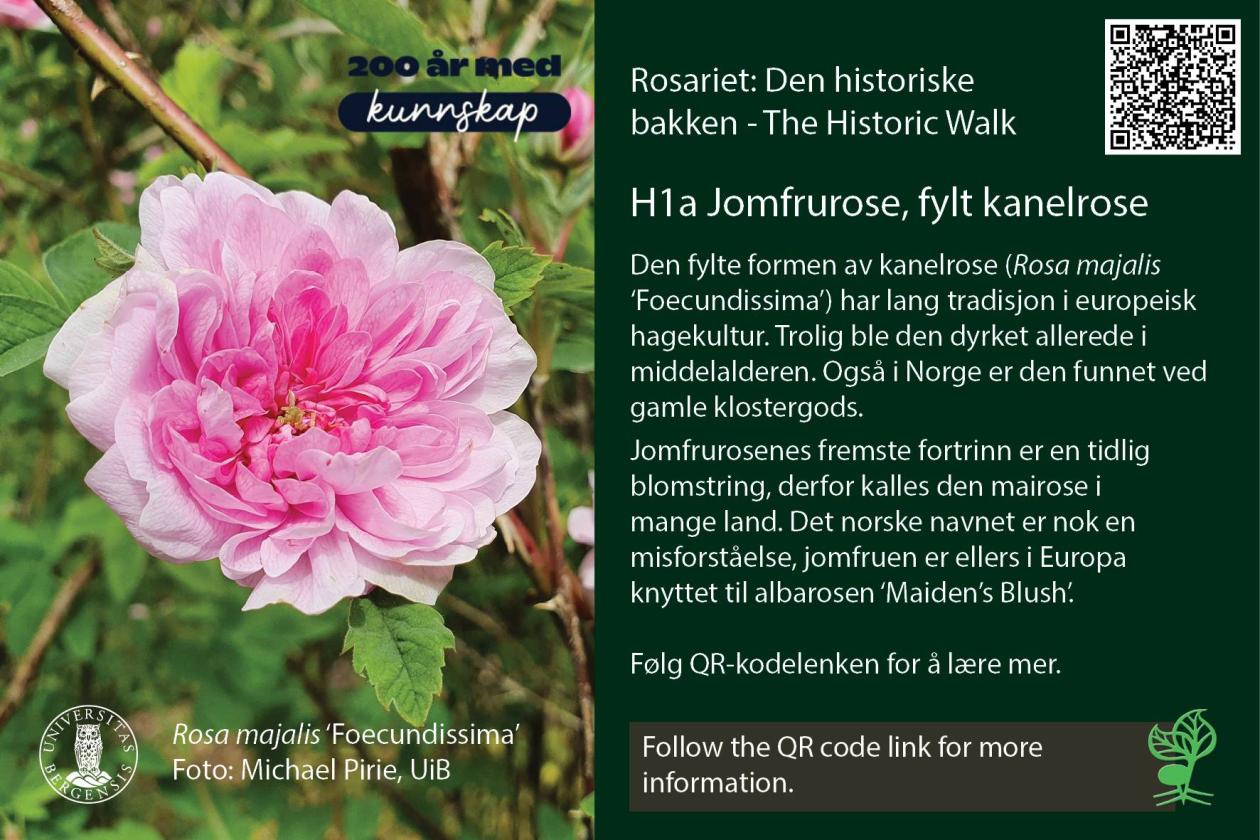
H1a The cinnamon rose (Rosa majalis)
The double cinnamon rose (Rosa majalis ‘Foecundissima’) has a long tradition in European garden culture. It was probably already grown in the Middle Ages and has been found in Norway at old monasteries.
The main advantage of the 'Jomfrurose' is its early flowering, which is why it is called May rose in many countries. The Norwegian name is probably a misunderstanding, as the maiden (Jomfru) is otherwise associated in Europe with the albarose 'Maiden's Blush'.
There are several forms of double cinnamon rose, resulting from various mutations that have produced double flowers. Since it is one of the most willing to form root shoots, it is easy to propagate and has travelled from garden to garden. Where it arrived, it tends to stay, simply because it is difficult to get rid of. It is also one of the most winter-hardy shrub roses, and is widely used in the north.

H1b American roses
In the 17th and 19th centuries, several rose species came to Europe from North America. There they met Europe's garden roses. One result of such a meeting is the ‘Svearnas rose’ (Rosa ×suionum, also called 'Minette'). It is believed to be a cross between Rosa virginiana, which arrived in Europe before 1807, and the Damask rose 'Quatre Saisons'.
The 'Svearnas rose' is very common in our neighbouring countries of Sweden and Finland, where it is often found in derilict places. Its distribution in Norway is to the east, and with few exceptions it is absent in western Norway. This may indicate that those that are here travelled from the east, but may also be due to the fact that it does not thrive in rain. The flowers do not open, but instead just rot.

H2 European wild roses and their hybrids
Hardy wild roses such as the dog rose (Rosa canina), mountain rose (R. pendulina), apple rose (R. villosa), and sweet briar (R. rubiginosa) were introduced into gardens at an early stage as hedges and for the edible rose hips. Apple-scented leaves made R. rubiginosa particularly popular (hence the Norwegian common name 'eplerose' - apple rose - but not to be confused with R. villosa). It was found in medieval monastery gardens and is mentioned in the Hamar Chronicles (Hamarkrøniken, c. 1550).
Rosa villosa

H2b Old Garden Roses (Misc OGR) Group
Cultivated forms of European wild roses rose were popular in 17th and 19th century landscape gardens and parks, and can still be found in old gardens. One such is ‘Milderosa’, which has been found in the Old Garden at Fana Folkehøgskole.
Some garden shapes have a tradition as ‘family roses’, such as 'Hurdalsrosa'. It was brought home from Giessen in Germany by a priest's son from Hurdal in Nannestad around 1855, and has since spread to descendants and friends of the family.
Rosa 'Hurdalsrosa'

H3a Burnet or Scotch rose (Rosa spinosissima) and its hybrids
The burnet rose (Rosa spinosissima, synonym: R. pimpinellifolia) is found in sandy soils and waste ground throughout Europe and most of Asia. It has been cultivated since time immemorial and today it is almost impossible to determine where it is originally wild and where it has escaped from gardens.
Garden forms with fragrant, double flowers are known back in the 17th century, but breeding flourished around 1800, thanks in particular to the Brown brothers in Perth, Scotland. From there, many ‘Scottish roses’ also made their way to Norway, and since they expand by means of highly persistent runners, they are often found remaining in - or near - old gardens. Some of the Scottish roses were loved for their exquisite scent and have been preserved as the treasures they are.
More information (in Norwegian): Salvesen (2008).
Rosa spinosissima

Rosa spinosissima 'Red Nelly'

Rosa x reversa 'Poppius'

Rosa spinosissima

H3b Austrian briar (Rosa foetida) and its hybrids
Austrian briar is found wild in Western Asia and came to Western Europe in the 1580s from Austria with the botanist Clusius. Around the same time, the Capucine or Austrian Copper rose (Rosa foetida “Bicolor”) emerged, a mutation with flowers that are red inside and yellow outside. In the early 1800s, Rosa foetida was crossed with its close relatives, the burnet roses. Soon yellow burnet roses appeared on the market and became immensely popular; first 'William's Double Yellow' in England in 1828 and then 'Harison’s Yellow' in the USA shortly afterwards.
They are very hardy, but in a humid coastal climate they show their sad weakness: they become diseased and destroyed by leaf rust. Today, they are therefore very rare to find in the outer reaches of Western Norway; you have to go into the fjords and over the mountains to Eastern and Southern Norway.
Yellow garden roses: Double yellow roses have been cultivated since time immemorial in the East, and Rosa hemisphaerica 'Flore Plena' arrived in Europe before 1600. It was only after 'Persian Yellow' was introduced in 1837 that there was a breakthrough in breeding.
There were many unsuccessful attempts to produce a repeat-flowering yellow garden rose. Joseph Pernet Ducher tried to cross 'Persian Yellow' with repeat flowering roses in Lyon in 1883. After almost 10 years and hundreds of crosses, he had countless plants, but none usable. Then he happened to find a self-sown seedling with orange-yellow flowers. In 1898, he was able to present it as 'Soleil d'Or'. The rose became a sensation and gave rise to varieties with completely new colours, from yellow and orange to fiery red. This was a breakthrough in breeding, to the extent that 9 out of 10 modern rose varieties today carry genes from 'Soleil d'Or'!
Rosa foetida

H4a The Damask rose (Rosa x damascena)
The production of rose oil can be traced back thousands of years in Western Asia and the Mediterranean. These precious oil-roses are depicted on over 2,000-year-old coins from Rhodes and Macedonia, and spread their fragrance during the orgies reported from the Roman Empire. It is not possible to say for sure whether the roses were gallica or damask. Confusion surrounding the names also contributes to this. However, scented roses arrived in Europe at an early stage, their perfume even gracing Charlemagne's court.
Damask roses are still grown for perfume from the Middle East to Bulgaria. The method is the same as it was almost 2000 years ago. Such roses played a major role in the earliest development of garden roses, when fragrance was just as important as colour. Damask roses also came to our country early on, but today they are rare to find in old gardens.
More information (in Norwegian): Salvesen (2004; 2007).

H4b The Autumn Damask rose (Rosa x damascena f. bifera)
The phenomenon of repeat flowering (remontant) roses was already mentioned by Theophrastus 2300 years ago. There are many indications that the Romans knew of roses that were capable of flowering twice (bifera). The Damask rose “Quatre Saisons”, the oldest known with this characteristic, is said to have been cultivated by the Romans, but is not documented until 1659 in England.
The remontant damask rose was highly sought after and became widespread in Europe before being outcompeted by roses from China in the 19th century. It is likely that wealthy citizens and clergymen also brought remontant damask roses to our country, but little is known about when and to what extent. Today they are long gone.
More information (in Norwegian): Salvesen (2004; 2007).
Rosa x damascena f. bifera 'Quatre Saisons'

H5a The Gallic or French rose, or rose of Provins (Rosa gallica)
The French rose grows wild in southern Europe from the Atlantic to Asia Minor. It is thought to have originated in the Caucasus, but no-one today dares to say for sure. The ancient Greeks and Romans cultivated a number of fragrant, full-bodied roses, possibly including forms of Rosa gallica, which we believe the Romans spread throughout Europe. The form 'Officinalis' (the apothecary's rose) has long been grown for medicinal purposes, including in the town of Provins near Paris.
In the 19th century, crosses with the Provins rose formed the basis for large-scale breeding of garden roses in France, and before 1850, more than 2,000 varieties of gallica roses had been introduced into the trade. Of these single-flowering shrub roses with fragrant, densely packed flowers in purple-red and lilac-pink, barely 300 varieties remain today, and efforts are being made to track down those that have disappeared. Several varieties have been cultivated in this country and are sometimes found in old gardens.
More information (in Norwegian): Salvesen (2003).
Rosa gallica 'Officinalis'

H5b The Frankfurter rose (Rosa x francofurtana)
In the herbals that came after the Reformation, we can read about the ‘rose without thorns’ (Rosa sine spinis), the ‘rose from Frankfurt’ (Rosa franco-furtana) and others, which do not quite match gallica roses.
Such roses are common in old gardens in Norway, but they have a strikingly eastern distribution and, with few exceptions, are absent in western Norway. They are hardy and easy to propagate by root shoots. The flower base is well-developed and broad, and the flowers are densely packed with an unfortunate tendency not to open properly. There are often few thorns on the flower shoots and the veins in the leaves are pronounced and closely spaced, giving the small leaves a characteristic ribbed pattern. Several of them have been handed down through the generations and may have their own local names, although they tend to be referred to under "prestegårdsroser" (vicarage roses).
Before the widespread maintenance of cemeteries with motorised lawnmowers, they were often seen at old graves, and were therefore called "kirkegårdsroser" (graveyard roses).
H6 Provence roses (Rosa x centifolia)
'Centifolia' means a hundred leaves, or in this context, petals. This group is characterised by very densely doubled flowers, usually in light shades of pink, rarely white. They probably originated at the end of the 16th century in the rich agricultural areas that would later become the Netherlands and Belgium. The oldest in culture today is 'Major', also known as the “Painter's Rose", "Malernes rose" in Norwegian ('Rose des Peintres'), since Dutch and Flemish flower painters liked to depict them. The paintings are so detailed and lifelike that they represent an important source for the early history of the cultivated rose.
In addition to the densely filled, bowl-shaped flowers, their scent is their foremost characteristic and probably the most important reason why they have been preserved. Early on, they were used to make perfume, an activity particularly famous from Provence in the south of France. Provence roses ("bolleroser": ‘bun roses’ in Norwegian) were fashionable in the 18th century and widely grown here in the north too, but today they are rarely found in old gardens.
More information (in Norwegian): Salvesen (2006).
Rosa centifolia 'Varietaga'

H7 Moss roses (Rosa x centifolia f. muscosa)
Moss roses originated as sports of Provence roses, whereby the glandular hairs on the flower base and sepals develop branches together forming a layer reminiscent of brown-green ‘moss’.
The first written records of this phenonmenon date to the 17th century, and it probably occurred several times independently with slightly different results, as we can see by comparing 'Muscosa', from around 1720, with 'Cristata' ('Chapeau de Napoléon') from 1820.
Around the middle of the 19th century, moss roses were the subject of extensive refinement, and a greater variety of colours was produced, not least pure white and deep purple. Moss roses were popular in Norway at the time and are still occasionally found in old gardens.
More information (in Norwegian): Salvesen (2006).
Rosa 'Gloire des Mousseuses'

H8 The white rose of York (Rosa x alba)
From the work of Renaissance botanists, the scented roses mentioned by Pliny from Campania 2000 years ago can be interpreted as Rosa x alba, and a densely filled rose in the world's oldest herbarium has been identified as the variety 'Maxima' (from Italy in the years 1532-1553). Both this and 'Semiplena', which has less densely filled flowers, match the white garden roses described as common by Albertus Magnus (1206-1280).
Forms of Rosa x alba are also mentioned in the earliest garden literature, and today the varieties 'Maxima' and 'Semiplena' are often found in old gardens, also along the coast. They are therefore often called ‘coastal white roses’ (kysthvitroser) or ‘white vicarage roses’ (hvite prestegårdsroser) but can also have local names, with family traditions associated with them. Perhaps not surprisingly, they are easy to propagate from root shoots and are very hardy.
More information (in Norwegian): Salvesen (2005).
Rosa ×alba ‘Maxima’

Rosa 'Félicité Parmentier'

H9 The Portland rose (Rosa x portlandica)
Portland roses can flower throughout the summer and therefore became popular. The original Portland rose was probably a cross between the autumn damask rose and the apothecary rose. It is named after the 2nd Dutchess of Portland (1715-85), who is said to have brought it home from Italy. The Duchess was an avid rose collector, but apparently never travelled outside her native England. This means that the story is not entirely credible, and repeat flowering Rosa x chinensis (China rose; månedsroser) already existed in the 17th century in the royal gardens in Paris.
'The Portland Rose' sets viable seed and was widely used in breeding. The first varieties in the group were made by André Du Pont, who supplied the castle of La Malmaison with roses. In the western Norwegian climate, many of them are a little difficult and tend to be attacked by fungus. But some, like 'Mme. Boll' and 'Jacques Cartier' from the mid-19th century, are popular and still on sale.
More information (in Norwegian): Salvesen (2007).
Rosa 'Portland Rose'

Rosa 'White Jacques Cartier'

H10 Bourbon roses (Rosa x borboniana)
The first Bourbon rose was discovered in 1817 on the island of La Reunion (formerly Bourbon Island), a French colony. Farmers often planted two rows of roses around their fields as a fence: one with the autumn damask rose, the other with the China rose “Old Blush”. The Bourbon rose must have arisen spontaneously by crossing between these.
In 1823, the rose was introduced to France and gave rise to more than 400 varieties, many very floriferous and long-lived. They dominated the rose market until around 1870 with fragrant, densely packed flowers in pink to purple (less often white or variegated). They also became popular in this country, and one variety has become particularly widespread: 'Great Western' from 1838. It is often referred to as the "rød prestegårdsrose" (red vicarage rose), unless it has been given a local name such as "bestemorsrose" (grandmother's rose) or "sylterose" (jam rose). Whether or not they are aware of it, it is the scent of this rose that many people remember from their grandmother's garden.
Rosa 'Great Western'
Rosa 'Vassteinrosa'

H11 The China rose (Rosa chinensis and its hybrids)
The exchange of goods by sea between China and Europe began in 1540, when the Portuguese established the colony of Macao. However, it wasn't until the end of the 18th century that China roses (Rosa chinensis; månedsroser) arrived in Europe. By then, the Chinese had been growing them for more than a thousand years. The first were obtained at the market in Canton or in the Indian Ocean colonies. 'Old Blush' with pink flowers arrived in Stockholm in 1752, while purple 'Slater's Crimson China' reached London in 1789.
These are elegant shrubs with neat, smooth petals that flower all season, an important feature in the breeding of modern roses. They are not hardy in Western Norway, and are grown in pots that are brought inside for the winter. China roses were popular in the 19th century, but many of the old varieties have been lost. We have come across one, 'Fru Michelsens Månedsrose', named after the lady who gave it to us. It had followed the family from Radøy since before 1900.
Rosa 'Old Blush'

H12 The tea rose (Rosa x odorata) and hybrid tea roses
The name "tea rose" is an abbreviation for "tea-scented rose". The first, 'Hume’s Blush Tea-scented China', arrived in England in 1809 on the tea ships of The East India Company. Fifteen years later, the yellow-flowered 'Parks’ Yellow Tea-scented China' arrived the same way. With tea roses came new colors, such as peach yellow and salmon pink, and they gave rise to very vigorous climbing roses. Unfortunately, tea roses are not very hardy in Norway, and must be overwintered in greenhouses. Only a few, such as the elegant 'Lady Hillingdon', manage to display their splendor outdoors for a few years.
Tea roses crossed with China roses [or hybrid perpetuals?] gave rise to hybrid tea roses. Among the first successful varieties was 'La France'. It was introduced in 1867 by Jean Baptiste André Guillot in Lyon and is considered the first modern rose. In turn, hybrid tea roses, when crossed further, gave rise to cultivars with single or clusters of flowers appearing repeatedly throughout the season that could justify a place of honor in the bed in front of the house facade. But those only appeared at the end of the 19th Century.
Rosa 'Adam'

Rosa 'Marie van Houtte'

H13 Hybrid perpetuals
The history of this group of roses is difficult to trace in detail. Bourbon, Portland and China roses were probably included in the mix that, from the beginning in 1837 until its culmination around 1910, gave rise to as many as 4000 varieties. They were vigorous bushes that bore large, full and fragrant flowers on relatively short side shoots throughout the season. It was fashionable to mount cut roses without stems in frames and patterns (as potpourri) to provide fragrance in the living room and boudoir in addition to the play of colours from white to purple-red.
Remontant roses became popular in Norway towards the end of the 19th century, but most were susceptible to disease and have long since been lost. Occasionally we come across veritable rose 'trees' that produce hundreds of magnificent fragrant flowers every year. They are remnants of the craze that raged before the First World War. Today they are difficult to identify with certainty, but they are real cultural treasures.
Rosa 'Gloire de Chédane-Guinoisseau'

Rosa 'Monsieur de Morand'

Rosa 'Mme Victor Verdier'

H14a Noisette roses
The Noisette roses probably originate from a hybrid between the China rose 'Old Blush' and a white-flowered musk rose (Rosa moschata) that spontaneously emerged in the garden of plantation owner John Champney in South Carolina in 1802. From this seed, gardener Philippe Noisette produced a reblooming form, 'Blush Noisette', which he sent across the Atlantic to his brother, Louis Noisette, in Paris in 1814. From there, the Noisette roses spread throughout Europe.
After 1830, 'Blush Noisette' was crossed with climbing roses, and crosses with the tea rose 'Parks’ Yellow Tea-scented China' produced forms with yellow flowers, such as the famous 'Rêve d’Or'. It was important for the development of the Moschata group and modern shrub roses. A popular variety in Norway was 'Gloire de Dijon', which was reportedly found at every house in Bergen after the First World War.
Rosa 'Blush Noisette'

Rosa 'Gloire de Dijon'

References:
- Salvesen, P.H. 2003. – Historiske roser i Det norske arboret - 1. Fransk rose (Rosa gallica) og dens hageformer, gallicaroser – Årringen 2002 (6) 32 – 58.
- Salvesen, P.H. 2004. – Historiske roser i Det norske arboret - 2. Damaskroser (Rosa xdamascena) - parfymeroser og rosenolje – Årringen 2003 (7) 71 – 94 [PDF av Årringen 2003].
- Salvesen, P.H. 2005. – Historiske roser i Det norske arboret- 3. Hvitroser (Rosa xalba) – Årringen 2004 (8) 75 – 90 [PDF av Årringen 2004].
- Salvesen, P.H. 2006. – Historiske roser i Det norske arboret - 4. Sentifolieroser og moseroser (Rosa xcentifolia og dens varietet muscosa) – Årringen 2005 (9) 55– 78 [PDF av Årringen 2005].
- Salvesen, P.H. 2007. – Historiske roser i Det norske arboret 5. Europeiske månedsroser – Årringen 2006 (10) 57– 86 [PDF av Årringen 2006].
- Salvesen, P.H. 2008. – Historiske roser i Det norske arboret – 6. Pimpinelleroser og skotske roser – Rosa spinosissima L. og noen av dens hageformer – Årringen 2007 (11): 23–66 [PDF av Årringen 2007].
- Salvesen, P.H. & Åsen, P.A. 2011. – På jakt etter kulturminneroser i gamle hager langs kysten av Norge – Årringen 2010 (14): 4 – 90.
Definitions and terms
Historiske hageroser - Historic garden roses (Old Garden Roses - OGR)
Cultivated roses belonging to crossing groups developed prior to 1867.
Kulturminneroser - Heritage roses
Garden roses that have survived either in gardens or by being propagated and shared between people, with information suggesting that the history predates 1940. Includes many historic garden roses as well as some modern roses.
Prestegårdsroser - 'vicarage roses'
Historic roses in Norway that have long since lost their original trade names, and are often given new local names.