Student report: Academic freedom for gender and queer studies in decline
University of Bergen students brought important message about academic freedom to international conference.

Main content
This February, four students from the Centre for Women's and Gender Research (SKOK) at UiB traveled to the SAR European Advocacy Days 2026: "Academic freedom as a democratic imperative" in Innsbruck. The conference brought together students, faculty, democratic rights defenders, and institutional partners for two days of keynote lectures, student-led presentations, workshops, case studies, and curated excursions.
Accompanied by a teaching assistant (TA), the students shared the outcome of their work in the fall 2025 course Queer Theory with international virtual exchange: A report which shows that academic freedom for gender and queer studies is under pressure, and that the attacks on these disciplines have severe consequences.
Students skilled in human rights research and advocacy
The background for the students’ participation in the conference was that their course in Queer Theory was run as a Student Advocacy Seminar (SAS). These seminars provide university and college students with the opportunity to develop human rights research and advocacy skills through cooperation with Scholars at Risk (SAR), an organization that protects threatened scholars and promote academic freedom around the world.
The Queer Theory course was the first ever to be taught as an SAS at the University of Bergen. This makes the group of international and Norwegian students pioneers, along with their TA and course leader.
The European Advocacy Days are open to all SAS students and faculty, and TA Tiril Steiro Eide says that she and the students agreed that their participation in the conference was an invaluable opportunity:
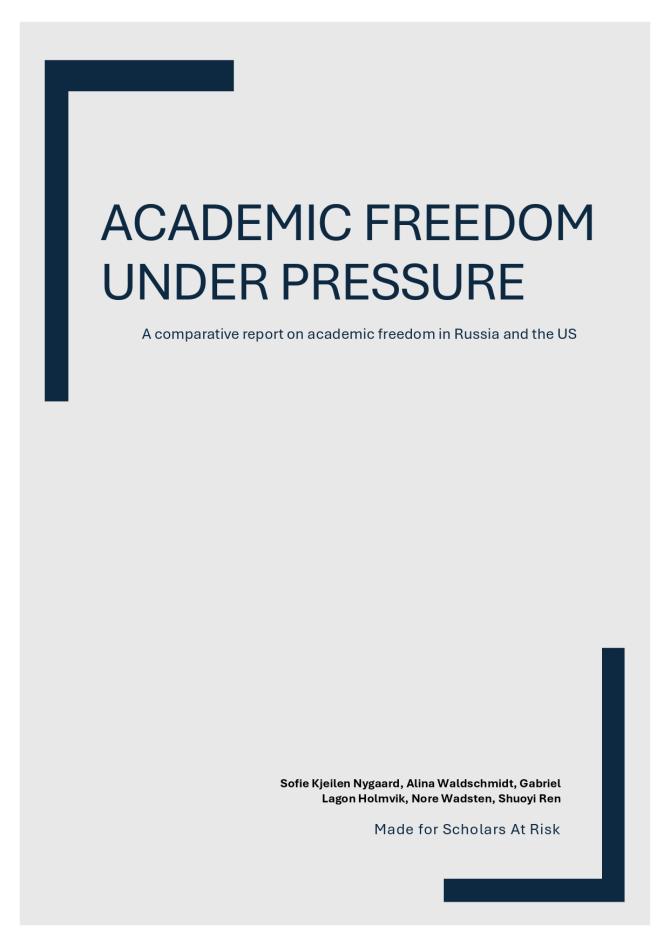
"The students got to communicate their message and present their work: Academic Freedom under Pressure: A comparative report on academic freedom in Russia and the US (Sofie Kjeilen Nygaard, Alina Waldschmidt, Gabriel Lagon Holmvik, Nore Wadsten & Shuoyi Ren, 2025)"
The only students to present on gender and queer studies
Steiro Eide says that while they were all new to SAS and the conference, they felt as welcomed and appreciated as more seasoned participants. She adds:
"They were the only students to present work about the academic fields of gender and queer studies. I’m so proud of Sofie, Nore, Alina and Gabriel."
For Alina Waldschmidt, the conference was a great experience where she got to talk with people from all around the world about current political topics.
“While I at points felt a bit drained, questioning how we’re going to change something by just sitting together and talking, in the end I felt way more empowered. Perhaps that’s what the conference is about: To underline that one is not alone.”
Queer Theory: From Virtual Exchange course to Student Advocacy Seminar
Originally, the course was run collaboratively by SKOK and a Florida university as an international virtual exchange course. However, the changes in the political climate in the US following Trump’s second inauguration led to the Florida university’s leadership preventing the course from running in the Fall 2025 semester.
Faced with this setback, the course leader at SKOK, Kari Jegerstedt, realized that this worrying development could be a unique opportunity to combine theoretical inquiry with real-world challenges relevant to the course theme.
In collaboration with SAS coordinator Adam Braver and SAR's Academic Freedom Monitoring Project, Jegerstedt transformed the course into a Student Advocacy Seminar. The students were tasked with writing a report for SAR on the state of academic freedom for gender and queer studies in the US, and to choose another country for comparison.
After a semester of intense group work, the students finalized the report they presented in Innsbruck.

Nore Wadsten (left) and Sofie Kjeilen Nygård presents the report on behalf of the group.
Sofie Kjeilen Nygård says she learnt a lot from the coursework:
"The experience of taking this course has me excited to learn more about queer theory, and to see how this knowledge will continue to shape my life moving forward."
She also found the conference very rewarding, with interesting presentations from both scholars and students. A highlight was Ugandan gender and queer studies scholar and activist Stella Nyanzi, currently a SAR scholar in Germany, who was one of the digital guest lecturers on the Queer Theory course:
"it was so cool to see her in person and learn about her fascinating entry into activism through 'radical rudeness' and naked protesting", says Nygård.

SAS coordinator Adam Braver in conversation with Stella Nyanzi.
New avenues for thinking about pedagogy
Jegerstedt is very proud of her students. Reflecting on the experience with SAS, she says: "For me personally, it has opened new avenues for thinking about pedagogy within the university context."
She admits that assigning relatively new students the task of writing a scholarly report, which would be read by an organization actively engaged in addressing threats to academic freedom, felt somewhat daunting at first.
"However, it proved to be not only a powerful source of inspiration for both the students and me, but it also transformed the classroom into a space of solidarity and genuinely serious discussion."
A great learning experience
The students sum up their learning experience as "challenging but rewarding." The work of co-writing a report was new to them, and it took them some time to organize the writing process.
However, it turned out to be a great learning experience which yielded many good discussions. As one student writes in their reflection essay:
"I feel confident that I have covered all the points connected to general competence, such as being able to collaborate with others to solve a task and thinking creatively and critically about current societal challenges."
Bridging the gap between academic scholarship and practical engagement
Jegerstedt says she is truly impressed with the work the students have done, both in writing the report and in engaging thoughtfully with challenging texts during the classroom discussions.
"For anyone interested in bridging the gap between academic scholarship and practical, global engagement at any student level, I can wholeheartedly recommend collaborating with SAS. I will definitely continue to do so in my own teaching."
Tools to engage critically and participate actively
Jegerstedt’s recommendation is backed up by SAIH, the Norwegian solidarity organization for students and academics. They introduced the concept of SAS to Jegerstedt and colleagues at UiB:
"At a time when academic freedom is under pressure worldwide, Student Advocacy Seminars give students the tools to engage critically and respond, not just as observers but as active participants within the university", says SAIH President Henriette Reierson Johnstone.
Advocacy can take many forms
Johnstone goes on to highlight the versatility of the Student Advocacy Seminars, and argues that this feature is precisely why more units at UiB and other Norwegian higher education institutions should prioritize having SAS:
"Where some SAS groups have focused on campaigns calling for the release of imprisoned students and academics globally, SKOK’s students focused on producing an academic report. This is a good reminder that advocacy takes many forms.
Johnston concludes: "These seminars create critical discussion, more understanding of the pressing issues of our time, and they equip students to contribute meaningfully to the defence of human rights, both within academia and beyond.”
Scholars at risk (SAR)
- SAR is an international network of institutions and individuals whose mission it is to protect scholars and promote academic freedom.
- By arranging temporary academic positions at member universities and colleges, SAR offers safety to scholars facing grave threats, so scholars’ ideas are not lost and they can keep working until conditions improve and they are able to return to their home countries.
- SAR also provides advisory services for scholars and hosts, campaigns for scholars who are imprisoned or silenced in their home countries, monitoring of attacks on higher education communities worldwide, and leadership in deploying new tools and strategies for promoting academic freedom and improving respect for university values everywhere.
- University of Bergen has been a member of SAR since 2008. Learn more about SAR Norway here.
Student Advocacy Seminars (SAS)
- SAS are available to all SAR members and are arranged and supervised by local faculty in partnership with SAR.
- SAS are tailored to each institution and group of students and is designed to give students a foundation in human rights research, standards, and mechanisms, organizing and advocacy, persuasive writing and leadership and teamwork skills
- Over the course of the seminar, students gain a deeper understanding of the value of the academic freedom they enjoy and the risks scholars and students around the world face in the pursuit of knowledge
- To learn more, contact SAS coordinator Adam Braver.
SAIH
- SAIH is a Norwegian solidarity organization, by and for students and academics
- The organization has worked for over 60 years to promote higher education and academic freedom as a human right.
- Together with volunteers, member organisations and local partner organisations in seven countries, they fight for everyone to have access to inclusive and quality higher education.
- Every year, 160,000 students choose to give NOK 20-50 in addition to their semester fee to SAIH. Together, they are raising more than NOK 11 million for the fight for higher education and academic freedom internationally.
Summary of the student report
The report shows some similarities between the US and Russia:
- Academic freedom in gender studies has markedly deteriorated in both states, event if the decline started earlier in Russia and is still worse than in the US.
- Both nations have been actively involved in what the report calls "arguably the most influential anti-LGBTQ organization", World Congress of Families (WCF).
- The "proclaimed desire to 'protect children' has been used as an argument in both countries to introduce anti-LGBTQ+ legislature."
The students’ work also highlights some important differences between the countries:
- The more decentralized, federal structure in the US opens for points of resistance in so-called sanctuary states and academic networks that aren’t available in Russia due to its centralized and overt state-driven repression.
- At the same time, the US model leaves it vulnerable to state-level attacks on gender and queer studies, often framed in the language of "intellectual freedom".
- The report underlines a striking paradox: That "as the well-known cradle and central hub of queer theory (…) the United States has frequently portrayed itself as a global defender and beacon of LGBTQ+ rights”. While it can be said that this rhetoric is hollow and the image deceptive, it has still let the US contrast itself favourably with countries like Russia.
- However, while the fields of gender studies and queer theory in the US are more established and institutionally recognized than ever before, the report argues, "they are simultaneously facing a coordinated, ideologically driven assault that threatens the very core of academic freedom."
The report concludes with some recommendations for what the students think can be done in the face of the on-going anti-gender movement both in and outside of academia.
- Further track and study the funding and rhetoric of the anti-gender movement and disseminate the findings to NGOs and other civil society groups
- Affected parties could form a collective fund for legal and medical expenses related to attacks on scholars and educational institutions
- Where pro-LGBTQ+ rhetoric brings the most risk, anonymous networks could provide both solidarity and an organizational base for anything from research to more concrete protections.
- When possible, speak openly with peers and loved ones about issues affecting queer rights and academic freedom.
- Where possible, open campaigns showing consequences of anti-gender activism should be taken up by activists and NGOs
- If practical, more independent methods of funding research should be looked into, along with possibly conducting research outside of academic institutions.