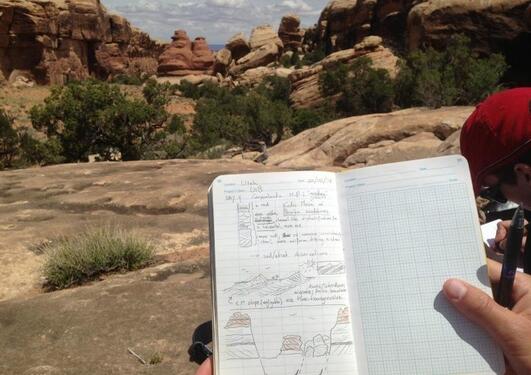
Examples of Master's projects at GEO
Here you will find examples master’s projects for those starting the master’s program in earth science at UiB. You can also visit the website of each of our research groups to see past and ongoing projects (links below). Many of the previous projects still have highly relevant research topics and supervisors might be able to create a similar project for you.
Main content
The Master's programme in Earth Sciences has been divided into five research topics: climate, environment, resources, energy og geohazards. All our master’s projects fall under one or more of these themes, and many of our research groups collaborate across these themes. Therefore, you will experience a large, interdisciplinary community as a student at GEO.Depending on which project and supervisor you end up working with you will become part of one of our research groups: Geodynamics and basin studies, Geochemistry and geobiology, Geophysics and Qauternary geology and paleoclimate.
The Master’s program consists of two components: a course part totaling 60 credits and the master’s project and thesis of 60 credits. The total workload for the master’s program is 120 credits, equivalent to two years of study. You start by finding your project and supervisor, have a look below on how to get started!
How do I find a project to work on?
Use the menu below. Consult the projects description, and decide on which research theme you are interested in, and to some extent, which project you prefer. Also consult the listed courses for each project - do the courses match you background?
Contact the listed supervisor to learn more. In some cases, supervisors get contacted by several students. We will try our best to facilitate that all students get to write their thesis on a preferred topic, but we need you to keep in mind that each supervisor has a limited capasity of undertaking master's students. All students that are granted admission to our program will be allocated a project and a supervisor within the first couple of weeks after semester start.
In rare cases with more interested students on a project than the capasity allows, we will have to range the interested students by grades. This is only applicable in rare situations, and we strive to find solutions together with our students.
If none of the listed projects seem to suit you, it is also possible to design your own Master's project together with one of our supervisors from our academic staff. In this case, we ask you to contact interesting superviros to pitch your idea. For more information about this process, or guidance to which supervisor to contact, please reach our to the programme coordinator (Vilde Dimmen).
We also reccomend you to visit the webpage for each of our research groups (link in menu below), to consult which projects has been given earlier. Many of our research themes are still highly relevant and can be reformed to new projects.
Which courses should I choose?
At The Deptartment of Earth Sciences, all courses has an early deadline for sign up (Wednesday week 33 / Wednesday week 2).
All students must by the first copuple of days, within the deadline, consult which courses to sign up for in StudentWeb. External students from outside of UiB may find trouble adding courses in StudentWeb. Consult the Programme Coordinator to open your preferred courses.
Courses relevant for your Master's project can be found in the project description, or by consulting your supervisor, or your preferred research group.
NB!! This process is our top priority during the semester start week, do not hesitate to reach out!
Master's Projects in Geodynamics and Basin studies
Check out previous projects from this group here!
Master's Projects in Geochemistry and geobiology
Check out previous projects from this group here!
This research group also runs the Centre for Deep Sea Research - check out their pages as well (internal link) for previous/ongoing projects!
Master's Projects in Geophysics
Check out previous projects from this group here!
Master's Projects in Quaternary geology and Paleoclimate
Check out previous projects from this group here!